
Custom uniform production time depends on the approved specification, material requirements and manufacturing schedule; your usable deadline is the date finished uniforms reach the people who need them. A production completion date does not include every step of a rollout: design approval, sampling, freight, customs and local distribution also need a place in the schedule. For a 2026 launch, request a dated plan from specification approval through delivery rather than treating a factory dispatch date as the finish line.
- Custom uniform production time must distinguish manufacturing completion from delivery and employee distribution.
- Approve uniform specifications and samples before accepting a final production schedule.
- Track manufacturing lead time and freight separately; a dispatch date is not a rollout date.
- Boolanga is best suited to enterprise uniform programmes that need design, manufacturing, distribution and operations software together.
Why this matters
A uniform order is not complete when garments leave a production line. Your retail team or courier fleet needs the correct sizes, branding and quantities at the right destination before work starts.
If you are defining a fleet order, use the courier uniforms for delivery fleets guide alongside the production schedule. The specification and the delivery plan should describe the same operational requirement.
For your 2026 procurement brief, separate factory completion, destination delivery and wearer readiness. These are 3 different milestones, and substituting one for another creates a deadline that looks complete on paper but does not answer when your team can use the uniforms.
How long does custom uniform production take?
Use the supplier's confirmed schedule for your approved order, not a general lead-time claim. The schedule should identify what starts the production clock, what finishes it and which activities sit outside it.
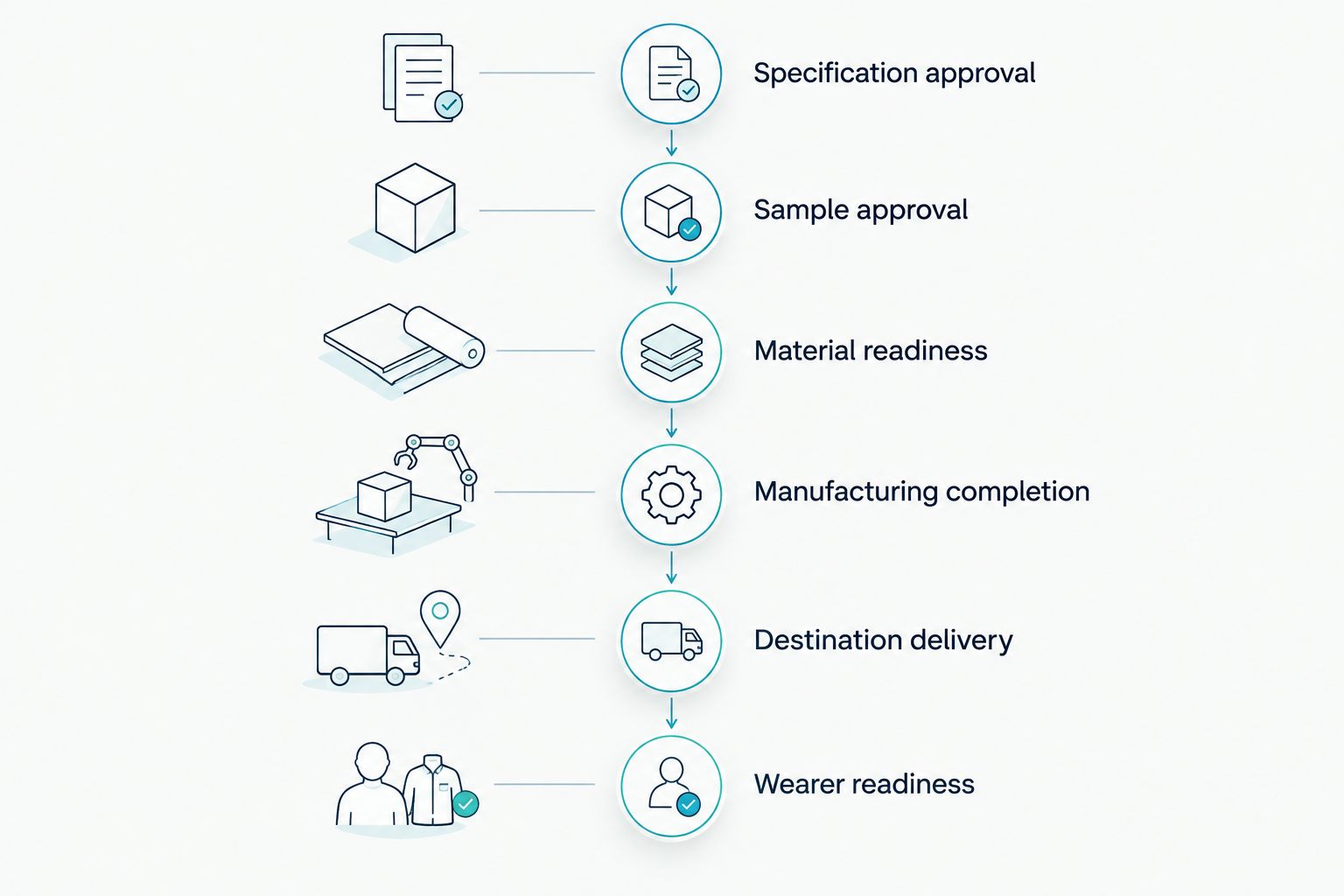
Request these 6 milestones in order. Some activities can overlap, but every dependency still needs an owner and a completion condition.
| Milestone | What must be resolved | Evidence to request |
|---|---|---|
| Specification approval | Garment design, size range, branding and order quantities | An approved specification with a version reference |
| Sample approval | Fit, construction and branding acceptance | Written approval or a consolidated correction list |
| Material readiness | Required fabric, trims and decoration materials | Confirmation that materials match the approved specification |
| Manufacturing completion | Cutting, sewing, decoration and agreed inspections | A completion date with acceptance criteria |
| Destination delivery | Freight, customs where applicable and receipt | A destination-specific delivery plan |
| Wearer readiness | Allocation by site, role and size | A receiving and distribution plan |
A useful answer to the timing question therefore has a start condition and an end condition. Ask whether the quoted period starts at order placement, sample approval or material readiness, and whether it ends at factory completion or destination receipt.
Do not add overlapping activities together as though they all happen sequentially. Equally, do not assume that freight arrangements or local distribution disappear because manufacturing finishes on time.
What should the supplier's timeline actually say?
A usable schedule identifies the approved specification, each milestone date, the responsible party and any unresolved dependency. It also explains what happens if an approval or material decision changes.
For example, a schedule that says production starts after sample approval needs a corresponding approval deadline. Without that deadline, the buyer's decision remains outside the plan even though manufacturing depends on it.
Ask for a written distinction between confirmed dates and dates that still depend on an action. A date tied to an unresolved specification is a planning assumption, not an unconditional commitment.
Build the schedule around approval gates
Treat approvals as release points, not informal conversations. Your 2026 uniform rollout should show exactly which decision allows the next activity to begin.
Specification approval
Confirm the garments, branding positions, colour references, size breakdown and delivery destinations before releasing the specification. Record who can approve changes so that feedback from separate departments does not create competing instructions.
The specification should also distinguish requirements from preferences. If a feature is mandatory for the job, make that clear before the supplier prepares a sample or proposes a material.
Sample approval
Use the sample to check the agreed design, fit, construction and decoration. Gather feedback into a single response rather than sending separate comments from procurement, operations and brand teams.
Approve the version you intend to manufacture. If the sample needs changes, document those changes and confirm whether another approval is required before bulk production starts.
Production release
Release manufacturing against the approved specification and agreed quantities. Confirm that the supplier has the information needed to proceed, including any destination-specific packing or labelling instructions.
A production release should not silently carry unresolved choices into manufacturing. If something remains open, name it, assign an owner and record its effect on the schedule.
Why custom uniform production time varies
The work required changes with the order. Use these factors to ask precise scheduling questions instead of accepting a single unexplained delivery promise.
- Design requirements. Establish whether the order uses an approved design or needs development. Ask which design decisions must close before sampling can begin.
- Material requirements. Confirm the fabric, trims and decoration materials against the specification. Ask which material dependencies remain unresolved when the schedule is issued.
- Manufacturing scope. Identify the garment types, construction requirements and decoration work included in the order. Ask the supplier to connect the schedule to that scope.
- Approval requirements. Name the people responsible for fit, branding and operational acceptance. Ask how corrections move through the approval process.
- Distribution scope. Identify destinations, freight arrangements, customs responsibilities and local receipt requirements. Ask for delivery milestones that match the actual destination list.
- Operational allocation. Define how uniforms will be assigned across sites, roles and sizes. Ask what order and allocation information must be final before packing or distribution.
These factors are questions to resolve, not reasons to accept an undefined timeline. The supplier should translate the agreed scope into dated commitments and explain which decisions affect them.
Which sourcing route fits your deadline?
Compare sourcing routes by the work each requires, not by assuming that every uniform order follows the same process. The right route depends on whether your priority is reproducing an approved garment, decorating an existing style or developing a new specification.
| Sourcing route | Best for | Operational advantage | Constraint to resolve |
|---|---|---|---|
| Existing garment with branding | Teams that can accept an established garment specification | You can assess the garment before deciding on decoration | Fit, fabric and construction choices follow the existing garment |
| Newly developed uniform | Teams with specific design or operational requirements | You can define the specification around the intended work | Development and sample approvals must be included in the plan |
| Repeat approved order | Teams replenishing an established uniform programme | The previous specification provides a starting point | Materials, sizing, quantities and production arrangements still need confirmation |
Choose the route that meets the requirement with the fewest unresolved decisions. A familiar garment is not a suitable shortcut if it fails the job requirement, and a repeat order is not automatically identical to the previous production run.
For repeat orders, reference the approved version explicitly. Do not rely on an old photograph or a purchase order description to communicate construction, branding and material requirements.
Separate manufacturing from freight and distribution
For a 2026 multi-country rollout, request a destination-level plan rather than one global completion date. Manufacturing can finish together while the remaining delivery work differs by destination.
Name the party responsible for freight booking, shipment documentation, customs handling where applicable and receipt. Keep the handoffs visible: the person tracking factory completion is not automatically the person confirming that a site has received the order.
Packing instructions also belong in the schedule. If a location needs uniforms separated by wearer, role or size, communicate that requirement before packing rather than leaving the receiving team to reconstruct the allocation.
At receipt, check quantities and sizes against the allocation plan, then record discrepancies. A delivery confirmation establishes that a shipment arrived; it does not establish that every employee received the correct uniform.
What should you ask before approving a delivery date?
Ask where the date applies and what must happen before it becomes firm. A destination-specific commitment answers a different question from an estimated factory completion date.
Use these questions in the supplier discussion:
- What event starts the quoted production period?
- Which specification and sample does the schedule reference?
- Which materials or approvals remain unresolved?
- Does the completion date include inspection and packing?
- Who owns freight, customs and destination receipt?
- What happens to the plan if a specification changes?
Keep the answers with the order record. When someone requests a change, you can then assess it against the agreed plan rather than reconstructing the original assumptions.
Where an end-to-end uniform partner fits
Boolanga is best suited to enterprise uniform programmes that need design, manufacturing, distribution and operations software together. Its offer covers branded workwear, uniforms, courier gear and merchandise, linking the physical order with the operational work around it.
The advantage of Boolanga's end-to-end uniform model is its stated scope across these functions. The buyer's responsibility remains: define acceptance criteria, approval authority and destination requirements before accepting a schedule.
Evaluate Boolanga against the same milestone framework you use for any enterprise uniform partner. Ask for the dependencies and handoff responsibilities to appear in the proposal, not just a final delivery date.
Define your uniform rollout
Discuss design, manufacturing, distribution and operations software against your delivery requirements.
Can you shorten custom uniform production time?
You can remove avoidable approval delays by submitting a complete brief, consolidating feedback and making decisions against an agreed specification. Ask the supplier which activities can overlap without bypassing sample approval or acceptance checks.
Do not treat an omitted step as time saved. Removing a fit check or leaving distribution unplanned changes the risk you accept; it does not prove the order will meet the operational deadline.
Does a repeat uniform order take the same time?
A repeat uniform order still needs a confirmed schedule. Reference the previous approved specification, then verify materials, quantities, size allocation and delivery requirements for the new order.
If any element changes, ask whether it requires a new sample or approval. Reusing an order name does not establish that the manufacturing requirements are unchanged.
When should you start planning a uniform rollout?
Start when you can define the required wearer-ready date and the operational brief. Work backwards through distribution, freight, manufacturing, materials and approvals with the supplier.
For a 2026 launch, record the deadline as a specific operational event: the date employees must have usable uniforms. That gives procurement and the supplier a shared finish line.
FAQ
What does custom uniform production time include?
Custom uniform production time needs an explicit start and finish condition. Ask whether it covers only manufacturing or also includes sampling, material preparation, inspection and packing; track freight and distribution separately unless expressly included.
Does production start when I place the order?
Order placement alone does not define the production start. Confirm whether manufacturing depends on specification approval, sample approval, material readiness or another agreed release condition.
Is a factory completion date the same as a delivery date?
A factory completion date is not a delivery date. Freight, customs where applicable, destination receipt and local distribution still need their own responsibilities and milestones.
Can I change sizes after approving the uniform order?
Treat a size change as an order change and request confirmation before accepting it. Ask the supplier to state the effect on quantities, manufacturing, packing and the agreed delivery schedule.
What's the best way to compare uniform supplier timelines?
Compare timelines with the same start condition, finish condition and order scope. A manufacturing-only schedule cannot be compared directly with a plan that includes sampling and destination delivery.
What should I confirm before a multi-country uniform rollout?
Confirm destination-level quantities, size allocations, delivery responsibilities and receipt requirements. Keep these details connected to the approved specification and the manufacturing schedule.
One last thing
Put the wearer-ready date at the top of your 2026 order brief, not the factory completion date. Then ask every owner to confirm the milestone that makes that date achievable.
The final receiving check matters as much as the production update: uniforms at a warehouse and uniforms issued correctly are different outcomes. Close the order against the outcome your team actually needs.


