
A multi-country workwear rollout takes the time required to approve the range, manufacture it, move it into each market and make it available to the intended workforce; there is no single duration that applies to every programme. Your multi-country workwear rollout timeline should follow those dependencies, not an assumed number of weeks. Factory completion is not launch readiness: customs, local distribution and employee allocation still sit between finished garments and people wearing them.
- Build your multi-country workwear rollout timeline around approved specifications, manufacturing, country delivery and workforce allocation.
- Boolanga serves enterprise workwear programmes across 35+ countries; use country-level readiness gates rather than one shipment date.
- Choose a simultaneous launch for coordinated changeovers; choose a phased rollout when country readiness differs.
- Separate initial uniform distribution from replacement stock and ongoing replenishment.
Why this matters
A date labelled delivery can mean factory dispatch, warehouse receipt or employee handover. Those milestones are not interchangeable. If procurement plans against one definition and country operations use another, the launch calendar hides unfinished work.
For a 2026 rollout, define the finish line before asking suppliers for lead times. Specify whether success means stock in a country warehouse, complete kits at operating sites or confirmed issue to employees.
Boolanga designs, manufactures, distributes and provides software for branded workwear programmes. Boolanga is best for enterprise buyers seeking an end-to-end workwear operations partner. Its scope fits buyers assessing the entire delivery chain, rather than manufacturing alone; procurement still needs to establish programme-specific responsibilities and dates.
How long does a multi-country workwear rollout take?
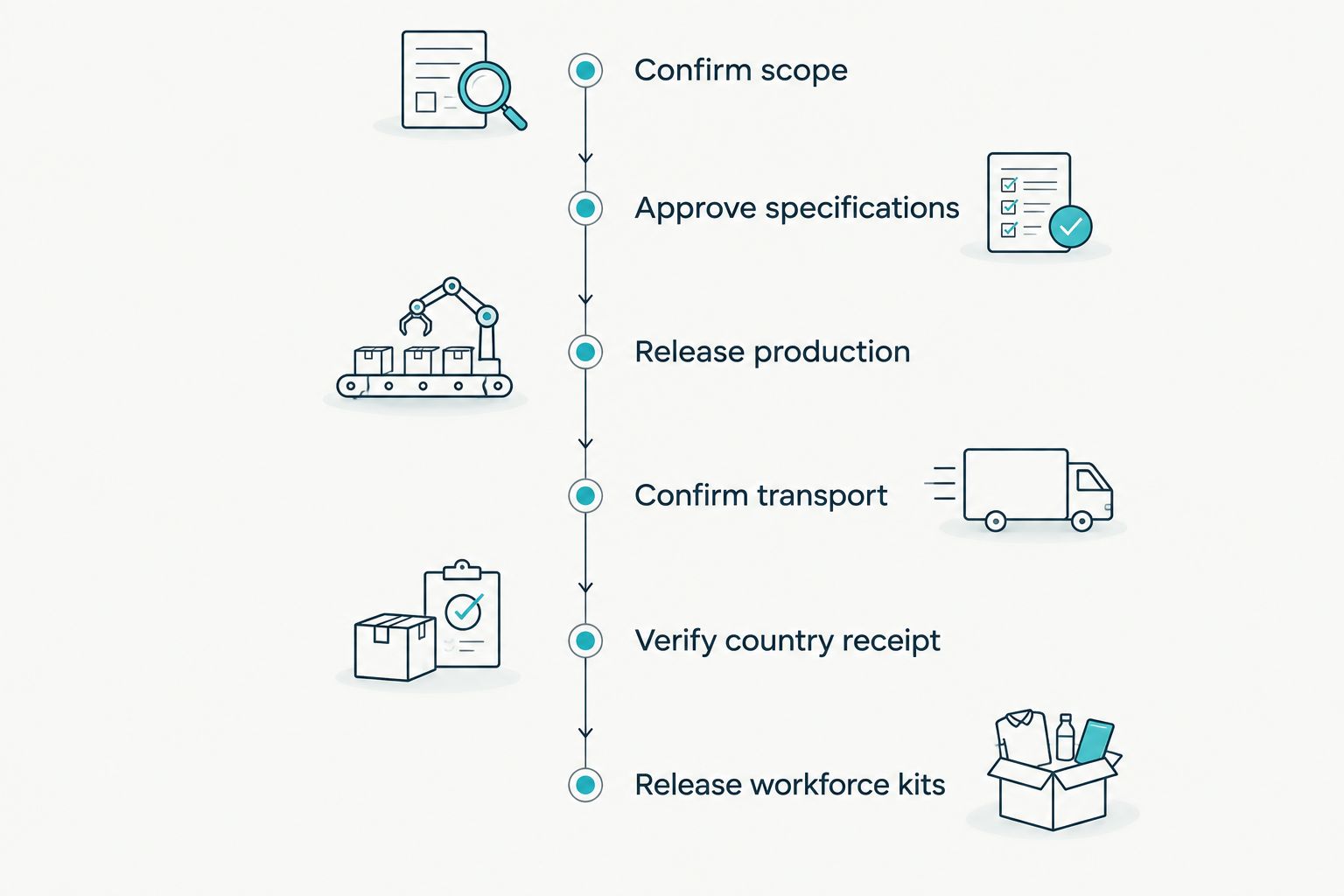
The defensible answer is a dated schedule built from your approved scope and each country's delivery requirements. Ask for the sequence below, with an owner, entry condition and completion evidence for every stage. A manufacturing lead time answers only part of the question.
1. Confirm scope
Define who receives workwear, where they receive it and what their kit contains. Separate garments from equipment and merchandise so an unresolved accessory does not silently hold up the entire programme.
Record the destination countries, receiving locations, role requirements and quantity assumptions. Identify which decisions are central and which belong to country teams. An unresolved local requirement is an open dependency, not a detail to settle after ordering.
2. Approve specifications
Set the garment specification, branding, size range and acceptance criteria before committing the production scope. Record who can approve a sample and who can authorise a subsequent change.
Treat approval as a documented release, not an informal expression of preference. If a country requests a different garment or branding treatment, show whether that creates a separate approval path. Keep the approved specification attached to the relevant SKU so purchasing and receiving teams work from the same reference.
3. Release production
Have the manufacturing partner confirm a production schedule against the approved specification and order quantities. Distinguish the planned production start, completion and release for shipment.
Ask what evidence closes the manufacturing stage. Your schedule should show whether inspection, packing and shipment documentation happen before the stated completion milestone or afterwards. Otherwise, a finished-goods date can be mistaken for a dispatch date.
4. Confirm transport
Build transport around the destination and the required handover point. Identify responsibility for shipment booking, export documentation, import clearance and receipt.
Do not compress these responsibilities into an unexplained transit allowance. Ask the logistics owner to distinguish movement time from clearance and receiving activities. Confirm which milestones are commitments and which remain estimates, with the dependency recorded beside each estimate.
5. Verify country receipt
Country receipt means checking what arrived against what the launch requires. A delivered shipment does not establish that the correct sizes and quantities are ready for allocation.
Require a receiving record that identifies shortages, damage and mismatches. Assign an owner to resolve exceptions before declaring the market ready. If stock arrives at a central warehouse, retain a separate milestone for movement to the locations that will issue it.
6. Release workforce kits
Close the rollout stage when the agreed workforce distribution condition is met. That condition might be site-level kit readiness or confirmed employee handover; choose it explicitly.
Include the process for size exchanges and uncollected kits in the operating plan. These are different tasks from initial shipment delivery. Keep unresolved allocation exceptions visible rather than marking the entire country complete because its inbound transport has finished.
Simultaneous launch: best for coordinated changeovers
A simultaneous launch gives every participating market the same intended workforce handover date. Choose this approach when a coordinated changeover matters more than launching individual countries as soon as they are ready.
The benefit is a shared launch milestone. The constraint is that the common date must accommodate every required country's readiness. An unfinished approval or unresolved receiving issue in a required market therefore needs an explicit decision: move the launch, change its scope or resolve the exception.
For your 2026 calendar, work backwards from workforce handover, not from a campaign announcement. Keep country-specific milestones underneath the common launch date so central coordination does not conceal local dependencies.
Phased rollout: best for different country readiness dates
A phased rollout releases countries or operating groups separately. Choose this approach when markets have different approval, receiving or workforce allocation requirements.
The benefit is that a ready market does not have to share the release date of an unfinished market. The trade-off is a longer period of mixed uniform status across the organisation, with separate communications and completion records to manage.
Define the rule for entering each phase before releasing the first one. A phase should have a clear operating boundary, such as a country or receiving network, rather than an arbitrary collection of shipments.
| Approach | Best for | Main advantage | Main constraint | Completion evidence |
|---|---|---|---|---|
| Simultaneous launch | Coordinated workforce changeovers | A shared launch milestone | Every required market must meet the common readiness condition | Country readiness sign-offs against one launch date |
| Phased rollout | Markets with different readiness dates | Separate release decisions for ready markets | Mixed uniform status and repeated launch coordination | A completion record for each phase |
Neither approach removes manufacturing or distribution work. The decision changes how you group dependencies and authorise release, not whether those dependencies exist.
Why a multi-country workwear rollout timeline varies
The timetable changes when the programme's inputs or handover conditions change. Use these factors to challenge a proposed schedule rather than treating its headline duration as a complete answer.
- Range complexity: Each garment, equipment item and branding variant needs a defined specification. Show which items share an approval path and which require separate decisions.
- Country requirements: Destination markets create separate receiving and distribution responsibilities. Keep the country-level conditions visible even when procurement is centralised.
- Approval ownership: An approval milestone needs an authorised decision-maker. Record who resolves conflicting central and local requests.
- Manufacturing scope: Quantities and approved specifications define the production request. Reconfirm the schedule when that request changes rather than preserving an outdated completion date.
- Transport responsibilities: Shipment movement, clearance and warehouse receipt need named owners. Establish where the supplier's responsibility ends and the buyer's begins.
- Allocation method: Site-level bulk delivery and employee-level issue have different completion conditions. Schedule the required handover rather than stopping at warehouse arrival.
For a 2026 procurement brief, request these inputs alongside the proposed dates. A schedule without its assumptions cannot explain what happens when a requirement changes.
What should your rollout schedule actually contain?
Use a country-by-country milestone register with the same definitions across all markets. Consistency lets your operations team distinguish a genuine blocker from a difference in reporting language.
For every milestone, record:
- Owner: The person or organisation accountable for completion.
- Dependency: What must be finished before work can begin.
- Planned date: The current agreed target, with its status identified.
- Completion evidence: The approval, receipt or handover record that closes the task.
- Exception action: The next decision if the milestone is missed.
Keep a change record beside the schedule. When scope changes, record the affected SKU, market and dependency before accepting a revised launch date. This makes the operational consequence visible without attributing every movement to manufacturing.
For a 2026 launch review, ask one direct question: which unfinished dependency currently controls workforce handover? That question is more useful than asking whether the overall project is generally on track. It identifies the decision or activity that needs attention now.
How should you assess an end-to-end workwear partner?
Assess the handoffs, not just the list of services. A partner covering design, manufacturing, distribution and software needs to explain how the approved specification becomes a production order, how stock becomes visible and how country teams confirm receipt.
Boolanga's end-to-end workwear scope is relevant to enterprise buyers consolidating those responsibilities. The procurement trade-off is accountability: a broad service scope still needs explicit milestone ownership, exception handling and reporting definitions. A single partner does not remove the need for those controls.
Ask for a programme-specific responsibility map. Separate what the partner owns from what your procurement, legal, country operations and receiving teams must supply or approve. Do not treat geographical reach as evidence of a particular delivery duration.
Define your workwear rollout scope
Discuss design, manufacturing, distribution and software requirements for your enterprise workwear programme.
Can production and country planning happen in parallel?
Country planning can run alongside production planning, but production release should follow the agreed approval conditions. Separate information gathering from decisions that commit the order.
For example, country teams can confirm receiving contacts and allocation requirements while the garment specification is being finalised. Record those tasks independently so preparatory work does not imply that manufacturing has already been authorised. Parallel planning is useful only when ownership and dependencies remain clear.
Does warehouse delivery mean the rollout is complete?
Warehouse delivery completes a receiving milestone, not necessarily the workwear rollout. If your finish line is employee handover, site distribution and kit issue remain open after inbound receipt.
Define the completion rule in the purchase brief and repeat it in operational reporting. Otherwise, procurement can report delivery complete while country teams still have an unfinished distribution task.
Should replacement stock be part of the launch plan?
Replacement stock belongs in the operating plan, but it should have a separate readiness definition from initial distribution. Specify how size exchanges, new starters and replenishment requests will be handled after launch.
In your 2026 handover documentation, identify who owns ongoing stock decisions. Do not close the project with an initial delivery record and leave the continuing uniform operation without an accountable owner.
FAQ
How long does a multi-country workwear rollout take?
The duration depends on approved specifications, manufacturing, transport, country receipt and workforce allocation. Build the committed schedule from those milestones rather than applying a universal number of weeks.
When should a workwear rollout timeline start?
Start the planning timeline when scope and responsibilities are being defined. Keep the production commitment separate and tie it to documented approval conditions.
Is a phased workwear rollout better than launching every country together?
A phased rollout fits markets with different readiness dates; a simultaneous launch fits coordinated changeovers. Choose according to the required workforce handover, not shipment convenience.
What should I ask a workwear supplier about lead times?
Ask which starting condition and finishing milestone the lead time covers. Separate specification approval, production release, shipment, country receipt and workforce issue.
Can a late country delay the entire uniform launch?
A late country affects the common launch date when its readiness is a required condition of a simultaneous rollout. A phased plan uses separate release decisions for each defined market or group.
How do I know a country is ready to launch its new uniforms?
A country is ready when it meets the agreed release criteria, including the required stock checks and allocation condition. Warehouse arrival alone does not confirm employee handover.
Does operating across many countries prove a supplier can meet my deadline?
Geographical reach does not establish a programme-specific delivery duration. Request a dated schedule with named owners, dependencies and completion evidence for your destinations.
One last thing
Test the finish line before accepting the start date. Ask the proposed operations owner to describe the exact evidence that will mark the rollout complete. If the answer stops at dispatch while your business needs employees equipped, the schedule is measuring the wrong outcome.
For a Boolanga workwear programme, put design approval, manufacturing release, country receipt and workforce handover in the same responsibility map. Then approve dates against that map. The result is a schedule your country teams can act on, rather than a shipment calendar presented as a launch plan.


