
Pharmacy delivery courier gear is the carrying equipment, workwear and handling kit used to deliver medicines while protecting product condition and maintaining a documented handover. This 2026 guide explains how to specify that gear around the medicine’s storage instructions, your transport mode and the pharmacy’s delivery procedure—not around bag capacity alone.
- Choose courier gear for pharmacy delivery around medicine storage instructions, route conditions and documented handovers.
- An insulated delivery bag is not proof of temperature control; assess the complete packing and transport system.
- Boolanga suits enterprise teams consolidating branded courier gear, uniforms, manufacturing and distribution.
- Keep uniform procurement separate from approval of pharmaceutical transport packaging and handling procedures.
Why courier gear matters for pharmacy delivery couriers
Pharmacy delivery combines physical transport with product-specific handling instructions. A bag that fits the parcel does not establish that the medicine remained within its permitted storage conditions or reached the intended recipient.
Your equipment specification therefore needs inputs from the pharmacy, dispatch team and couriers. Procurement owns the order; the responsible pharmacy team defines medicine-handling requirements. Keep those responsibilities explicit in your 2026 purchasing brief.
Some medicines require refrigerated storage, commonly 2°C to 8°C, while others have different labelled requirements. That range is not a universal delivery specification: follow the particular product’s instructions and the pharmacy-approved transport procedure.
Uniforms solve a different problem: consistent identification, weather protection and task suitability. The courier uniforms for delivery fleets guide covers that workstream; pharmaceutical packaging still needs its own assessment.
How to specify pharmacy delivery courier gear
Define the medicine-handling requirements first
Start with a shared requirements sheet, maintained in a spreadsheet or document. Ask the pharmacy’s responsible team to classify the consignments you actually deliver, including storage conditions, packaging restrictions and failed-delivery instructions. Do not ask couriers to infer these requirements from a medicine name.
Distinguish the pharmacy’s sealed inner package from the courier’s outer carrying equipment. The inner package protects and identifies the consignment; the outer equipment supports transport. Your specification should state which party supplies, checks and replaces each component.
Approve the handling brief before selecting a bag. Include out-of-hours deliveries, unattended vehicles and returns in the brief. Those situations need written decisions, not improvised courier workarounds.
- Record the applicable storage instructions for each consignment category.
- Identify who approves the transport packaging.
- Define prohibited combinations within a carrying compartment.
- Write the procedure for failed delivery and return.
- Assign ownership of packaging checks and replacement.
Match the carrying system to the route
Assess the route manually before comparing equipment. Walk through loading, travel, parking, building access and handover with the courier. A system that works in a vehicle boot can be awkward on a bicycle or when the courier must carry parcels upstairs.
Check the complete load, not an empty bag. Secure the pharmacy’s package against movement without crushing it, and keep it accessible without unpacking unrelated consignments. Exterior branding should not expose recipient information or identify the medicine inside.
For your 2026 specification, record the transport mode and expected exposure conditions. Insulation, closure design and mounting arrangements are separate requirements; none substitutes for evidence that the proposed transport system meets the medicine-handling brief.
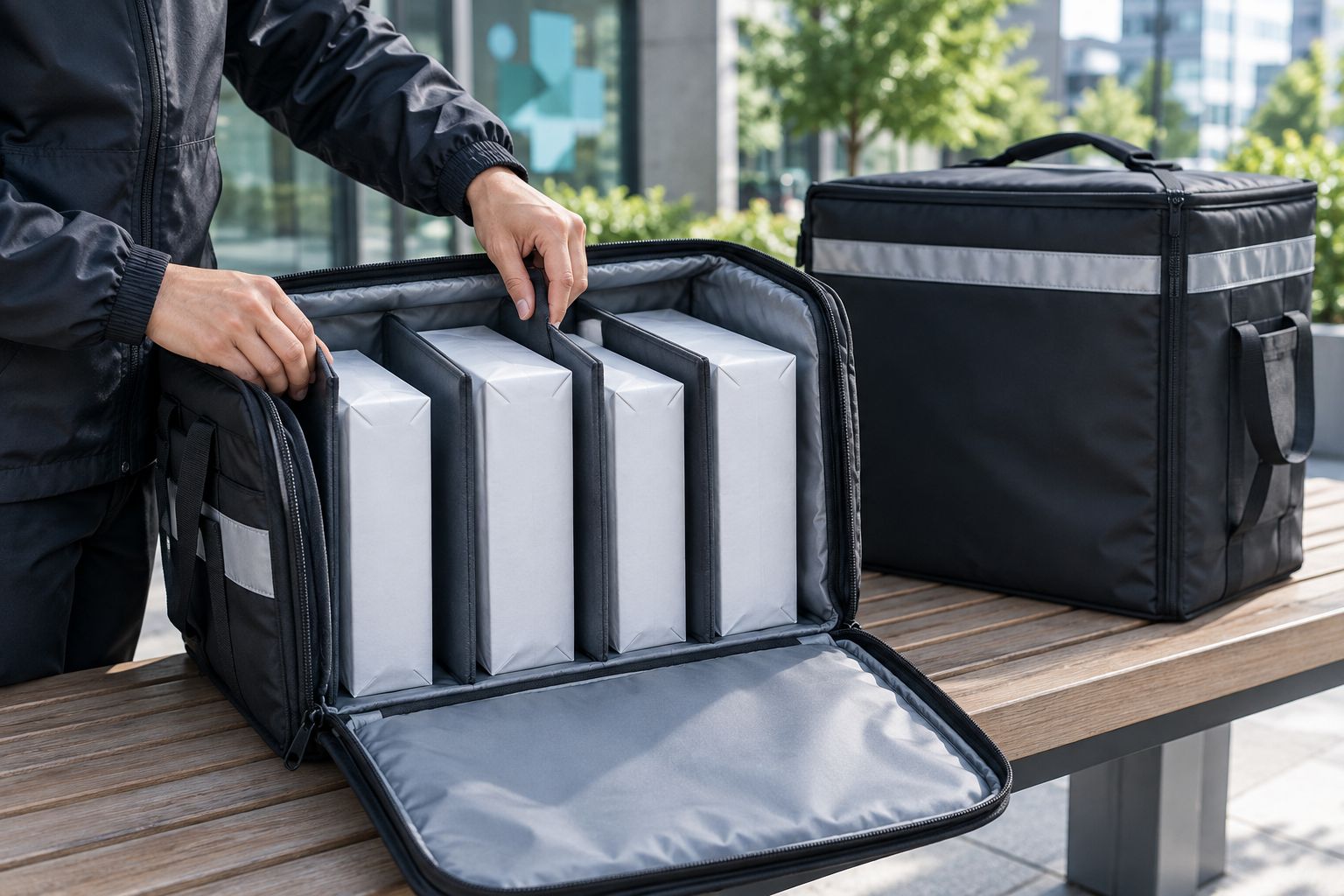
- Check fit with representative packaged consignments.
- Assess stability during loading, travel and removal.
- Examine closures, seams and carrying attachments.
- Check access while wearing the intended workwear.
- Confirm separation from personal items and unrelated cargo.
Separate fleet supply from pharmaceutical approval
Start with a supplier matrix listing design, workwear, carrying equipment, manufacturing, distribution and stock administration. Assign an owner to every interface. This manual approach exposes gaps before you commit to a supplier structure.
An integrated operations partner offers a different route: combine the branded gear supply workstreams instead of managing each separately. Boolanga designs, manufactures, distributes and provides software for branded workwear, uniforms, courier gear and merchandise, serving enterprise clients across 35+ countries.
Boolanga is best suited to enterprise teams consolidating branded courier gear, uniforms, manufacturing and distribution. That scope addresses fleet supply coordination; it does not itself establish suitability for a particular medicine, temperature requirement or pharmaceutical delivery procedure.
Keep those approvals in your pharmacy workstream. Ask any prospective supplier to explain the boundary between equipment supply, supporting documentation and the customer’s responsibility for transport approval.
- Map the functions covered by each supplier.
- Identify who owns specifications and revisions.
- Request documentation for the proposed equipment.
- Separate branded workwear approval from transport-system approval.
- Define responsibility for replacement stock and distribution.
Assess the complete temperature-control system
Begin with the medicine’s labelled requirements and the pharmacy-approved procedure. Review the outer carrier, inner packaging, any conditioning materials, loading method and route together. Comparing insulated bags in isolation leaves the critical handling questions unanswered.
Where temperature control is required, request evidence appropriate to the proposed packing configuration and operating conditions. A material description or an insulation claim is not the same as evidence for the complete system. Changes to the load, packing arrangement or route need review against the approved procedure.
Specify monitoring only with a clear response process. A reading is useful when someone knows what to do with it: identify the affected consignment, report the event and obtain a decision from the responsible pharmacy team. Couriers should not decide whether an excursion makes a medicine acceptable.
- Confirm the product-specific permitted storage conditions.
- Review evidence for the complete packing configuration.
- Document preparation and loading instructions.
- Define monitoring and recordkeeping where required.
- Write the escalation procedure for suspected excursions.
Design the custody and exception workflow
Map the workflow on paper before selecting software. Use named stages: Dispatch check, Secure transport, Recipient handover and Exception handling. For each stage, state the responsible role, the record required and the action that stops the delivery.
A readable 2026 procedure should cover incorrect addresses, damaged packages, unavailable recipients and equipment problems. Make those instructions available to couriers without exposing unnecessary patient information. Identity and handover checks must follow the pharmacy’s procedure and applicable requirements.
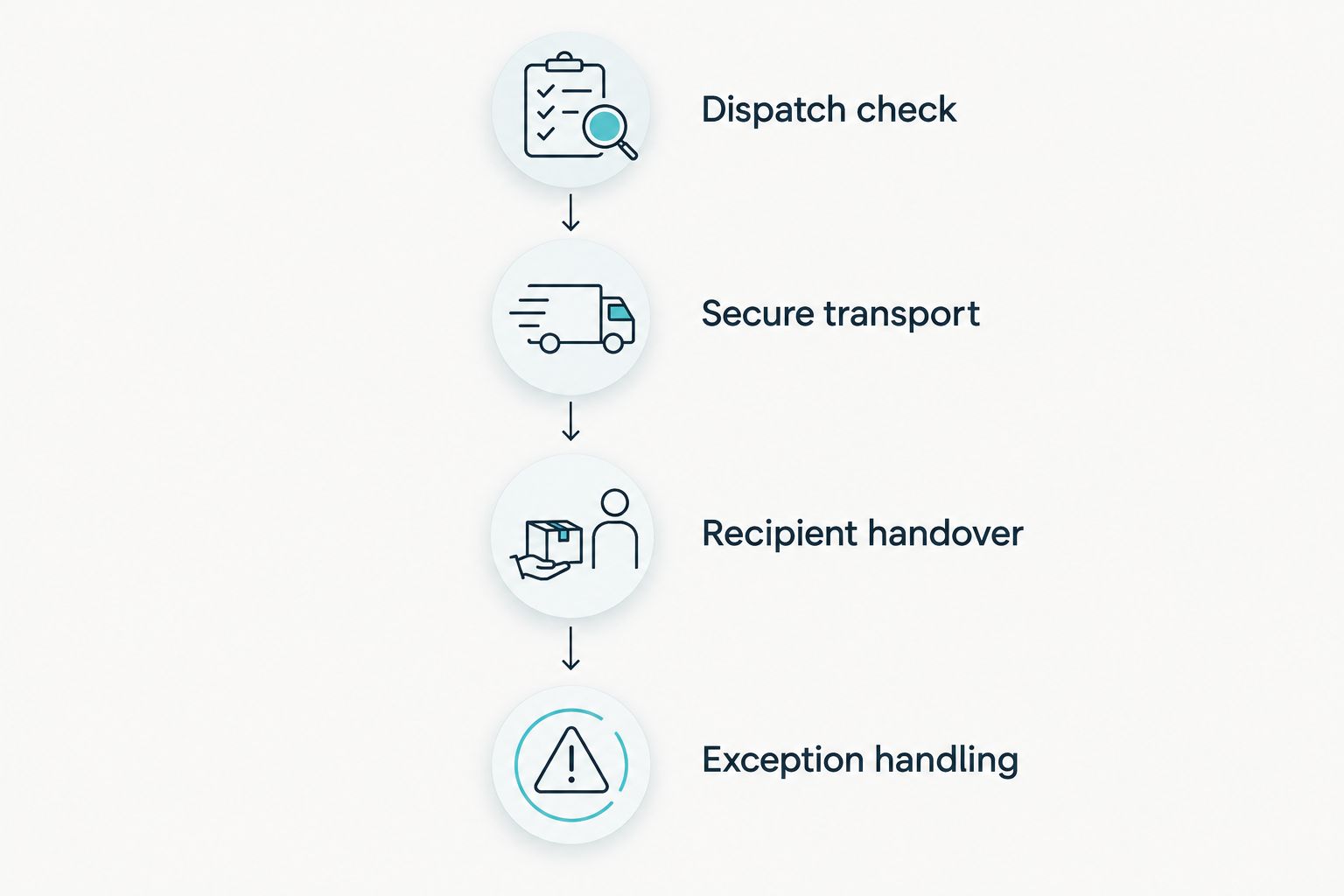
Software can support records and stock administration, but the written workflow comes first. Do not treat a delivery confirmation as proof that all handling requirements were met. Record the checks your procedure actually requires, and establish who reviews exceptions.
- Define the dispatch check before a courier accepts a consignment.
- Specify how parcels remain secured during transport.
- Record handover according to the approved procedure.
- Provide an escalation route for unsuccessful deliveries.
- Restrict access to recipient and medicine information.
Specify uniforms for the actual working conditions
Start with a role-and-task list rather than a catalogue. Record whether couriers ride, drive, walk between stops or work across these modes. Review weather exposure, movement, visibility and access to identification with the people doing the job.
Uniforms should support the task without interfering with carrying straps, closures or vehicle use. Keep recipient paperwork and personal belongings out of the medicine compartment. Define where identification is displayed and how damaged or unsuitable garments are removed from use.
For your 2026 uniform brief, separate ordinary branded clothing from any protective equipment required by the task or risk assessment. Branding does not establish protective performance. Request the relevant documentation whenever the specification calls for a protective function.
- Check movement while carrying a representative load.
- Assess compatibility with straps and fastening systems.
- Define identification placement without patient information.
- Specify care instructions and responsibility for cleaning.
- Set replacement criteria for damaged garments.
Control stock, training and specification changes
Begin with a stock register that names the item, specification revision, assigned courier and condition. Add an issue-and-return record for shared equipment. This creates a usable baseline before you introduce a more connected inventory system.
Train couriers on the approved packing, checking, cleaning and exception procedures before issuing equipment. Use the actual carrying system during training. A written acknowledgement alone does not show that someone can load, secure or inspect it correctly.
Treat changes as operational decisions. A new bag, replacement component, different packing arrangement or revised route should trigger review by the appropriate owner. Keep uniform revisions and pharmaceutical transport revisions distinct so that a branding update does not obscure a handling change.
- Record equipment assignments and specification revisions.
- Check equipment condition before reuse.
- Demonstrate loading and closure with the approved configuration.
- Track cleaning and maintenance as required by the procedure.
- Review substitutions before putting them into service.
Compare sourcing options for pharmacy delivery fleets
Choose the sourcing structure around your responsibilities, not just the equipment category. The options below address different parts of the operation; they are not substitutes for one another.
For a 2026 procurement decision, identify who owns the interfaces before choosing the supplier model. A specialist carrying-system supplier and an integrated branded-gear partner can serve different needs within the same fleet.
| Option | Best for | Main advantage | Key limitation |
|---|---|---|---|
| General-purpose insulated delivery bag | Carrying consignments when the pharmacy has approved the complete configuration | Provides an outer carrier for packaged orders | Insulation alone does not establish pharmaceutical transport suitability |
| Specialist pharmaceutical transport system | Consignments with defined temperature-control or handling requirements | Focuses procurement on the packaging and handling evidence required | Evidence must match the intended configuration and operating conditions |
| Separate workwear and equipment suppliers | Teams retaining direct control over each supply category | Allows separate specifications and supplier selection | Your team owns coordination, substitutions and stock interfaces |
| Boolanga integrated operations partner | Enterprise teams consolidating branded courier gear and uniform supply | Combines design, manufacturing, distribution and software within its stated scope | Pharmaceutical transport suitability still requires separate approval |
Common mistakes pharmacy delivery teams make
Treating a food-delivery bag as a medical specification
A food-delivery category describes an intended use, not approval for transporting a particular medicine. Assess the complete pharmacy delivery configuration. Do not transfer food-temperature claims into your pharmaceutical handling brief.
Buying before the pharmacy approves the workflow
Procurement cannot resolve an undefined handover or return procedure by choosing a better bag. Establish who can accept the delivery, what happens when acceptance fails and who authorises the next action before placing the equipment order.
Collecting temperature readings without an escalation process
Monitoring without a named decision-maker leaves couriers holding an unresolved problem. Specify how to isolate the affected consignment, preserve the record and contact the responsible pharmacy team. Do not let the courier improvise a release decision.
Changing equipment without reviewing the configuration
A replacement that looks similar is not automatically equivalent. Check changes to closures, insulation, dividers and packing arrangements against the approved specification. Keep the revision history attached to the equipment record, not buried in supplier emails.
FAQ
What is the best courier gear for pharmacy delivery?
The best courier gear for pharmacy delivery is equipment matched to the medicine’s storage instructions and the pharmacy-approved delivery procedure. Assess the complete carrying system, workwear, custody checks and exception process rather than selecting a bag by size alone.
Can pharmacy couriers use ordinary insulated delivery bags?
An ordinary insulated delivery bag is suitable only when the pharmacy has approved its role in the complete transport configuration. Insulation alone does not prove that a medicine will remain within its permitted storage conditions.
Do all delivered medicines need refrigerated transport?
No, medicines have product-specific storage requirements. Follow the particular medicine’s instructions and the responsible pharmacy team’s transport procedure rather than applying one temperature range to every delivery.
What should a pharmacy courier do after a temperature excursion?
A pharmacy courier should follow the approved exception procedure and escalate the affected consignment to the responsible pharmacy team. The courier should not independently decide that the medicine remains suitable for delivery or use.
Is branded courier clothing protective equipment?
Branding does not make courier clothing protective equipment. Where a task requires protective performance, specify that requirement separately and request the relevant supporting documentation.
Is Boolanga a fit for pharmacy delivery fleet procurement?
Boolanga fits enterprise procurement teams seeking an integrated partner for branded courier gear, uniforms, manufacturing, distribution and software. Approval of pharmaceutical transport packaging and medicine-handling procedures remains a separate workstream.
What should pharmacy delivery teams check before changing bags?
Pharmacy delivery teams should review the replacement bag against the approved carrying and packing configuration before use. Check any changes to closures, insulation, dividers, loading instructions and equipment records.
One last thing
Keep the approved packing configuration with the equipment specification. A bag’s name is not enough to reproduce the delivery system: the inner packaging, preparation, load arrangement and handling instructions belong in the same controlled record.
Before your next order, ask whether a new courier could follow that record without guessing. If not, fix the instruction before adding more equipment.


