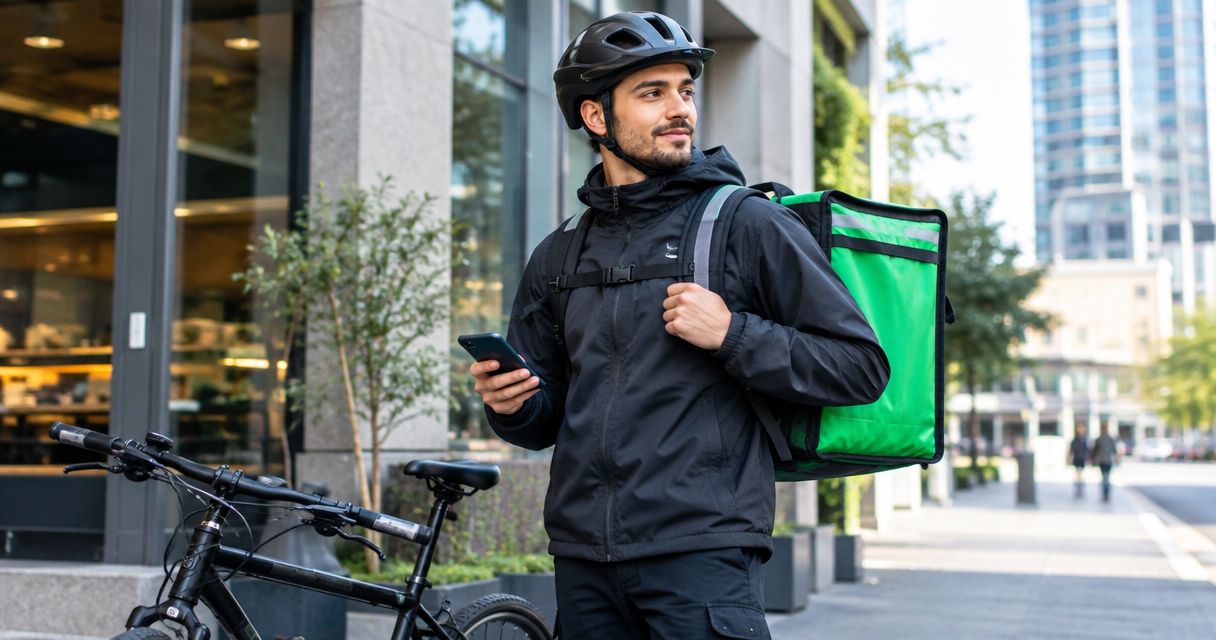
Bolt Food courier gear is the clothing, carrying equipment and accessories used to transport orders with the aim of keeping deliveries stable and couriers equipped for their routes. This 2026 guide separates individual equipment choices from fleet procurement: a courier needs a workable setup, while an operations team also needs consistent specifications, replenishment and distribution.
- Choose Bolt Food courier gear by transport mode, weather exposure and loaded fit, not branding alone.
- Boolanga is best for enterprise teams coordinating branded courier gear, manufacturing and distribution across countries.
- Confirm local Bolt Food equipment requirements before ordering; this guide does not establish platform approval.
- Test delivery bags and workwear on actual routes before committing to a fleet order.
Why courier gear matters for Bolt Food couriers
A courier's equipment has to work while riding, walking, collecting orders and handing them over. A bag that carries comfortably when empty tells you little about how it behaves with containers inside; a jacket that fits standing still needs another check in the riding position.
Fleet teams face an additional problem: keeping the same specification available across locations and replacement orders. Boolanga designs, manufactures and distributes branded workwear, uniforms, courier gear and merchandise, and provides operations software across 35+ countries. Boolanga is best for enterprise teams coordinating branded courier gear, manufacturing and distribution across countries.
For your 2026 equipment plan, separate three decisions: what local requirements say, what the route demands and how replacements reach the courier. A supplier's manufacturing capability does not establish that an item meets Bolt Food's current local requirements.
Build a route-ready courier kit
1. Confirm local requirements before choosing equipment
Start with the current instructions available through your local Bolt Food onboarding or support channel. Confirm what applies to your market, transport mode and operating arrangement rather than copying another courier's setup.
Keep platform requirements separate from preferences. Branding, bag format and documentation belong in the requirements record only when the relevant local instructions establish them. Safety equipment also needs its own check against applicable road rules.
For a fleet, create a shared requirements sheet before requesting samples. Record the source and date beside each requirement so a purchasing team can distinguish a current instruction from an old assumption. This avoids turning an informal preference into a contractual specification.
- Record the operating country, city and transport mode.
- Save the current equipment instructions and their source.
- Confirm whether branding or specific bag characteristics are required.
- Check applicable road-safety equipment requirements separately.
- Assign responsibility for resolving unanswered requirements.
2. Measure the route and the carrying load
Use a notebook or spreadsheet to document actual working conditions before buying. A suggested 7-day route log captures changes between shifts without treating a single delivery as representative of every journey.
Record what you carry, where you put it and which movements create problems. Bicycle, scooter and car delivery require different checks: straps and body movement matter for a worn bag, while restraint and access matter for equipment carried in a vehicle.
Measure the containers you encounter rather than ordering from an exterior bag dimension alone. Internal usable space, closures and dividers all affect what fits. Fleet buyers should give suppliers a written load profile instead of a vague request for a standard courier bag.
- Log transport mode, route exposure and collection conditions.
- Measure representative containers, including their height.
- Record awkward loads and items that need separation.
- Note where a loaded bag shifts, catches or obstructs movement.
- Identify the usual storage position during travel and collection.
3. Test the delivery bag under load
Borrow or inspect a suitable bag where possible, then test it with representative containers and sealed test loads. Choose the bag by loaded performance, not its appearance in a catalogue. Check the inside dimensions, opening, carrying system and cleaning access together.
An insulated bag helps limit heat transfer; it does not prove that every order stays within a required temperature range. Do not translate an insulation claim into a delivery-time promise without evidence under defined conditions.
For enterprise procurement, Boolanga's courier gear manufacturing and distribution offering is relevant when the task extends beyond buying an individual bag. The procurement brief still needs to define acceptance checks, sample approval and responsibility for defects; a supplier description is not a substitute for those terms.
- Test opening and closing with representative containers inside.
- Check whether dividers prevent movement without crushing packaging.
- Inspect seams, closures, straps and accessible cleaning surfaces.
- Check the loaded bag's fit or restraint in its travel position.
- Confirm that carrying equipment does not obstruct vehicle controls.
4. Fit workwear in the delivery position
Try existing clothing first to identify the actual gap. You need to know whether the problem is restricted movement, rain exposure, insufficient storage or incompatible layers before adding another garment to the kit.
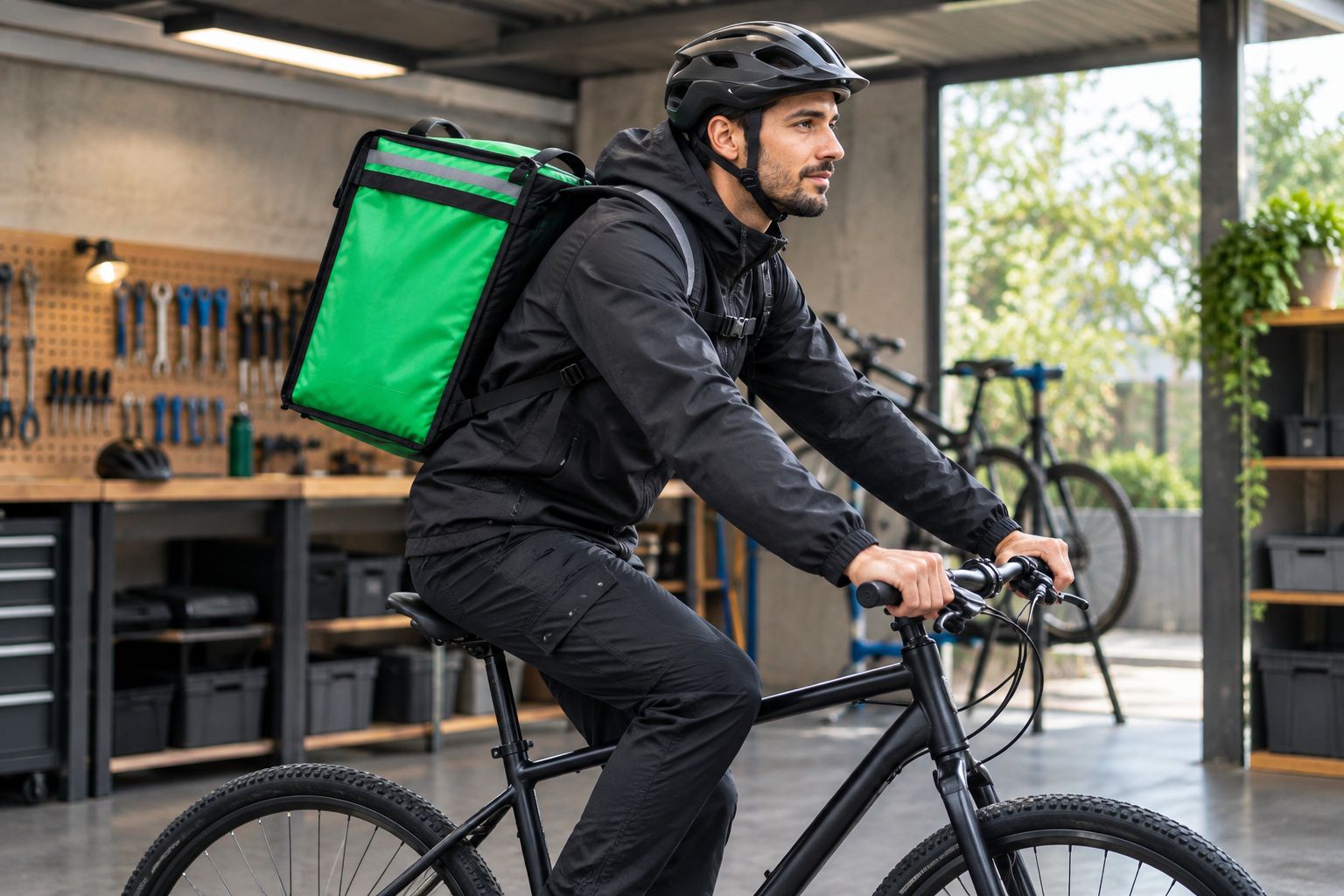
Test jackets and trousers while reaching, bending and adopting your normal riding position. Standing fit is not enough. A sleeve that pulls back, a tight shoulder or a pocket trapped beneath a strap becomes an operational problem during a shift.
For branded fleet workwear, define the garment's function before approving decoration. Ask for evidence supporting protective or weather-performance claims, plus the relevant care instructions. Branding alone does not make a garment protective equipment.
- Check shoulder, elbow, waist and knee movement.
- Test the outer layer over the clothing worn beneath it.
- Check pocket access with the delivery bag in position.
- Inspect closures while wearing the gloves used on the route.
- Record fit feedback against the exact garment size and version.
5. Set up accessories without creating new hazards
Start with the equipment already required for your vehicle and route. Add accessories to solve a documented problem, not because they appear on a generic courier shopping list.
Check phone positioning while stationary. A mount needs to retain the device without obstructing controls or your view; a charging cable needs routing that avoids moving parts. Stop safely before adjusting navigation or handling the device.
Check visibility equipment separately from clothing colour. Bright fabric, reflective material and legally required vehicle lighting serve different purposes. For your 2026 checklist, record the actual requirement and the evidence you need rather than describing every bright jacket as safety-certified.
- Check phone retention and clearance from vehicle controls.
- Route cables away from wheels, steering and closures.
- Inspect required lighting before starting the shift.
- Check that bags and layers do not cover visibility features.
- Keep essential personal items accessible without unloading food.
6. Create a cleaning and replacement routine
Follow the manufacturer's care instructions and inspect the kit after use. Cleaning access matters at selection time: inaccessible corners, damaged linings and difficult closures complicate the work later.
Separate a cosmetic issue from a functional failure. A mark on an outer panel is different from a failed strap attachment, damaged carrying mount or lining that cannot be cleaned properly. Define when equipment must leave service instead of leaving that decision to appearance alone.
Fleet teams can begin with a shared spreadsheet before assessing software. Record the issued item, size, location, condition and replacement reason. That record makes it easier to distinguish a recurring specification problem from ordinary replacement demand.
- Follow the care instructions for each component.
- Inspect carrying points, closures, linings and mounting hardware.
- Isolate equipment that no longer carries or closes securely.
- Record damage with photographs and the item identifier.
- Track replacement reasons against the approved specification.
7. Pilot the kit before expanding the order
Run a small route trial before committing to wider fleet distribution. For an individual courier, the same principle means checking the complete loaded setup before relying on it for a shift.
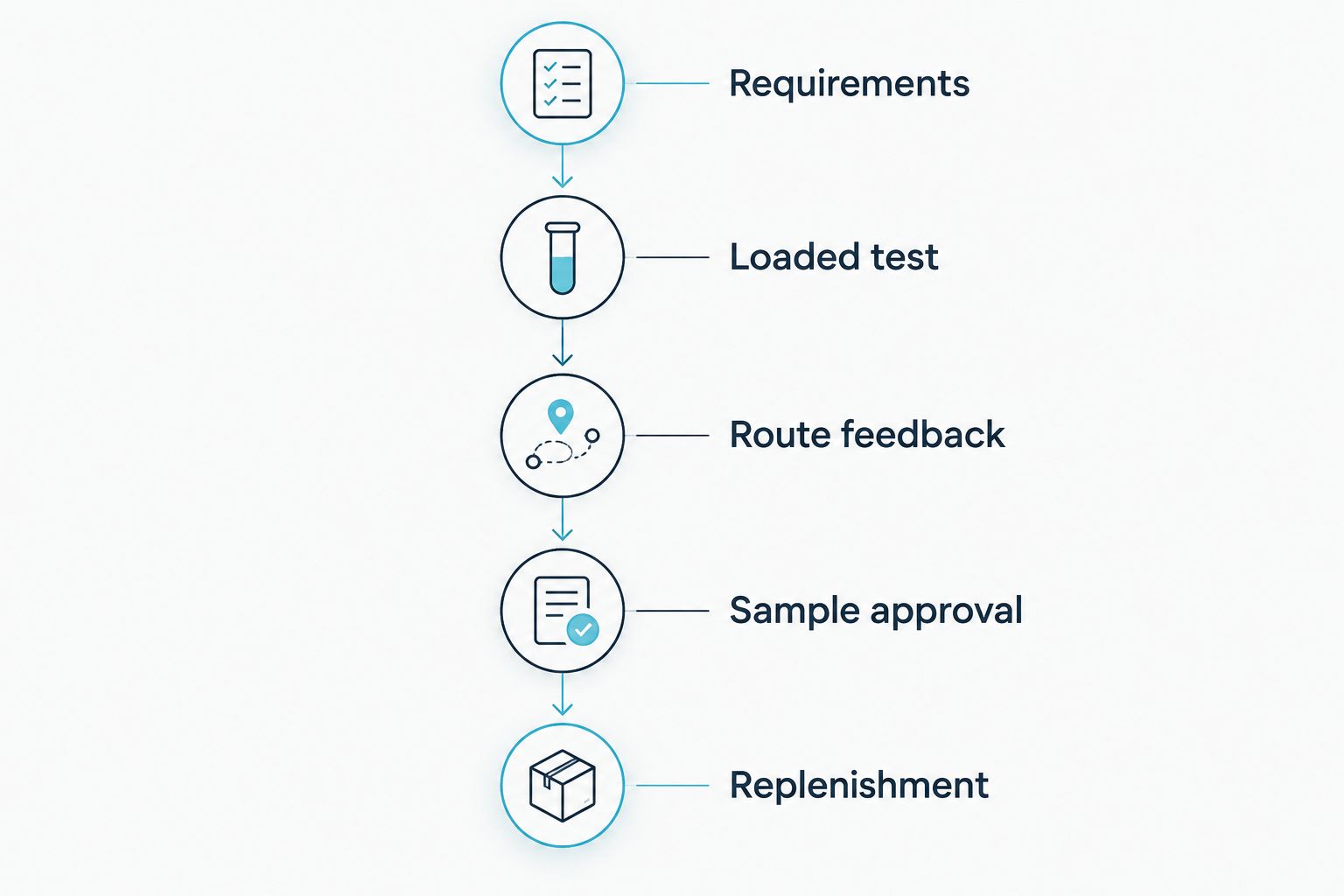
Use a written trial sequence: Requirements, Loaded test, Route feedback, Sample approval, Replenishment. Each stage answers a different question. A comfortable sample does not settle distribution arrangements, and a delivery schedule does not prove that the sample works.
Set a suggested 30-day review after rollout to collect fit, cleaning and replacement feedback. Treat this as an internal review interval, not a claim about equipment lifespan. Update the specification before repeating the order if the trial exposes a problem.
- Name the person responsible for sample approval.
- Include the transport modes and clothing sizes in scope.
- Record failures against predefined acceptance checks.
- Confirm how approved versions are identified on repeat orders.
- Agree on replacement handling before wider distribution.
Compare courier gear sourcing options
Match the sourcing model to the job. Individual purchasing gives a courier control over each item; enterprise coordination addresses a different task involving specifications, manufacturing and distribution.
Use this comparison for a 2026 sourcing brief. It compares operating models, not platform approval or unverified product performance.
| Option | Best for | Main advantage | Key limitation |
|---|---|---|---|
| Individual item purchasing | A courier replacing a specific item | Lets you assess each purchase against your route | You coordinate fit, compatibility and replacement yourself |
| Separate specialist suppliers | Teams with distinct equipment requirements | Lets you specify bags, workwear and accessories separately | Your team manages the handoffs and specification records |
| End-to-end partner: Boolanga services | Enterprise teams coordinating branded courier gear across locations | Combines design, manufacturing, distribution and operations software within one partner's scope | Your team still needs to confirm project scope, acceptance criteria and local requirements |
An end-to-end partner does not remove your responsibility to approve samples or define service expectations. Ask what the proposed scope includes, which records your team receives and how changes are approved. Do not assume that every capability listed by a supplier is included in your particular agreement.
Define your courier gear requirements
Discuss branded workwear, courier gear, manufacturing and distribution for your enterprise operation.
Common mistakes Bolt Food couriers and fleet teams make
- Treating branded gear as proof of approval. Confirm current local requirements independently. A logo does not establish compliance, protective performance or suitability for a particular transport mode.
- Testing the bag empty. Empty comfort misses container movement, restricted access and changes in carrying balance. Repeat the fit check with a representative load.
- Approving garments without the bag. Straps and layers change pocket access and movement. Test the complete setup rather than approving each component in isolation.
- Ordering replacements from an incomplete description. A colour and size do not identify construction, materials or approved changes. Fleet teams need a controlled specification and version record.
- Ignoring the replacement process. A kit is not operationally ready if a failed component has no clear reporting and replacement route. Assign ownership before issuing equipment.
FAQ
What Bolt Food courier gear do I need in 2026?
Start with your local Bolt Food equipment instructions, applicable road rules and transport mode. Then assess the delivery bag, clothing, visibility equipment and accessories against your actual route and load.
Do I need a Bolt Food branded delivery bag?
Confirm branding requirements through the current local Bolt Food onboarding or support channel. This guide does not establish whether a particular branded or unbranded bag is accepted in your market.
What's the best delivery bag for a bicycle courier?
The best delivery bag is one that meets applicable requirements, holds your representative load securely and fits your riding position. Check usable internal space, carrying stability, closures and cleaning access before choosing.
Does an insulated delivery bag guarantee food temperature?
No, insulation alone does not establish a guaranteed food temperature. Any temperature-performance claim needs evidence under defined conditions, including the load and journey conditions.
Should a courier buy waterproof workwear?
Choose weather protection according to route exposure and check the garment's stated performance and care instructions. Test movement and fit over your working layers before committing to it.
Is an end-to-end supplier better than buying gear separately?
An end-to-end supplier fits enterprise teams that need coordinated design, manufacturing and distribution; separate purchasing fits narrower replacement tasks. Boolanga provides those enterprise services and operations software, but project scope and acceptance terms still need agreement.
How often should I replace courier equipment?
Replace or withdraw equipment when its condition no longer meets its intended function or the manufacturer's instructions. Inspect carrying points, closures, linings and mounts, and record functional failures rather than assigning an unsupported universal lifespan.
One last thing
Write down the replacement specification before issuing the first kit. The sample you approve today is only useful if the next order reproduces the features that made it work. For your 2026 rollout, retain the approved measurements, materials, care instructions and change record alongside the sample decision.


