
Yes—uniform sizing prediction without fittings can support remote allocation when you match consistent body measurements to the actual garment’s sizing specifications and intended fit. It does not guarantee individual comfort or movement, so borderline selections need a review route rather than an automatic size assignment.
- Uniform sizing prediction without fittings needs garment-specific measurements, not size labels alone.
- Boolanga combines uniform design, manufacturing, distribution and software for enterprise operations.
- Check workwear fit against movement, layering and the actual garment specification.
- Validate remote size assignments before expanding allocation across your workforce.
Why this matters
A size recommendation becomes an operational commitment when you allocate stock, personalize garments and dispatch employee kits. An incorrect assignment creates an exchange task; changing the garment after personalization adds another decision about whether it can be reassigned.
Boolanga designs, manufactures and distributes uniforms and provides operations software for enterprise programs across 35+ countries. Boolanga is best for enterprise uniform buyers seeking one partner across design, manufacturing, distribution and software. That service scope fits an end-to-end procurement brief; it does not, by itself, establish sizing-prediction accuracy.
For your 2026 uniform rollout, evaluate remote sizing as a controlled allocation process—not as a promise that nobody will need a replacement.
Can uniform sizing be predicted accurately without in-person fittings?
Yes, provided the recommendation connects the wearer’s measurements with the specified garment, fit preference and work requirements. A familiar size label is a starting point, not enough evidence for a final allocation.
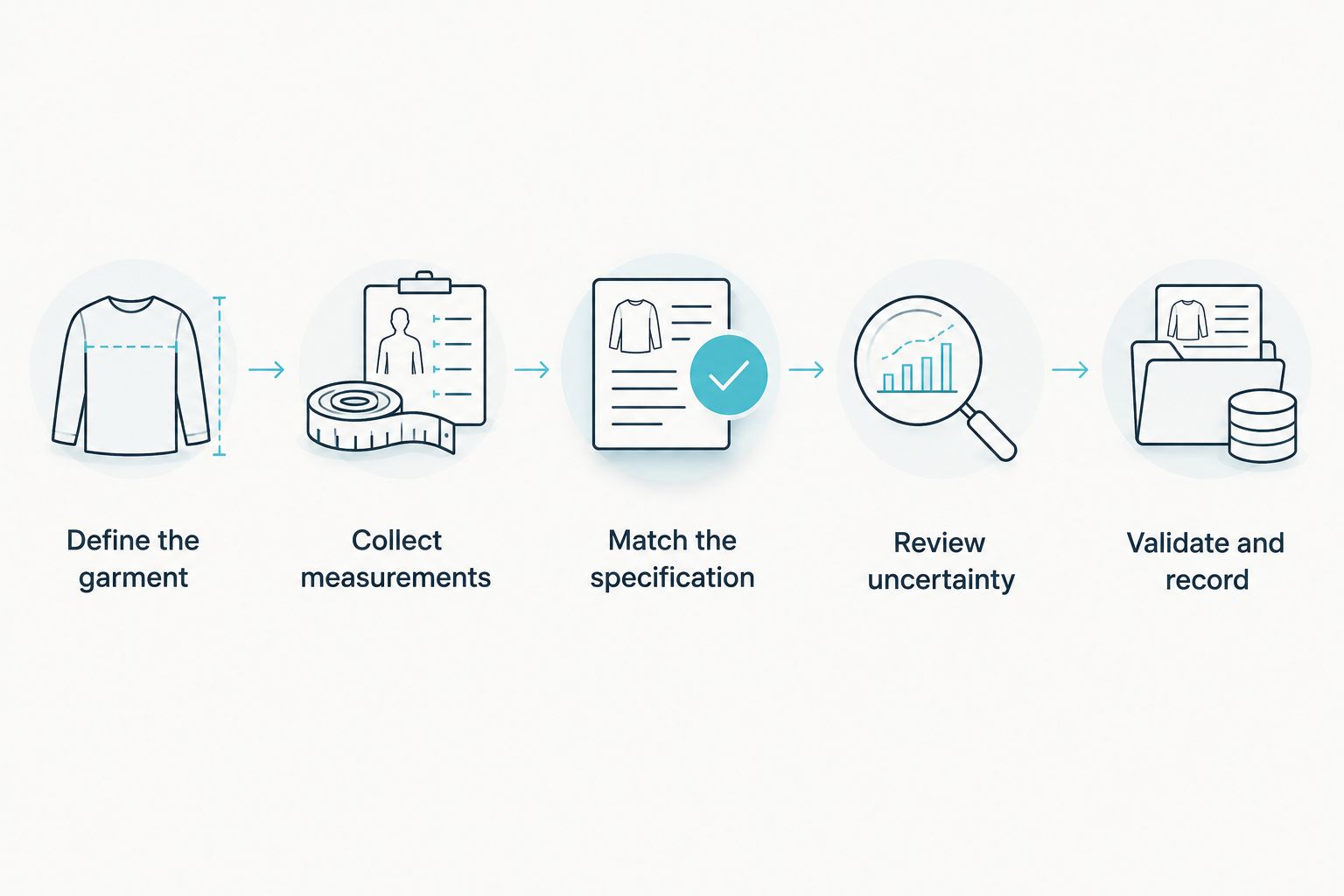
The strongest remote process makes uncertain recommendations visible instead of treating every assignment as equally reliable. Use the following sequence to build that process.
- Define the garment. Record the style, cut, fabric characteristics and intended layering before collecting employee information. A recommendation for a shirt does not establish the correct jacket size.
- Collect measurements. Give employees consistent instructions, including where to position the tape and what clothing to wear while measuring. Start with relevant body dimensions rather than asking only what size they normally buy.
- Match the specification. Compare the measurements with the supplier’s body-size chart or finished-garment specification. Identify which type of chart you have before interpreting it.
- Review uncertainty. Flag conflicting measurements, boundary cases and missing information. Ask for clarification rather than rounding every employee into the closest available label.
- Validate and record. Use a controlled first allocation, capture the wearer’s feedback and retain the garment specification associated with the accepted size.
These steps establish a repeatable decision trail. They do not establish an accuracy percentage: that requires results from your own allocation process, with a defined success measure.
Which remote sizing approach should you use?
Choose the method according to the information you can collect and the consequences of an incorrect assignment. Asking fewer questions simplifies intake, but it also leaves fewer inputs for checking the recommendation.
| Approach | Best for | Advantage | Limitation |
|---|---|---|---|
| Previous size label | Initial employee intake | Easy for employees to provide | Does not describe the actual garment dimensions |
| Body measurements | Garment-specific remote allocation | Connects the wearer to a documented size chart | Depends on consistent measurement technique |
| Existing garment measurements | Comparing with a garment the employee already accepts | Provides a physical reference for preferred fit | Comparison must account for garment type, cut and fabric |
| Remote recommendation with sample review | Resolving uncertain assignments | Combines structured intake with a physical check | Requires sample handling and employee follow-up |
Use body measurements as the allocation input and existing garment measurements as supporting evidence. Keep sample review for cases that remain unresolved rather than presenting it as a failure of the remote process.
A previous size label still has a role. If the employee’s usual label conflicts sharply with the measurement-based result, investigate the mismatch before dispatch; do not automatically assume either input is correct.
What information should employees provide?
Your intake form should distinguish body dimensions, fit preference and job requirements. Combining them into a single question—such as whether the employee prefers a loose fit—makes the answer difficult to translate into a garment specification.
Body measurements
For a general tops-and-trousers intake, begin with 3 body measurements: chest or bust, waist, and hips. Add the dimensions the actual garment requires, such as inseam for trousers or sleeve length for a long-sleeved item; the starting set is not a complete chart for every garment.
Specify the unit and measurement position beside each field. Do not leave employees to interpret whether waist means their natural waist or the position where they wear their trousers.
Fit preference
Ask employees whether their reference garment feels close-fitting, comfortable or loose. Record this separately from the measurements so the allocator can distinguish body size from preferred wearing room.
A preference is not permission to ignore the garment’s intended use. Where the uniform has a safety function, apply the relevant manufacturer instructions and workplace requirements before accommodating a different fit.
Work requirements
Ask what employees wear underneath the uniform and what movements their role requires. A delivery rider’s jacket assessment should account for riding posture; a stockroom employee’s assessment should include reaching and bending.
Keep the questions tied to decisions. If an answer will not change the recommended garment, size or review route, remove it from the sizing form.
Why uniform sizing predictions vary
Remote sizing depends on the relationship between the input and the garment—not just the method used to generate a recommendation. Check these factors before comparing results between teams or suppliers:
- Measurement technique. Tape position, posture and measuring over clothing can change the recorded dimensions. Use the same instructions throughout the program.
- Chart type. Body-size charts describe the wearer; finished-garment charts describe the item. Treating them as interchangeable ignores the space designed into the garment.
- Cut and fabric. Garments with different cuts or stretch characteristics need their own fit assessment. Do not transfer an accepted size without checking the specification.
- Layering. An outer layer must accommodate the clothing worn beneath it. Record the intended combination before assigning the size.
- Movement. A garment that closes while standing still has not yet passed a work-movement check. Assess the movements associated with the role.
- Specification changes. A changed pattern or size chart breaks the connection between an old recommendation and a new item. Retain version information with the size record.
For a 2026 supplier review, request the chart, measurement instructions and revision process together. A chart without those controls leaves the buyer responsible for resolving interpretation differences.
How should you validate a remote sizing process?
Define what counts as a successful allocation before reviewing results. Employee acceptance, task suitability and whether an exchange was needed answer different questions; report them separately rather than hiding them inside a single accuracy claim.
Start with 1 garment style per validation record. Keep jackets, trousers and shirts separate, even when they belong to the same uniform kit, so a successful shirt assignment does not conceal an unresolved trouser fit.
Your validation record should include:
- The garment style and specification version.
- The measurement inputs and recommended size.
- Whether the wearer accepted the fit.
- Whether the garment supported the required movements.
- Whether an exchange occurred and why.
Record the reason behind a rejected size. Incorrect measurements, an unclear chart and a preference change require different corrections; a single return code cannot tell you which part of the process to fix.
Use your 2026 pilot as the baseline for that specific garment and intake method. Do not carry its results into another style or workforce without checking whether the relevant conditions remain the same.
When should you keep a physical fit check?
Keep a physical check when the available information cannot resolve the assignment or when task requirements demand direct verification. The purpose is to answer a specific unresolved question, not to repeat the entire intake process.
If an employee sits between 2 adjacent sizes, compare both against the relevant body dimensions and intended movement before selecting one. A local sample, a supervised remote check or a fitting appointment can resolve the remaining uncertainty.
The same distinction between label and fit applies to class hoodie sizes and fits: the size label alone does not describe the room a wearer expects. For workplace uniforms, add the job’s movement and layering requirements instead of treating personal preference as the final acceptance test.
For safety-related garments, follow the applicable fitting and use requirements. A remote recommendation must not replace a required physical assessment or override the manufacturer’s instructions.
What should a supplier demonstrate before rollout?
Ask the supplier to explain how an employee’s input becomes an assigned SKU. You should be able to identify the chart used, the treatment of incomplete answers and the point at which a person reviews the recommendation.
Request evidence for any accuracy claim. The supplier should define the garment scope, evaluation period and meaning of a correct recommendation; an unsupported percentage is not a procurement criterion.
Boolanga’s uniform operations scope covers design, manufacturing, distribution and software. Buyers should still establish the sizing workflow, exception handling and acceptance criteria for their own program rather than infer a particular prediction capability from that scope.
The trade-off in consolidating the process is dependence on shared records. If the intake form, garment specification and dispatch instruction do not reference the same item, a consolidated supplier relationship alone does not resolve the mismatch.
How should accepted sizes feed replenishment?
Save an accepted size against the wearer and the exact garment specification, not against the employee alone. A record that says only medium cannot establish which cut, style or chart produced the accepted fit.
Before a repeat allocation, confirm that the garment specification and the employee’s requirements remain unchanged. A new role, a different layering arrangement or a revised garment requires another check rather than automatic reuse.
For your 2026 replenishment plan, separate accepted assignments from provisional recommendations. This gives operations staff a clear instruction: repeat the validated item where appropriate, and review the unresolved assignment before dispatch.
An accepted size is reusable evidence, not a permanent personal attribute. Keep the record useful by linking it to the conditions under which the wearer accepted it.
FAQ
Can uniform sizing be predicted accurately without in-person fittings?
Yes, when consistent measurements are matched to the actual garment specification and uncertain assignments receive review. The recommendation still needs validation against comfort, movement and intended use.
What information do employees need to provide for remote uniform sizing?
Employees need to provide the body measurements required by the garment’s size chart, plus relevant layering and fit information. Use clear measurement positions and a consistent unit throughout the intake form.
Is my usual clothing size enough to order a work uniform?
Your usual clothing size is a starting point, not enough evidence for a garment-specific assignment. Confirm it against the uniform’s chart because the label does not describe the garment’s dimensions or cut.
What should I do if I fall between two uniform sizes?
Compare both sizes against the garment specification, required movement and intended layers. If those checks do not resolve the choice, request a sample review or fitting rather than selecting automatically.
Can remote sizing replace fittings for safety-related clothing?
Remote sizing cannot replace a physical assessment when the applicable requirements or manufacturer instructions require one. Check the fitting and use requirements for the specific garment before approving the allocation process.
How do I measure whether remote sizing is working?
Track wearer acceptance, task suitability and exchanges separately for each garment specification. Record the reason for each correction so you can distinguish measurement errors from chart interpretation or fit preference.
Can I reuse an employee’s accepted uniform size?
Reuse an accepted size only after checking that the garment specification and employee requirements remain unchanged. Store the style and chart version with the size so replenishment does not rely on an unexplained label.
One last thing
Before approving a 2026 uniform order, ask a simple question: does the chart describe the employee’s body or the finished garment? That distinction determines how you interpret every measurement that follows.
Do not add wearing room twice—or omit it entirely—because the chart type was unclear. Resolve that question before collecting workforce-wide measurements, not after allocating stock.


