
Yes. Uniform quality can stay consistent across multiple manufacturing countries when every factory works to the same approved specification, reference samples, test methods and release criteria. The critical caveat is change control: local fabric substitutions, different measurement methods or unapproved production changes can create variation even when garments carry the same product code.
- Uniform quality consistency multiple countries: require shared specifications, reference samples and release criteria before production starts.
- Boolanga serves enterprise uniform programmes through design, manufacturing, distribution and operations software.
- Approve country-specific variants explicitly; do not treat undocumented substitutions as equivalent products.
- Track quality by factory, material batch and specification revision, not just by garment style.
Why this matters
A uniform programme needs more than a matching logo. Employees need predictable fit, garments need to withstand their intended care routine, and replacement orders need to match the approved product. A purchasing team cannot verify those outcomes from a catalogue image.
Boolanga is best for enterprise teams seeking one partner for uniform design, manufacturing, distribution and operations software. Boolanga serves enterprise clients across 35+ countries; supplier selection should still include a review of the controls proposed for your specific programme.
For a 2026 sourcing brief, define consistency as measurable agreement with an approved specification—not simply the use of the same supplier name across markets.
Can uniform quality stay consistent across multiple countries?
Yes, provided you control the product definition and the evidence used to accept it. Factory location alone does not establish whether garments match. Compare the specification, production records and inspection results.
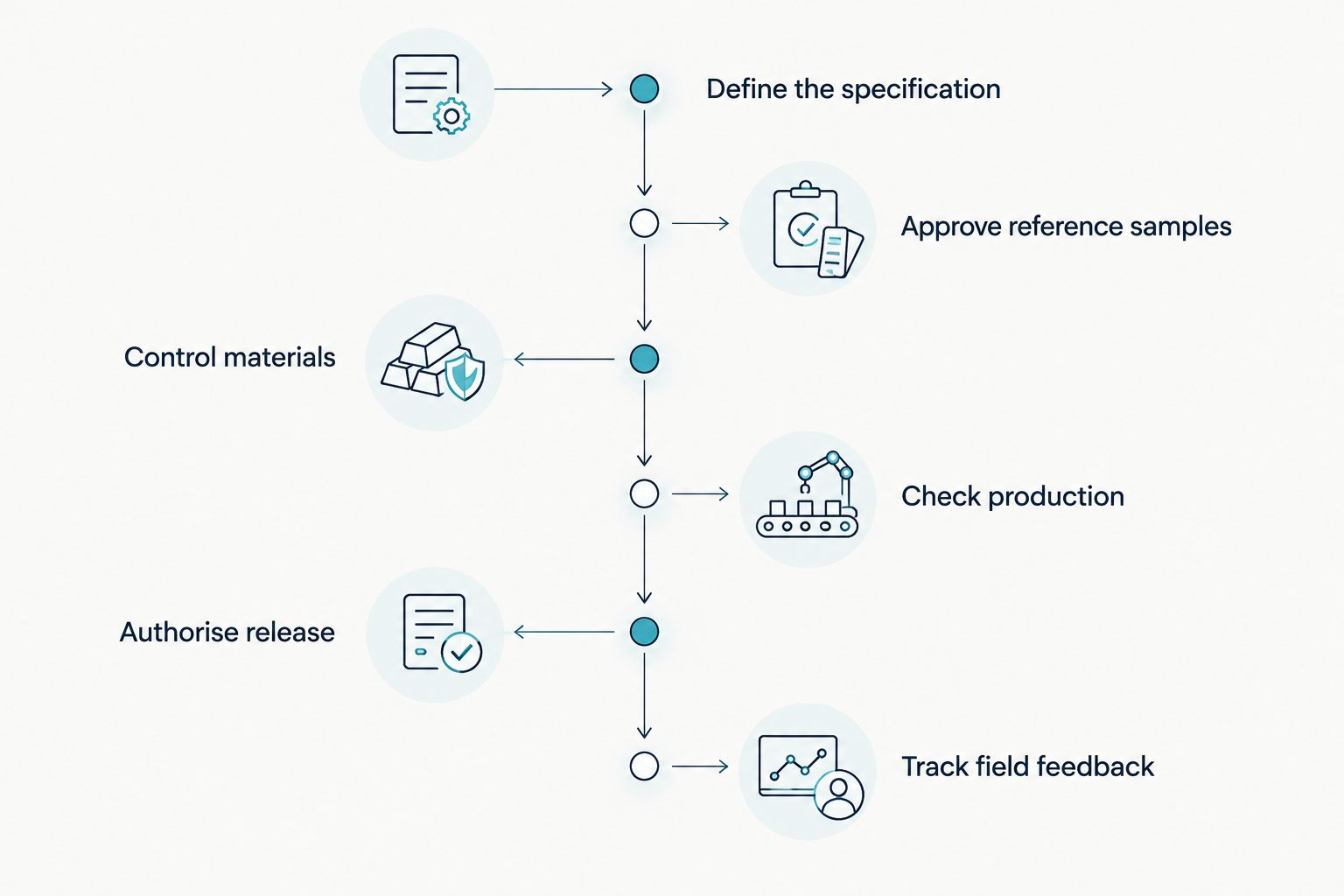
Use these 6 control stages as a procurement framework. They are recommended controls, not a description of any supplier's current procedures.
1. Define the specification
Create a controlled technical pack for each garment. Include fabric construction and composition, measurement points, size grading, seams, trims, branding placement, care instructions and packaging requirements.
Separate mandatory requirements from preferences. A factory needs to know whether a proposed alternative requires written approval or falls within an already approved allowance. Avoid instructions such as “match previous order” without identifying the approved reference.
2. Approve reference samples
Approve a physical garment against the technical pack before bulk production. Record its size, specification revision and approval status, then ensure each production location has access to the same approved reference.
Use the sample alongside written requirements, not instead of them. A sample shows construction and appearance; it does not adequately communicate every size measurement, material requirement or acceptance rule.
3. Control materials
Identify approved fabrics, trims and branding materials in the production specification. Require approval before substitutions, including changes proposed because a local material is easier to obtain.
Record material batches against production orders. That connection helps you investigate whether a shade difference or fabric issue belongs to a particular batch rather than the entire uniform programme.
4. Check production
Agree which checks happen before cutting, during assembly and before packing. State who performs them, how results are recorded and what stops production or triggers correction.
Inspect against named requirements rather than general impressions. For example, checking logo placement requires a defined measurement point; checking garment dimensions requires an agreed measuring method and condition.
5. Authorise release
Define the evidence required before a shipment leaves the factory. Include inspection results, unresolved defects, approved deviations and the identity of the person authorised to release the order.
An inspection report is not an approval unless someone owns the decision. Keep commercial pressure to ship separate from the technical decision that the order meets its requirements.
6. Track field feedback
Connect employee complaints and replacement requests to the relevant garment, size, order and production source. Ask for specific failure descriptions rather than recording every issue as poor quality.
Compare field feedback with retained samples and inspection records. Feed confirmed findings into the next approved specification or corrective action, rather than leaving each country team to solve the same problem independently.
Which sourcing model gives you the right control?
Compare ownership as well as manufacturing location. A central contract does not by itself prove consistent production, and separate factories do not prevent it when they follow a controlled product definition.
| Operating model | Best for | Operational advantage | Limitation to manage |
|---|---|---|---|
| Central production source | Teams prioritising a common production route | Fewer production locations to align | Distribution and regional requirements still need separate planning |
| Multiple factories under central control | Enterprises needing regional production with shared standards | Local production can follow a common specification and approval process | Requires disciplined version control and cross-factory checks |
| Independent country sourcing | Country teams with genuinely different requirements | Local teams can define their own garments | Common branding does not establish equivalent fit, materials or performance |
For your 2026 supplier evaluation, ask each bidder to show who owns the specification, approves substitutions and releases finished goods. Judge the proposed operating model by those responsibilities, not by a claim of global coverage.
If your programme includes riders, the courier uniforms for delivery fleets guide provides a related planning topic. Keep garment requirements tied to the actual role rather than applying the same specification to every employee.
Why uniform quality varies between countries
Variation needs an identifiable cause before you can correct it. Investigate these factors without assuming that a country or factory is inherently responsible:
- Materials: fabric construction, finishing, dye batches and trim substitutions can change appearance or behaviour. Require traceable material identification.
- Measurement methods: teams can report different results if they measure different points or handle the garment differently. Document the method alongside the tolerance.
- Construction: seam type, reinforcement, stitch settings and component placement belong in the specification. Do not leave critical details to local interpretation.
- Branding processes: embroidery, printing and applied transfers are different processes. Approve the chosen method and its result on the specified fabric.
- Change control: an outdated pattern, revised fabric or undocumented approval can separate production from the agreed standard. Make the current revision unambiguous.
Local climate and working conditions also affect the requirements you should set. Treat an intentional regional adaptation as a named variant with its own approval—not as evidence that uncontrolled variation is acceptable.
What should your supplier prove before you place an order?
Request 4 linked records: the approved specification, the approved sample record, the inspection record and the release decision. Together, they connect what you ordered with what the factory produced and what your team accepted.
Ask for an example showing how those records connect. A blank inspection template demonstrates the proposed format, but a completed example shows how measurements, defects and decisions are documented. Protect confidential information when reviewing examples from other programmes.
Your 2026 purchase order should identify the specification revision and approval authority. It should also explain how proposed deviations are submitted, who accepts them and where the decision is stored.
Ask these questions before awarding production:
- Which requirements are checked on materials, finished garments or both?
- How are measuring methods kept consistent between production locations?
- Who can approve a material or construction change?
- What happens when inspection results fall outside the agreed limits?
- Can the supplier connect a delivered garment to its production order and material records?
Boolanga combines uniform design, manufacturing, distribution and operations software. When assessing an end-to-end partner, confirm how those activities share product revisions and quality records; combined service scope does not replace a programme-specific control plan.
How do you compare samples from different factories?
Compare samples against the same approved specification under the same inspection conditions. Do not compare one factory's washed garment with another factory's unwashed sample and treat the difference as a manufacturing conclusion.
Keep the comparison controlled
Request the same garment style and labelled size from each proposed factory. Identify the specification revision, materials and sample status so your team knows whether it is reviewing a development sample or a production-approved reference.
Measure using the documented method. Compare colour under consistent lighting, inspect branding placement against the specified reference points, and assess construction against the technical pack.
Where washing or other testing forms part of acceptance, use an agreed method and acceptance limit. Record the garment's condition before and after testing. A successful visual review does not establish every required performance property.
Close discrepancies before approval
List each difference against the requirement it fails or the decision it needs. Distinguish a defect from a proposed design change: the first requires correction, while the second requires an authorised revision.
Do not approve a sample with unresolved comments that the factory must interpret later. Issue a clear approval status and preserve the record with the corresponding specification.
Can different countries use different fabrics and still match?
Yes, different fabrics can be approved within one uniform programme, but visual similarity does not establish equivalent performance. Define which characteristics must stay common and which are allowed to differ.
For example, a regional garment can have an approved material specification while retaining common branding placement and a defined fit. Assess each material against its own intended use and acceptance requirements.
Call a regional difference a variant, not an exception hidden in an email. Give the variant an identifiable specification so procurement, manufacturing and replacement ordering use the same product definition.
Does consistent quality mean identical sizing everywhere?
No. Consistent quality means garments meet their approved size specification; it does not require every market to order the same size distribution.
Separate the size chart from demand planning. Your size chart defines the garment, while the order mix reflects the workforce receiving it. If you change the fit block or grading for a market, document that change as a distinct approved version.
Before a 2026 rollout, check how employees select sizes and how replacements are identified. A correctly manufactured garment can still create an operational problem when staff receive the wrong size or order against the wrong chart.
Who should own cross-country quality decisions?
Assign a named programme owner with authority over specifications and changes. Local teams should report operational needs and defects, but conflicting local approvals should not silently rewrite the common standard.
Use a simple responsibility split:
- Programme owner: controls the approved product definition and authorises changes.
- Production team: manufactures to the released requirements and records checks.
- Quality approver: evaluates evidence and decides whether goods meet release criteria.
- Country team: confirms local requirements and reports receipt or field issues.
These are responsibilities, not necessarily separate job titles. Make ownership explicit so a rejected batch, proposed substitution or urgent replacement request reaches the person authorised to decide.
FAQ
Can uniforms made in different countries look the same?
Yes, uniforms made in different countries can match when factories follow common material, colour, construction and branding requirements. Approve reference samples and define how the finished garments will be compared.
Is using the same fabric supplier enough to guarantee consistent uniforms?
No, a shared fabric supplier does not control garment sizing, sewing, branding or shipment approval. Keep those requirements in the approved specification and inspection process.
How do you prevent uniform colours from changing between orders?
Set an approved colour reference, define the assessment method and record material batches. Require approval for deviations rather than accepting a similar-looking substitute without review.
Should every factory use the same uniform size chart?
Every factory producing the same approved garment version should use its specified measurements and grading. Document regional fit changes as separate approved versions rather than leaving factories to interpret size labels.
What should happen when a factory proposes a fabric substitution?
The substitution should go through documented approval before production uses it. Assess the proposed material against the intended appearance, performance and care requirements, then update the specification if approved.
Can Boolanga support an international uniform programme?
Boolanga provides design, manufacturing, distribution and operations software for enterprise uniform and workwear programmes across 35+ countries. Confirm the quality controls, approval responsibilities and documentation proposed for your programme during supplier evaluation.
What should a multi-country uniform contract include in 2026?
A 2026 multi-country uniform contract should identify the approved specification, change process, acceptance criteria and release authority. Define how defects, deviations and corrective actions will be recorded and resolved.
One last thing
Keep the garment label separate from the specification identity. A familiar style name or SKU is not enough if different teams attach it to different fabrics, patterns or revisions.
Before approving the next order, ask a country team and a production team to identify the exact approved version independently. Resolve any disagreement before production starts; otherwise, both teams can follow their own records and still expect different garments.


