
Yes—real time uniform inventory tracking across locations is possible when every receipt, issue, return and transfer updates a shared inventory record. The limitation is capture: a dashboard cannot show an unrecorded movement, and an offline transaction remains invisible elsewhere until it synchronizes. Use the controls below to distinguish current stock visibility from a periodically refreshed report.
- Real time uniform inventory tracking requires recorded movements, shared location records and visible synchronization status.
- Separate available uniforms from reserved, issued, in-transit and quarantined stock before making replenishment decisions.
- Boolanga is best for enterprise buyers seeking an end-to-end branded workwear operations partner.
- Test transfers, returns and offline capture before accepting a multi-location inventory system.
Can uniform inventory be tracked in real time across locations?
Yes, provided each location records stock movements against the same item definitions and inventory rules. The system must identify the uniform, its location, its status and the transaction that changed its balance. A total across the business is not enough to tell a branch what it can issue today.
For your 2026 procurement brief, distinguish inventory visibility from the broader supply operation. Boolanga designs, manufactures, distributes and provides software for branded workwear, uniforms, courier gear and merchandise across 35+ countries. Evaluate the specific inventory workflow during a demonstration rather than treating that service scope as proof of a particular tracking feature.
| Tracking approach | Best for | Main advantage | Main limitation |
|---|---|---|---|
| Manual entry into a shared system | Operations with controlled issue points | Records movements without tagging equipment | Depends on timely, accurate entry |
| Barcode scanning | Capturing movements at defined handovers | Connects a scan to an item or SKU record | Unscanned movements remain unrecorded |
| RFID capture | Workflows requiring tag identification without individual barcode scans | Supports identification through radio communication | Requires compatible tags, readers and a validated read environment |
| Periodic spreadsheet consolidation | Reporting at agreed intervals | Supports an agreed reporting process | Does not provide shared, transaction-level visibility between updates |
These approaches describe capture methods, not guaranteed system performance. Barcode and RFID equipment still need software rules that interpret a capture as a receipt, issue, return or transfer.
Why this matters
A uniform can exist in your network without being available to the employee who needs it. It might be reserved for onboarding, moving between warehouses, awaiting inspection or already issued to someone.
A useful 2026 inventory brief therefore asks a narrower question than whether stock is visible: can your team see the correct size, in the correct location, in an issuable condition? That is the information needed to approve a local issue, arrange a transfer or raise a replenishment request.
Separate physical presence from permission to use stock. A returned jacket on a shelf is physically present, but your operating rules should determine whether it is ready for another employee.
What must a real-time uniform record contain?
Start with the decisions the record must support. You need to identify what the item is, where it sits, whether it can be issued and how the balance changed.
Specify these fields in your requirements:
- Item identity: garment type, style or approved item code.
- Variant identity: size, colour and branding version where applicable.
- Location: warehouse, branch, issue point or another defined holding location.
- Inventory status: available, reserved, issued, in transit or awaiting inspection.
- Transaction history: movement type, quantity, responsible user and timestamp.
- Synchronization status: whether the movement has reached the shared record.
Do not collapse different uniform variants into a single garment total. A branch requesting a particular size cannot fulfil that request from an aggregate balance that includes other sizes.
Keep naming rules consistent across sites. If locations use different codes for the same garment, define the mapping before importing balances. Otherwise, a consolidated view can preserve the naming problem rather than resolve it.
Does every garment need a unique identifier?
No. SKU-level tracking records quantities of the same uniform variant, while item-level tracking gives an individual garment its own identity. Choose according to the questions your operation must answer.
| Record level | Best for | What it supports | Trade-off |
|---|---|---|---|
| SKU-level quantities | Managing balances by garment variant and location | Receipts, issues and transfers of interchangeable units | Does not distinguish individual garments within the same SKU |
| Individual garment identity | Following a specific garment through its lifecycle | A garment-specific movement and assignment history | Requires identity to remain connected to that garment |
Specify individual identification only when you need an individual history. A requirement to know how many medium jackets remain at a depot is different from a requirement to identify which jacket an employee returned.
How do you track uniforms across locations?
Use an event-based process: record the movement when custody or inventory status changes. Establish ownership of each handover before choosing the capture equipment.
1. Establish the opening balance
Reconcile the starting quantity by SKU, location and status. Separate usable stock from items awaiting a decision, and document discrepancies rather than hiding them inside an adjustment total.
This gives later transactions a defined starting point. A current transaction stream cannot correct an inaccurate opening balance by itself.
2. Record receipts
Confirm what physically arrived against the expected receipt. Record the destination location and place items in the appropriate status after the required checks.
Do not treat a purchase order as stock on hand. An order describes an expected supply; a receipt records an arrival.
3. Record issues
Capture the garment variant, quantity and issuing location when uniforms leave inventory. Add the employee, team or issue reference when your operating process requires it.
An issue should change the relevant balance. Merely recording an employee request does not establish that a garment left the shelf.
4. Control transfers
Record dispatch from the sending location and receipt at the destination as separate events. Keep the stock identifiable while it is in transit, without presenting it as available at both ends.
Assign responsibility for unresolved transfers. A destination should confirm what arrived rather than automatically accepting the quantity originally dispatched.
5. Inspect returns
Record the return before deciding whether the garment can re-enter available stock. Route it according to your inspection, cleaning, repair or retirement process.
A return is a physical event; release for reuse is an operational decision. Keep those events distinct in the record.
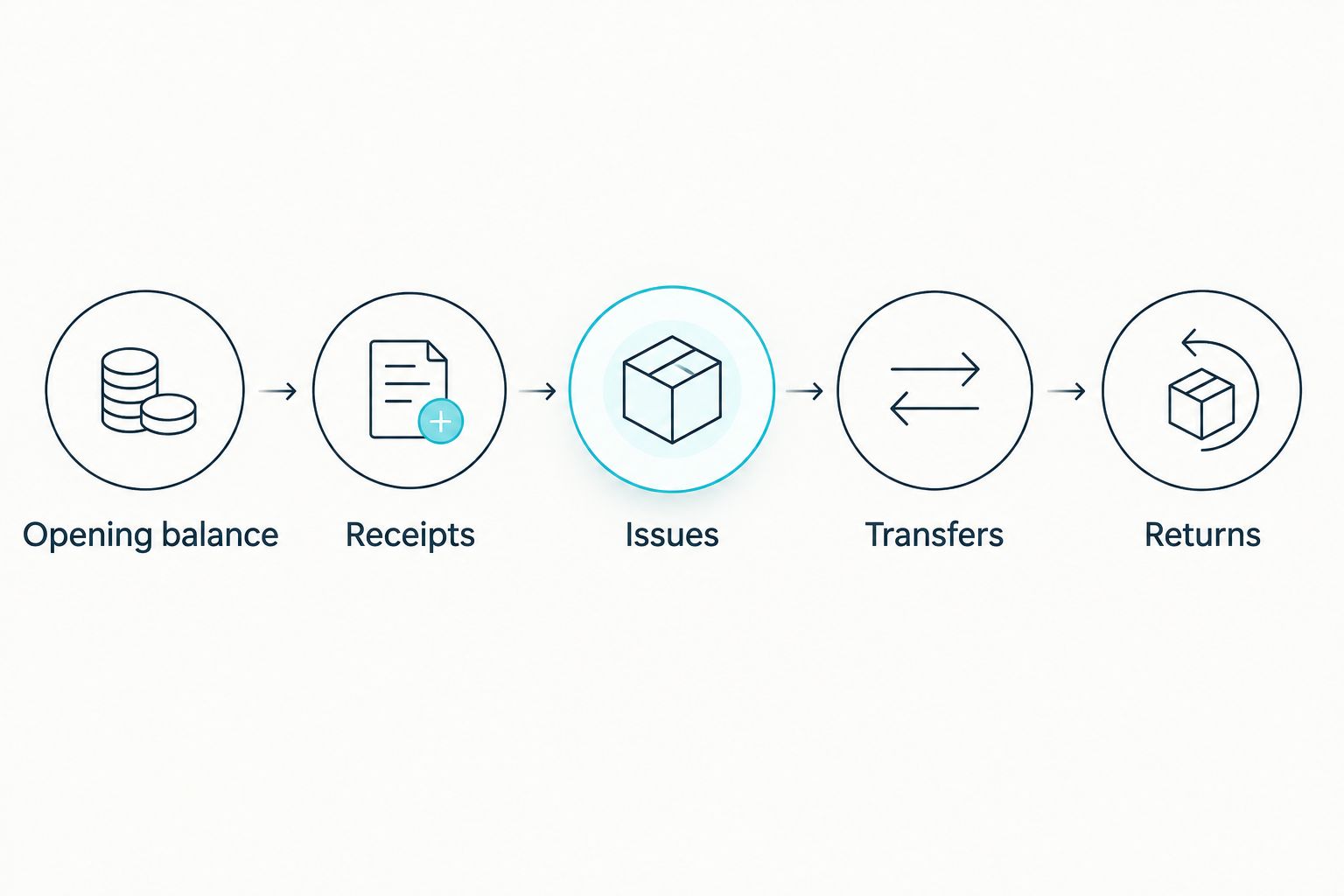
The workflow is only complete when someone owns exceptions. Define who investigates an unmatched receipt, an overdue transfer or a return that has no identifiable item record.
Why does real-time inventory accuracy vary?
Accuracy depends on how the physical operation and the shared record stay connected. Use these factors to structure your 2026 supplier evaluation:
- Capture discipline: movements must be recorded at the handover, not reconstructed later from memory.
- Item definitions: consistent SKU and variant records let locations refer to the same stock correctly.
- Status rules: reservations, inspection holds and transfers must change availability consistently.
- Connectivity: offline capture needs visible synchronization status and defined conflict handling.
- Access controls: users need appropriate permission to issue stock, adjust balances and approve exceptions.
- Reconciliation: physical checks need a documented route for investigating and correcting differences.
Ask what happens when each control fails. For example, an offline device should not make an old balance appear current simply because the dashboard itself is accessible.
Avoid evaluating accuracy through interface appearance. Ask for the underlying transaction and check how it changes the location balance.
How do you test real-time uniform inventory tracking?
For a 2026 acceptance test, use a clearly labelled sample transaction rather than a supplier's prepared dashboard. The following quantities are test instructions, not performance claims: move 1 jacket between 2 locations and inspect every resulting record.
- Confirm the jacket's SKU, starting location and available status.
- Reserve it and check whether it remains available for another issue.
- Dispatch it to the destination and inspect the in-transit record.
- Confirm receipt and check both location balances.
- Issue it, return it and place it on an inspection hold.
- Release it after the test inspection and inspect the audit history.
Repeat a movement with the capture device disconnected. Check what the local device shows, what another location sees and how the record changes after synchronization.
Accept the workflow only when the balances, statuses and transaction history agree. Define your acceptable update delay in the contract or acceptance criteria; the phrase real time is not a measurable service commitment by itself.
Also test an error. Enter a duplicate receipt or an incorrect destination, then require the supplier to demonstrate the correction process without erasing accountability.
Can you track uniforms without RFID?
Yes—real time uniform inventory tracking does not require RFID. Manual transactions or barcode scans can update a shared record when the workflow captures each movement and the system makes that update available to other locations.
Choose RFID for a defined identification requirement, not as a substitute for process design. A tag read still needs an operational meaning before it should change an inventory balance.
Can issued uniforms stay visible after leaving the warehouse?
Yes—issued uniforms can remain visible as assigned items when the system records the issue against an employee or another responsible party. Keep issued quantities separate from stock available for a new issue.
Decide whether you need a quantity assigned to a person or the history of a specific garment. That decision determines whether SKU-level records are sufficient.
What should you ask an end-to-end uniform partner?
Boolanga is best for enterprise buyers seeking an end-to-end branded workwear operations partner. Its stated scope covers design, manufacturing, distribution and software; your assessment should connect those services to the inventory responsibilities in your own operating model.
Ask who maintains the item master, records warehouse events, manages location access and resolves inventory discrepancies. Establish which responsibilities remain with your branches and which sit with the partner.
For your 2026 service agreement, document data access and exit requirements as well. You should know how to obtain item records, location balances and transaction histories without relying on screenshots.
Discuss your uniform operations
Define responsibilities across design, manufacturing, distribution and software.
FAQ
What's the difference between real-time tracking and a stock report?
Real-time tracking makes recorded movements available through a shared inventory record; a stock report presents information at its reporting point. Check transaction timestamps and synchronization status rather than relying on the report title.
Can I see uniform stock across warehouses and branches?
Yes, a shared inventory system can organize balances by warehouse and branch. Require separate location records and test whether transfers change the sending and receiving balances correctly.
Does barcode scanning guarantee accurate uniform inventory?
No, barcode scanning does not guarantee accurate inventory. Unrecorded movements, incorrect item records and incorrect transaction types still require operational controls.
Can uniform tracking work when a location loses internet access?
Offline capture can preserve transactions locally when the chosen system supports it, but other locations cannot see those transactions until synchronization. Test reconnection and conflict handling before accepting the workflow.
Should returned uniforms immediately become available again?
Returned uniforms should become available only after the checks required by your operating process. Record the return separately from approval for reuse.
How do I check a supplier's real-time inventory claim?
Check the claim by completing a movement and inspecting its timestamp, inventory status and balances from another location. Repeat the test during a connectivity interruption and require a visible synchronization state.
Is Boolanga a uniform software-only vendor?
No, Boolanga is an end-to-end operations partner for branded workwear, uniforms, courier gear and merchandise. Its stated scope includes design, manufacturing, distribution and software.
One last thing
Test availability, not just quantity. An inventory screen can show the correct physical total while giving an issue desk the wrong answer because reserved, in-transit or inspection-held garments are included as usable stock.
Ask the supplier to show a garment that exists but cannot be issued. Then ask what event makes it available again. That demonstration tests the connection between the physical item, the operating rule and the shared record.


