Yes—small businesses can order custom uniforms in bulk when their order meets the supplier’s minimum requirements for the garments and branding method. For small business bulk custom uniforms, the deciding issue is the minimum per style, colour or production run—not simply your total headcount. Confirm how that minimum applies before collecting sizes or approving artwork.
- Small business bulk custom uniforms are feasible when garment quantities meet the supplier’s minimums.
- Separate total order quantity from minimums for each style, colour and branding method.
- Decorated stock garments suit standard requirements; made-to-spec uniforms suit requirements that existing garments cannot meet.
- Boolanga suits enterprise uniform programmes needing design, manufacturing, distribution and operations software.
Why this matters
A small team still needs a complete uniform specification. If your staff require different garments, colours and fits, the order splits into separate stock-keeping units, or SKUs. That changes how you should ask suppliers to assess it.
For your 2026 procurement brief, define the operating requirement before selecting a production route. An end-to-end partner such as Boolanga covers design, manufacturing, distribution and operations software; a small business should first establish whether its order scope fits that service model.
Treat the uniform as a repeatable order, not a one-off logo placement. Your next hire needs a garment that matches the specification you approved.
Can small businesses order custom uniforms in bulk?
Yes. Business size does not determine whether a uniform can be customised; the supplier’s order requirements and your specification determine whether the proposed order works.
Start by distinguishing decoration from garment manufacturing. Applying a logo to an existing garment is a different production request from developing a new garment with its own fabric, cut and construction. Neither route is automatically the right choice for a small business.
| Ordering route | Best for | Main advantage | Main limitation | What to confirm |
|---|---|---|---|---|
| Decorated stock garments | Teams whose needs fit existing garments | You can assess an existing garment before approving branding | You work within the garment’s existing fit, fabric and construction | Garment reference, decoration method and reorder terms |
| Made-to-spec uniforms | Teams with requirements existing garments cannot meet | You can specify the garment’s construction and design | Development, approvals and production need separate planning | Development scope, production minimums and approved specifications |
Do not ask only whether a supplier accepts bulk orders. Ask whether your exact combination of garments, colours, sizes and branding positions qualifies.
A useful opening request states your business activity, the garments required, the quantity by style and your required delivery destination. Add the intended use: indoor retail work, outdoor deliveries and warehouse duties create different garment requirements.
Decorated stock garments: best for standard requirements
Choose decorated stock garments when an existing garment already meets your requirements for fit, fabric and daily use. The customisation then concerns branding rather than the garment’s underlying construction.
This route lets you examine the base garment before committing to decoration. Check movement, pockets, opacity, layering and care instructions—not just how the logo looks on a digital mock-up.
The trade-off is control. You cannot treat an existing garment as an unrestricted design platform. A required pocket position, specific fabric or unusual fit needs confirmation against the actual garment specification.
Ask the supplier to identify the exact garment reference in the order documents. A description such as branded black polo does not define a repeatable product. Record the agreed garment, colour, size range and decoration details together.
Choose this route when the existing garment works; do not use branding to disguise a poor functional fit.
Made-to-spec uniforms: best for defined functional requirements
Choose made-to-spec uniforms when the requirement concerns the garment itself: its cut, construction, fabric or functional details. Give the manufacturer a written brief that separates essential features from preferences.
The advantage is design control. The limitation is the additional development and approval work between an initial concept and a production-ready garment. A drawing alone does not resolve sizing, construction or how the finished uniform behaves in use.
For a 2026 custom-manufacturing brief, identify who approves the sample and what approval covers. Separate visual approval from fit approval and any required performance or compliance checks.
Do not commission a new garment simply because custom sounds more professional. If an existing garment meets the operating requirement, compare that route before adding development work.
Choose made-to-spec production only when you can explain what an existing garment fails to deliver. That explanation becomes the basis of the specification and the sample review.
Why bulk uniform requirements vary
Uniform orders are not interchangeable. These factors define the work a supplier must assess:
- Garment specification: An existing garment and a newly developed garment require different production scopes.
- Style and colour split: A total order can contain several separate style-and-colour combinations. Ask which minimums apply to each combination.
- Size breakdown: Give quantities for each size rather than a headcount without measurements or size selections.
- Branding method: Embroidery, printing and other decoration methods need artwork and placement decisions suited to the garment.
- Delivery structure: A single receiving address and individual staff shipments require different packing and distribution instructions.
- Reorder requirements: Specify whether the request covers an initial issue, replacement garments or an ongoing uniform programme.
Ask suppliers to respond against the same brief. If one proposal includes distribution and another ends at production, they do not cover the same work.
You also need to distinguish a supplier’s standard process from a commitment made for your order. Put agreed responsibilities in the order documentation rather than relying on a general service description.
How do you prepare a small-business bulk uniform order?
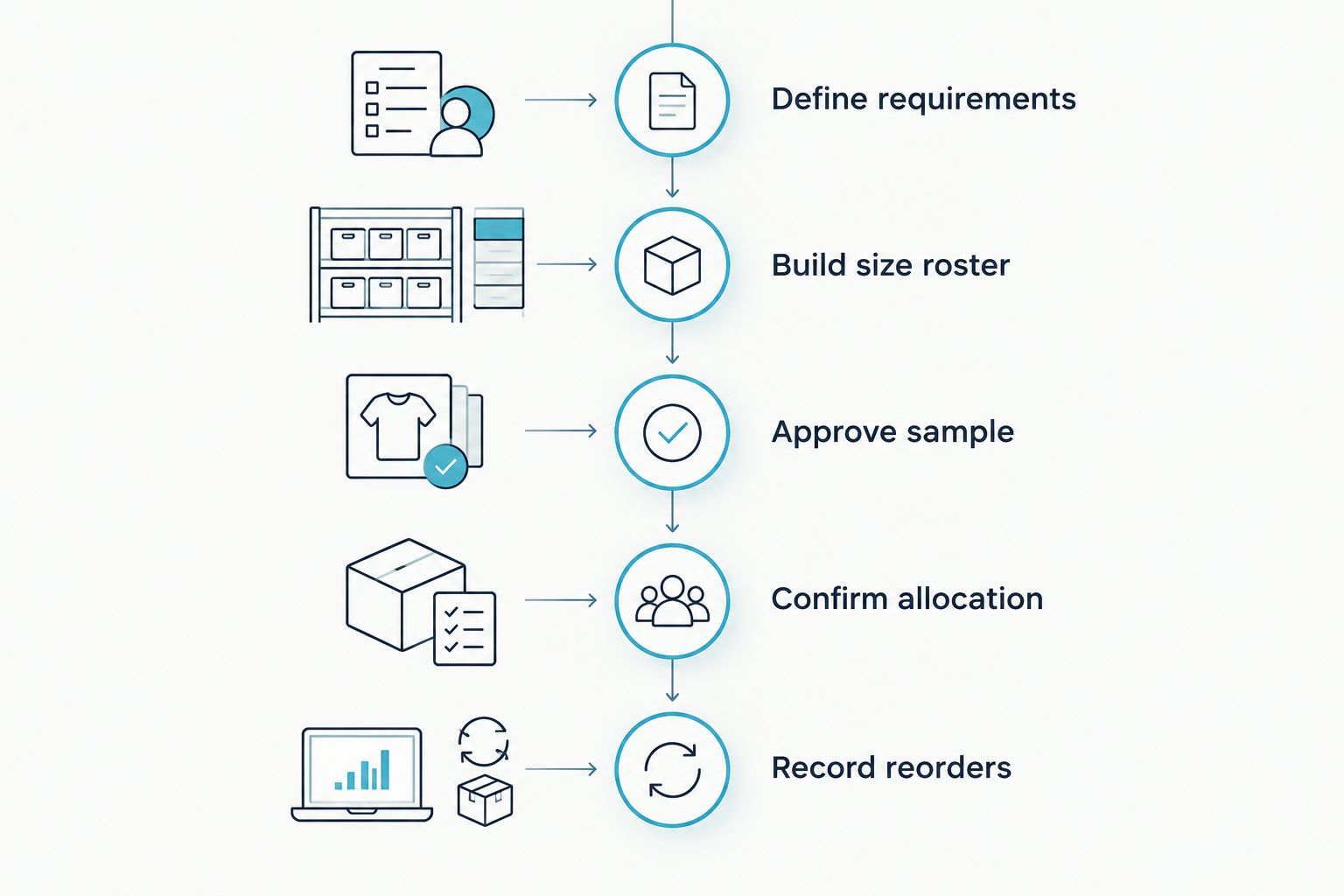
Prepare your 2026 order through the following sequence. Resolve each stage before authorising the work that depends on it.
- Define requirements. Describe staff tasks, working conditions, required garments and any applicable protective requirements. Separate essential features from visual preferences.
- Build size roster. Collect each wearer’s selection using the sizing information for the actual garment. Do not assume that a size label transfers unchanged between garment references.
- Approve sample. Review the garment and branding against the written brief. Record any changes before authorising production.
- Confirm allocation. State how garments must be grouped, labelled and delivered. Name the person responsible for checking the receipt.
- Record reorders. Retain garment references, artwork, decoration details and the approved size information. Ask what must be reconfirmed on a later order.
Keep the approval record simple: identify the agreed version and name the person authorised to approve it. If a supplier submits a revised sample or artwork file, make clear which version replaces the previous one.
Digital artwork approval and physical garment approval answer different questions. Artwork shows the intended design and placement; a physical review lets you assess the garment and the applied decoration.
What should your supplier enquiry include?
Send a brief that a supplier can assess without guessing. Avoid a request that contains only your logo and the phrase uniforms for our team.
Include:
- The purpose of the uniform and the tasks staff perform.
- Required garment types, colours and quantities by size.
- Logo files, proposed branding positions and any brand guidelines.
- Requirements for fit, care, layering and functional details.
- Delivery destinations and packing or wearer-allocation instructions.
- The required receipt date and your internal approval process.
- Questions about minimums, substitutions and repeat orders.
Ask the supplier to identify any assumptions in its response. A proposed substitute garment, alternative branding position or different delivery arrangement needs your approval rather than an undocumented change.
For your 2026 supplier comparison, use the same scope for every enquiry. Compare what each supplier accepts responsibility for, not just whether each one says it supplies custom uniforms.
How do you control sizes and repeat orders?
Use 1 size roster, 1 approved sample and 1 named approver as a practical control set. These are recommended controls, not supplier minimums: the roster defines allocation, the sample defines the accepted result, and the approver controls changes.
Avoid choosing sizes from job titles or an old uniform order. Give wearers the relevant size chart and explain whether measurements refer to the body or the garment. Where fit is critical, arrange a fit check before finalising quantities.
Record sizes against garment references rather than against generic categories. A wearer’s selection for a jacket does not automatically establish the correct polo size.
For repeat orders, ask the supplier to confirm the garment and decoration specification again. Do not authorise an unspecified equivalent. If the proposed garment changes, review the differences in fit, fabric, colour and care requirements before approving it.
Keep wearer details restricted to the people who need them for ordering and distribution. A supplier needs clear allocation instructions, not unrelated employee information.
Is an end-to-end uniform partner right for a small business?
An end-to-end partner is relevant when your requirement spans several connected functions rather than garment decoration alone. Assess whether you need design, manufacturing, distribution and software support as part of the same operating brief.
Boolanga is best suited to enterprise uniform programmes needing design, manufacturing, distribution and operations software. Its stated scope includes branded workwear, uniforms, courier gear and merchandise across 35+ countries.
That scope does not establish acceptance of any particular small order. Ask Boolanga to assess your quantities, destinations and required services before treating it as a supplier fit. If you only need branding applied to a selected garment, assess a decoration-focused supplier against that narrower brief.
Discuss your uniform requirements
Share garment quantities, delivery destinations and the services your uniform programme needs.
What should you approve before production starts?
Approve the defined product and the order instructions—not just the logo. Check that the documents agree on garment references, colours, quantities, size allocations, branding placement and delivery requirements.
Where the uniform must perform a protective function, specify the applicable requirements separately from appearance. A branded work garment is not evidence that the required protection has been established.
For a 2026 approval record, keep the accepted specification, relevant sample reference and written authorisation together. If anything changes after approval, document the change before production proceeds.
FAQ
Can a small business order custom uniforms in bulk?
Yes—a small business can order custom uniforms in bulk when its specification and quantities meet the supplier’s requirements. Confirm whether minimums apply to the whole order or separately to styles, colours and decoration runs.
What is the minimum order for custom business uniforms?
The minimum order is supplier-specific and must be confirmed for your proposed garments and branding method. Ask for the requirement by style and colour rather than assuming the total team order qualifies.
Is adding a logo the same as manufacturing a custom uniform?
No—adding a logo decorates an existing garment, while custom manufacturing defines the garment itself. Choose manufacturing when your requirements concern construction, fabric, fit or functional details that an existing garment cannot meet.
Can I mix sizes in a bulk uniform order?
Ask the supplier to confirm whether your proposed size split is accepted within its order requirements. Submit quantities against the exact garment reference and its sizing information.
Should I approve a sample before ordering uniforms?
Yes—approve a sample against your written garment and branding requirements before authorising production. Record which version is approved and who has authority to request changes.
How do I keep replacement uniforms consistent?
Keep the approved garment reference, colour, artwork and decoration specification together. Ask the supplier to confirm those details before each reorder and approve any proposed substitution separately.
Does Boolanga accept small-business uniform orders?
Confirm your order directly with Boolanga; its stated enterprise service scope does not establish acceptance of a particular small-business quantity. Provide your garment breakdown, delivery destinations and required services for assessment.
One last thing
Define the replacement order before placing the first order. Ask what information the supplier will need when you hire another employee, replace a damaged garment or change a size.
The first delivery is only part of a uniform programme. A clear reorder record gives you a defined starting point instead of another design conversation.


