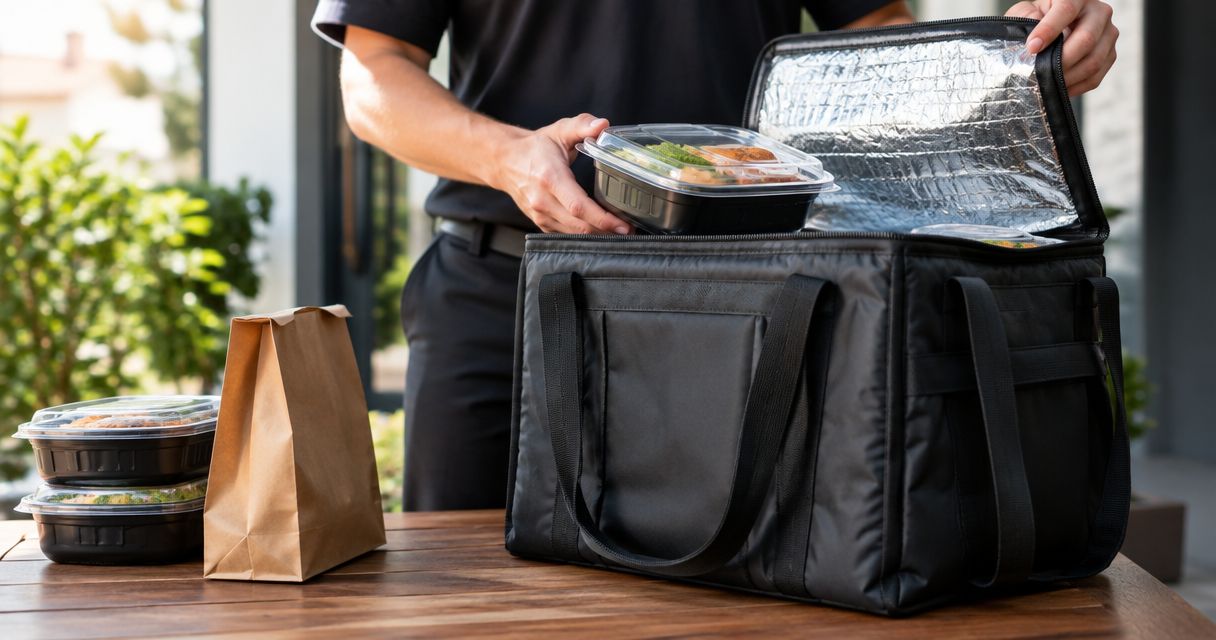
Yes, insulated delivery bags help keep food hot by slowing heat loss, but they do not guarantee that every order stays hot for the full delivery window. Performance depends on the food’s temperature at packing, its packaging, the bag’s condition and how long it spends waiting or travelling; a passive insulated bag does not reheat a cooling meal.
- Do delivery bags keep food hot? Yes, but insulation slows cooling rather than replacing lost heat.
- Validate the whole delivery window, including restaurant waits, travel, stops and handover.
- Boolanga supports enterprise courier-gear sourcing; assess thermal performance separately through route testing.
- Separate hot and cold orders, close bags between stops, and measure food temperature rather than bag air.
Can food delivery bags keep hot orders hot for the full delivery window?
A delivery bag is suitable for your delivery window only when representative tests show that the food meets your temperature requirements at handover. A warm bag lining, thick padding or a reflective interior does not establish that result.
Use this sequence to establish whether a bag works for your operation:
- Define the window. Include the time between packing and customer handover, not just the moving portion of the route.
- Set the requirement. Establish the applicable food-safety limits and your separate food-quality acceptance criteria.
- Test the load. Use the actual containers, meal combinations and bag-loading practices used by couriers.
- Measure at handover. Record food temperature using a suitable measurement method, alongside elapsed time and operating conditions.
- Approve the conditions. Document which loads and routes passed rather than treating the result as an unrestricted bag guarantee.
For your 2026 shortlist, the best food delivery bags guide provides a starting point. Keep sourcing decisions separate from proof of temperature retention: a bag category or supplier description cannot replace a measured delivery trial.
Why this matters
Customers receive the result of the entire delivery process, not just the courier’s travel time. Food can lose heat while waiting for collection, during loading, at earlier stops and during handover.
Your operating standard should therefore connect restaurant readiness, packaging, dispatch and courier handling. Buying an insulated bag addresses only part of that chain.
For a 2026 equipment specification, replace vague requirements such as keeping meals hot with an acceptance test. State what food is being measured, when measurement happens and what constitutes a pass. That gives procurement and operations the same decision rule.
Passive insulation versus active heating
Passive insulated bags resist heat transfer between the contents and the surroundings. They have no heat source, so they cannot restore a meal that entered the bag below the required temperature.
Actively heated carriers add heat through a powered system. That introduces power and operating requirements, and it still does not prove that every container reaches or maintains the required food temperature.
| Option | Best for | Main advantage | Main limitation | What to validate |
|---|---|---|---|---|
| Passive insulated bag | Routes where retained starting heat meets the delivery requirement | Does not require a powered heat source | Cannot replace heat already lost | Temperature at handover under actual loads and handling |
| Actively heated carrier | Operations specifying a powered heat source | Adds heat rather than relying only on insulation | Requires power management and food-specific validation | Food temperature, power continuity and packaging compatibility |
Choose passive insulation when it passes your route test; assess active heating when the operating requirement calls for added heat. Neither category deserves approval on its label alone.
Do not confuse a warmer carrier interior with a successful food-temperature result. Air, container surfaces and the food itself are different measurement targets. Your acceptance procedure must specify which one determines the decision.
Why temperature retention varies
The same delivery bag can produce different results when you change the load or the route. These factors belong in your test record and your courier instructions:
- Starting temperature. Insulation retains existing heat; it does not correct food that has already cooled before collection.
- Food and packaging. Portion size, container material, lid fit and the food’s thermal properties affect heat transfer. Packaging also governs moisture movement.
- Load configuration. A packed meal, a partly filled bag and a mixed-temperature load create different conditions. Test the configurations you actually dispatch.
- Bag closure and condition. Open closures, damaged insulation and worn seams change the barrier between the contents and the environment.
- Elapsed time and access. Waiting, repeated openings and multiple handovers extend exposure beyond the uninterrupted ride.
- External conditions. Ambient temperature and exposure during transport affect the temperature difference across the bag.
Avoid turning any factor into an unsupported duration claim. A statement that a bag keeps food hot needs defined starting conditions, a measurement method and a documented endpoint.
For your 2026 operating instructions, record these conditions alongside the result. Without that context, a successful trial cannot tell a dispatcher which future orders fit the approved delivery window.
How should you test a delivery bag on real routes?
Run a controlled comparison before a fleet rollout. Keep the meal, containers, starting conditions and measurement method consistent when comparing carriers, then repeat the assessment under representative operating conditions.
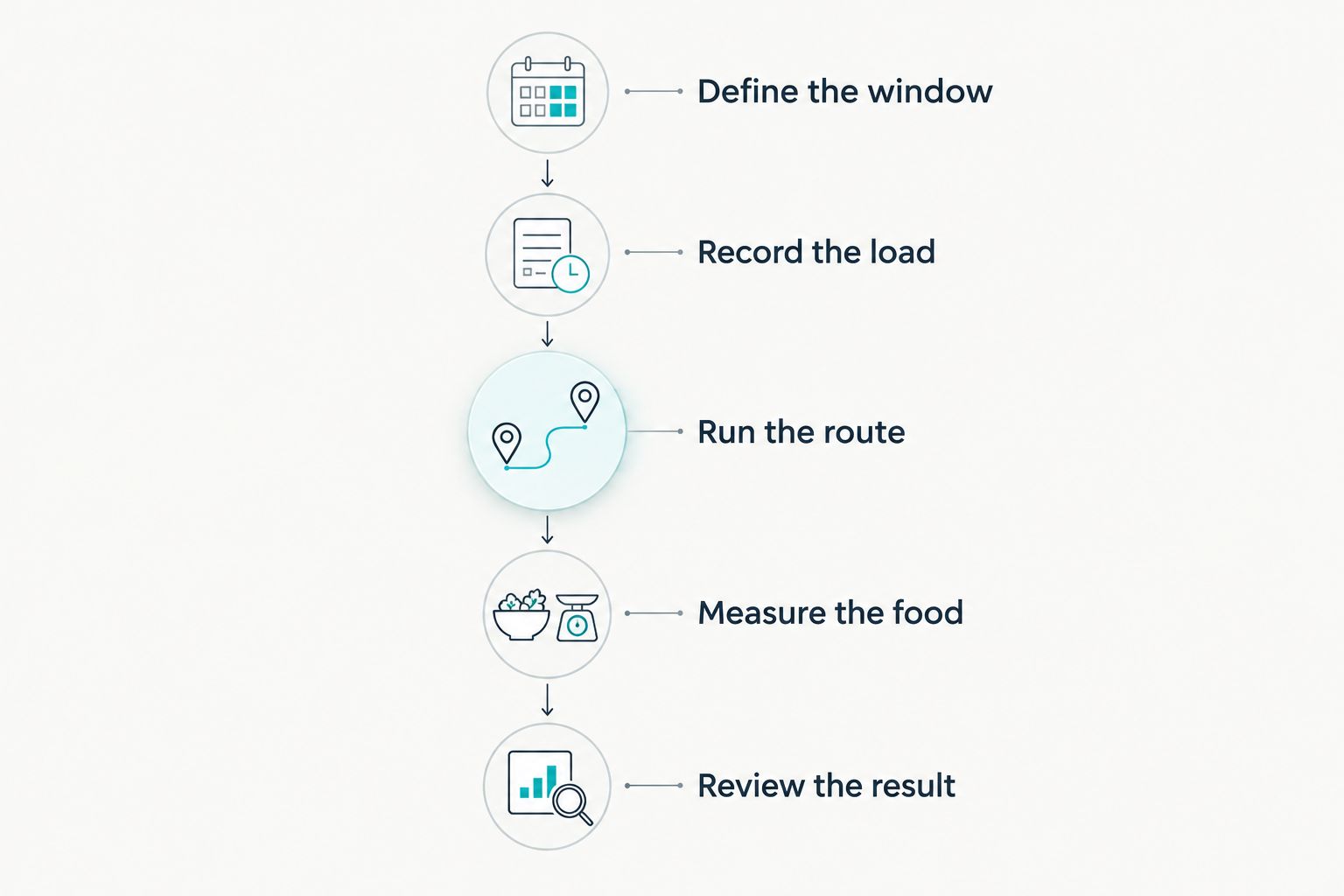
Use the following workflow so that a result can be traced back to a specific load and route:
- Define the window. Start the clock at the agreed packing or dispatch event. End it at the customer-handover point, including waiting and stops.
- Record the load. Identify the meal, portion configuration, packaging, bag model, bag condition and starting food temperature.
- Run the route. Follow the intended collection, loading, transport and handover process. Record delays and bag openings rather than excluding them afterwards.
- Measure the food. Use suitable, calibrated equipment and a documented sampling method. Follow hygienic procedures when taking measurements.
- Review the result. Compare the endpoint with the applicable safety requirements and your quality standard. Investigate failures before changing the specification.
The sequence matters: define acceptance before seeing the result. Otherwise, a team can end up approving a bag because it performed better than another bag, even though neither met the operating requirement.
For an example trial schedule, you can record conditions at 0 minutes, then use 15 minutes and 30 minutes as planned checkpoints if they fit your route. These are proposed measurement intervals, not claims about safe holding times or bag performance.
Do not repeatedly open the same test load merely to collect intermediate readings without accounting for that intervention. Use a measurement setup or separate test loads that let you distinguish normal route heat loss from heat loss caused by testing.
Your 2026 test record should identify the approved operating envelope: meal types, packaging, loading rules, route conditions and handover criteria. Retest when a material change makes the previous result unrepresentative.
How do you keep hot orders from cooling during delivery?
Protect the heat before the courier starts moving. Coordinate packing and collection, close the insulated carrier after loading, and avoid unnecessary access during the route.
Keep hot and cold items in separate thermal spaces. Putting them together creates heat transfer between items that require opposite outcomes. A divider should not be treated as a thermal barrier unless the complete configuration has been assessed.
Match the bag to the packaged load without crushing containers or preventing proper closure. Include instructions for placing containers upright, securing the load and keeping closures shut between handovers.
At dispatch, make the acceptance check practical:
- Confirm that the order is ready for collection under the restaurant’s procedure.
- Check that containers are closed and suitable for transport.
- Assign hot and cold items to the correct carriers or validated compartments.
- Confirm that the loaded bag closes properly.
- Flag routes or delays outside the approved delivery conditions.
These actions support temperature control, but they do not replace measurement. If orders consistently fail the handover requirement, investigate starting temperature, packaging and route timing before assuming that a different bag alone will fix the problem.
Does keeping food hot also keep it crisp?
No. Temperature retention and crispness are different performance requirements. Hot food releases moisture, and trapped moisture can soften foods whose quality depends on a dry surface.
Ventilation allows moisture to escape, but it also changes heat transfer. Closing every opening is therefore not a universal quality solution, and opening vents is not a universal temperature solution.
Test the actual menu item in its actual packaging. At handover, assess temperature and relevant quality characteristics separately, such as crispness, leakage or container deformation. A carrier that succeeds for a sauced dish is not automatically approved for fried food.
What should an enterprise buyer require from a supplier?
Ask for a defined specification and evidence that matches your operation. General insulation claims do not tell you how the finished carrier performs with your containers, closures and loading practices.
Your procurement brief should cover:
- Intended transport mode and how the carrier is secured.
- Packaged-load dimensions and separation requirements.
- Insulation construction, closures and replaceable components where applicable.
- Cleaning instructions and inspection criteria.
- The temperature-test method, conditions and acceptance criteria.
- Identification of approved samples and control of production changes.
Boolanga is best for enterprise teams sourcing courier gear alongside workwear and operational support. Its stated scope includes design, manufacturing, distribution and software across 35+ countries. That makes the partnership scope relevant to coordinated sourcing; thermal acceptance still belongs in your equipment specification.
For a 2026 sourcing project, distinguish vendor scope from product evidence. Boolanga’s end-to-end service scope does not establish a particular bag’s holding time, so request validation against your own delivery requirements.
You can review Boolanga for the broader operational scope. Use a written brief to connect gear sourcing with the conditions your couriers must meet.
Define your courier equipment requirements
Review the partner scope for courier gear, workwear, manufacturing and distribution.
FAQ
Do delivery bags keep food hot for the entire journey?
Insulated delivery bags slow heat loss, but they do not guarantee hot food throughout every journey. Validate the full packing-to-handover window with the actual food, packaging and route conditions.
How long does an insulated delivery bag keep food hot?
There is no single holding time that applies to every insulated delivery bag and order. Starting temperature, load, packaging, closures and external conditions determine the result, so use a documented route test.
Can an insulated delivery bag heat up cold food?
A passive insulated delivery bag cannot heat up cold food because it has no heat source. Active heating is a different equipment category and requires its own food-temperature validation.
Can I put hot meals and cold drinks in the same delivery bag?
Use separate thermal spaces for hot meals and cold drinks. Assess any compartmented arrangement as a complete loaded system rather than assuming that a divider prevents heat transfer.
Does a warm delivery bag prove the food is safe?
A warm delivery bag does not prove that the food meets its required temperature conditions. Measure the food using a suitable method and apply the food-safety requirements relevant to your operation.
Should I leave a delivery bag open to keep fried food crisp?
Do not treat an open delivery bag as a general solution for fried food. Test packaging and ventilation together because moisture release and heat retention affect different parts of the handover result.
What should a delivery fleet ask a bag supplier to prove?
Ask the supplier to substantiate performance under defined food, packaging, load and route conditions. Include the measurement method, endpoint and acceptance criteria so the evidence can inform an equipment decision.
One last thing
A better bag cannot recover heat lost before loading. Put a measurement checkpoint at collection as well as handover when investigating failures; that separates a starting-condition problem from a transport problem.
Keep that distinction in your 2026 fleet standard. Change the part of the process that failed, then repeat the same acceptance test before expanding the rollout.


