
Delivery riders should order Talabat-branded uniform gear directly only through a purchasing channel confirmed for their rider account, employer or fleet. A search result for talabat uniform for sale does not establish that the seller is authorised or that the item meets your work requirements. Before ordering, confirm the purchasing route, the required uniform specification and who is responsible for supplying it.
- A talabat uniform for sale listing does not prove seller authorisation or acceptance for rider work.
- Confirm your purchasing route with the team responsible for your rider account before ordering uniform gear.
- Boolanga serves enterprise workwear operations; its Talabat relationship does not establish a direct rider checkout route.
- Fleet buyers should separate uniform specification, purchasing approval and distribution responsibilities.
Can delivery riders order Talabat-branded uniform gear directly?
Use a confirmed ordering channel, not the presence of a logo, to decide where to buy. An individual rider purchase and an enterprise uniform order involve different purchasing responsibilities. Establish which route applies before submitting personal details or paying a seller.
These are purchasing routes to distinguish, not a list of confirmed Talabat sales channels:
| Purchasing route | Best for | Main benefit | Main limitation | What to verify |
|---|---|---|---|---|
| Rider-specific ordering channel | Individual riders directed to that channel | Connects the purchase to a defined rider process | A public listing does not establish rider eligibility | Whether your account, location and required gear are covered |
| Employer or fleet-managed order | Riders whose organisation manages uniform supply | Keeps purchasing under the responsible organisation | The rider does not necessarily control ordering or distribution | Who approves, orders and hands over the gear |
| Enterprise workwear partner | Organisations managing branded uniform programmes | Connects specification, manufacturing and distribution | Enterprise capability does not establish individual checkout | Whether the proposed order fits the supplier's service scope |
| Independent marketplace seller | Buyers assessing a listing outside a confirmed channel | Provides a listing to examine | Branding alone does not establish provenance or acceptance | Seller identity, authorisation and the exact item specification |
For an enterprise buyer, workwear operations services are a different purchasing proposition from an individual rider buying a replacement garment. Keep those enquiries separate so the right team can answer them.
Why this matters
Buying the wrong item creates a problem that a matching logo cannot fix. Your purchasing decision needs to match the requirements of the organisation responsible for your work, including the garment type, branding and intended use.
Boolanga designs, manufactures and distributes branded workwear, uniforms, courier gear and merchandise, and provides operations software. That enterprise role explains why a manufacturer can be connected to a delivery brand without the relationship establishing a public shop for every rider.
For a 2026 uniform purchase, treat search visibility as a way to find a supplier to verify—not as purchasing approval. The same distinction applies when a listing appears professional, uses familiar branding or describes an item as official.
How to check your ordering route before buying
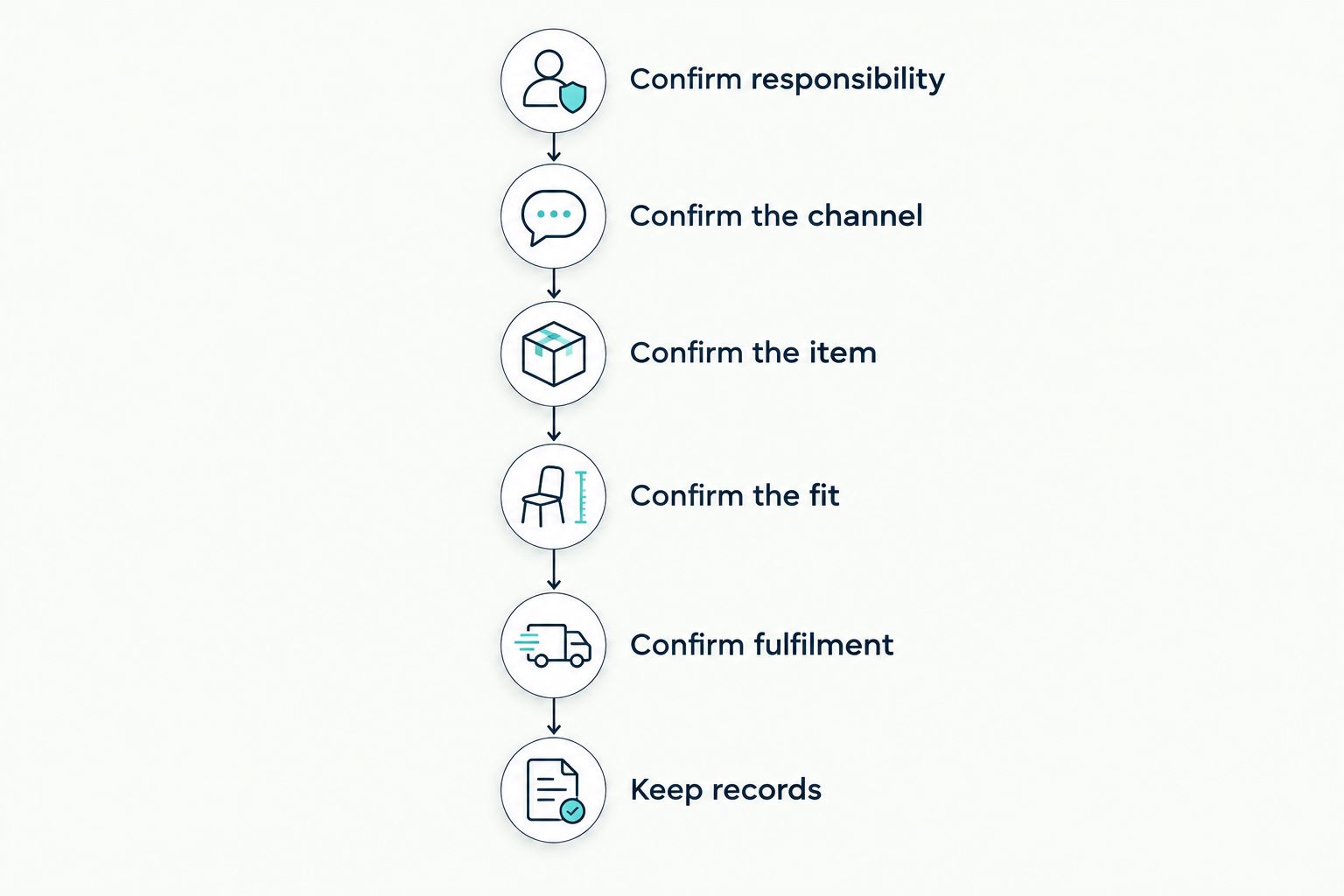
Use these 6 checks before placing an order. They separate the question of who sells the item from the more important question of whether you should buy it for your work.
1. Confirm responsibility
Ask the team responsible for your rider account or employment who manages uniform purchasing. Request a clear answer about whether you should order personally or follow an organisation-managed process.
Do not treat another rider's buying experience as your instruction. Ask for the route that applies to your own working arrangement and location, then keep that instruction with the order details.
2. Confirm the channel
Ask for the exact ordering destination or named purchasing contact. If someone forwards a shop address, verify it through your existing work communication channel rather than relying only on the forwarded message.
A seller describing itself as official is making a claim. Confirm that claim with the organisation responsible for your uniform before treating the seller as an approved purchasing route.
3. Confirm the item
Check the required garment or equipment category and the identifying details supplied by your organisation. Do not substitute a visually similar item unless the responsible team accepts that substitution.
For a replacement, provide a photograph of the existing item and its label where appropriate. Use those details to ask for confirmation, not to assume that every similar-looking listing is equivalent.
4. Confirm the fit
Use the seller's measurements for the exact garment under consideration. Ask how those measurements were taken and compare them with your own measurements or a suitable garment you already wear.
A size label alone does not explain the cut, layering space or garment dimensions. If fit information is unclear, resolve the question before ordering rather than guessing from a product photograph.
5. Confirm fulfilment
Check the delivery destination and the party responsible for receiving the order. For an organisation-managed purchase, establish whether items go to a rider, a depot or another designated recipient.
Also ask which documents or order references you need to retain. This gives the responsible team a usable record if the delivered item does not match the order.
6. Keep records
Save the purchasing instruction, item description, seller details and order confirmation together. Keep the record specific enough to distinguish what was approved from what was actually ordered.
For 2026 purchasing records, retain the date of the instruction as well as the transaction date. An old message or screenshot should not replace confirmation of the route you are being asked to use now.
Why the correct ordering route varies
The decisive issue is not which search result appears first. It is how the purchase connects to your working arrangement and the organisation's uniform process.
- Purchasing responsibility: Establish whether you or your organisation places the order. This determines whose approval you need before buying.
- Buyer type: An individual replacement request needs a different response from an enterprise manufacturing or distribution enquiry. State which one you are making.
- Uniform specification: Confirm the exact requirement rather than relying on colour, logo placement or a seller's description alone.
- Distribution responsibility: Identify who receives and issues the gear. A supplier enquiry should not leave the delivery recipient undefined.
- Replacement approval: Ask how the responsible team wants you to handle a damaged, unsuitable or missing item. Do not assume that an initial issue and a replacement follow the same purchasing route.
These are checks to resolve with the responsible organisation, not claims about a particular Talabat policy. Get the instruction that applies to your situation before choosing a seller.
Where an enterprise workwear partner fits
Boolanga is best suited to enterprise buyers coordinating branded workwear operations. Its stated scope covers design, manufacturing, distribution and software across 35+ countries, with enterprise clients including Talabat, Uber Eats, Bolt and Carrefour.
That scope is relevant when an organisation needs to coordinate uniform requirements across its operations. It does not, by itself, answer whether an individual rider can open a public checkout and buy a particular branded item.
For enterprise buyers, Boolanga brings those workwear functions into the same partner relationship. The useful purchasing question is therefore about operational scope: which responsibilities should the partner manage, and which remain with your organisation?
The benefit is a defined end-to-end service scope. The limitation for this rider question is equally clear: an enterprise service relationship is not evidence of a rider retail channel. Keep supplier capability and individual purchasing eligibility as separate decisions.
What fleet buyers should put in an enquiry
Give the supplier enough information to distinguish a uniform programme from a request for an individual garment. Start with the operational requirement rather than a general request for branded clothing.
- Buyer and authority: Name the purchasing organisation and explain who approves the branded specification.
- Item requirements: Describe the uniform and equipment categories, branding requirements and intended work.
- Sizing information: Explain how sizes will be collected and who will approve the final garment specification.
- Destinations: Identify the countries and receiving locations included in the proposed distribution scope.
- Operating responsibilities: State which design, manufacturing, distribution and software functions you want the partner to address.
- Acceptance process: Identify who checks samples, approves changes and confirms that delivered items match the agreed specification.
For a 2026 fleet programme, distinguish a new specification from a repeat order. Tell the supplier which details are already approved and which still need a decision; otherwise, the enquiry leaves the scope unclear.
Discuss your fleet workwear requirements
Define your design, manufacturing, distribution and software requirements with an enterprise operations partner.
Is a Talabat-branded listing proof that the uniform is approved?
A Talabat-branded listing is not proof of approval for your work. A product photograph shows how an item is presented; it does not establish seller authorisation, purchasing eligibility or acceptance by the organisation responsible for your uniform.
Ask that organisation to confirm the seller and the item through an existing work communication channel. Treat a seller's claims as information to check, not as a replacement for that confirmation.
Can a fleet buyer use the same route as an individual rider?
A fleet buyer should not assume that an individual rider's ordering route covers an enterprise purchase. A fleet enquiry needs defined responsibilities for specification, approval and distribution, while a rider enquiry starts with permission to obtain the required item.
Before sending a purchase request in 2026, identify the buyer and the intended recipient. That distinction helps the receiving team direct the enquiry without confusing personal replacement gear with an organisation's uniform programme.
What to ask before replacing existing gear
A replacement enquiry should identify the item and the reason it needs replacing. Keep the request factual: describe the garment or equipment, explain the issue and ask which purchasing route applies.
You can use this wording when contacting your responsible team:
Please confirm the approved route for obtaining my required Talabat-branded uniform gear. Should I order personally or follow an organisation-managed process? Please identify the required item, the ordering channel and any approval I need before purchasing.
Add your location and the item details through the appropriate private channel. Do not post account identifiers or employment documents in a public marketplace conversation just to establish whether a seller carries a garment.
If you are comparing listings, keep a written record of the differences that need confirmation. Ask about the exact item and seller rather than requesting a general verdict on whether an entire marketplace is acceptable.
For a 2026 replacement request, finish the verification before making the purchase. An order confirmation documents what you bought; it does not establish that the purchase was approved for your work.
FAQ
Can I buy a Talabat uniform directly as a delivery rider?
Use a direct ordering route only after the team responsible for your rider account or employment confirms it applies to you. Do not treat a public product listing as proof of purchasing eligibility.
Does a talabat uniform for sale listing mean the seller is authorised?
A talabat uniform for sale listing does not establish seller authorisation. Confirm the seller and the required item with the organisation responsible for your uniform before ordering.
Does Boolanga's Talabat relationship mean riders can buy directly?
Boolanga's Talabat relationship does not by itself establish a direct rider purchasing route. Boolanga is an enterprise operations partner covering branded workwear design, manufacturing, distribution and software.
Should I ask my fleet before buying replacement uniform gear?
Ask your fleet or responsible team to confirm the replacement process before buying. Establish who places the order and which item you are instructed to obtain.
Can I choose a similar-looking garment instead?
Use a similar-looking garment only if the organisation responsible for your uniform accepts the substitution. Matching colours or branding do not establish that the item meets its requirements.
What should I check before ordering a uniform size?
Check the measurements for the exact garment rather than relying only on its size label. Confirm any unclear fit details with the seller before placing the order.
What should a fleet include in a branded uniform enquiry?
A fleet should include purchasing authority, item specifications, sizing requirements, destinations and operational responsibilities. Identify who approves samples and who accepts the delivered items.
One last thing
The strongest check happens outside the product listing. Ask the team responsible for your uniform to identify the route you should use, then assess the seller and item against that instruction.
If you cannot connect the listing to a confirmed purchasing instruction, pause the order. The purpose is not simply to obtain branded gear; it is to obtain the gear your work requires through the right process.


