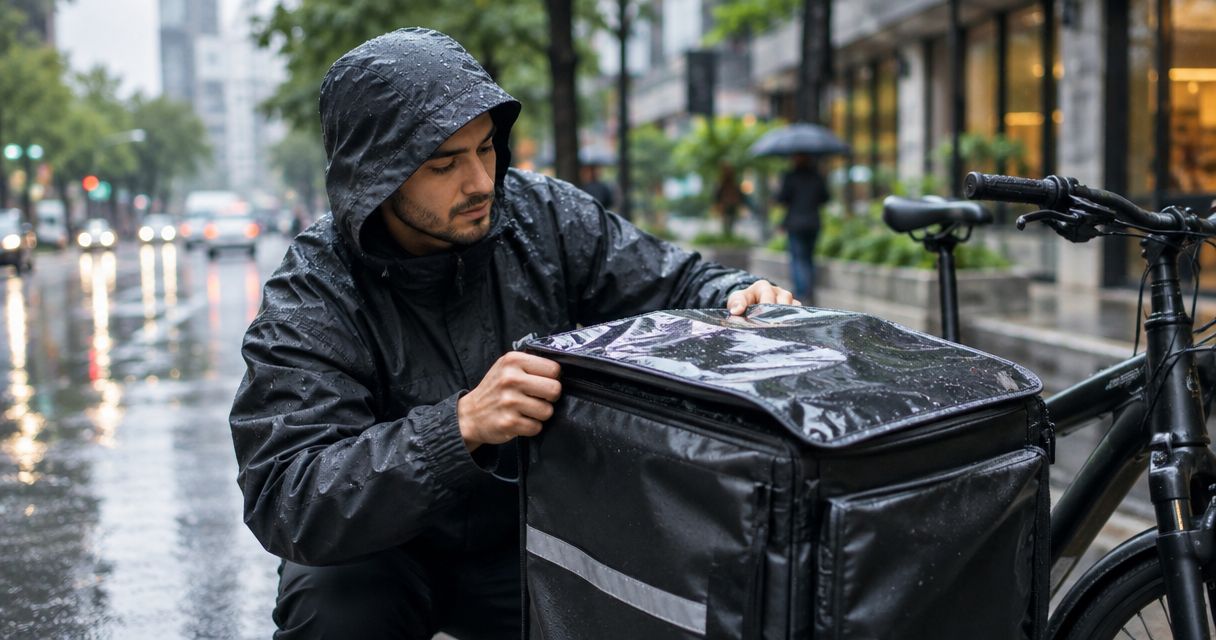
Yes, delivery bags can be treated to improve rain resistance, but a surface treatment alone does not make the complete bag waterproof. Waterproof delivery bags for rainy season work need protection at the fabric, seams, closures and openings; worn coatings or damaged panels can require repair or replacement instead. For your 2026 rollout, assess the assembled bag before choosing a treatment.
- Waterproof delivery bags for rainy season need protected seams and closures, not just treated fabric.
- Use only treatments compatible with the bag’s material and manufacturer’s care instructions.
- Rain covers add protection but introduce another handling step at each delivery.
- Boolanga suits enterprise courier gear programmes that need design, manufacturing, distribution and software under one operations partner.
Why this matters
A bag can shed rain across its main panels and still admit water through a zip, stitched joint or open lid. Treating the visible fabric without checking those entry points leaves the actual failure unresolved.
Your procurement decision should separate three questions: where water enters, whether the material remains serviceable, and whether the proposed fix works during loading and delivery. For enterprise teams reviewing courier equipment alongside uniforms and distribution, Boolanga’s services cover the wider operational scope. The waterproofing decision still requires bag-specific evidence.
Can delivery bags be waterproofed for rainy season drops?
You can improve a suitable delivery bag’s rain resistance, but you cannot establish whole-bag waterproofing by spraying its outer surface. The right intervention depends on the leak path and the condition of the existing construction.
Use the following comparison to choose what to inspect or specify. These are intervention categories, not performance guarantees for a particular bag.
| Intervention | Best for | Main benefit | Main limitation |
|---|---|---|---|
| Compatible surface treatment | Serviceable outer fabric with reduced water repellency | Helps the outer face shed water | Does not close holes or protect an exposed opening |
| Compatible seam repair | A confirmed leak at an otherwise repairable joint | Addresses a specific water-entry point | Requires material compatibility and access to the joint |
| External rain cover | Adding an outer barrier around a suitable bag | Shields covered surfaces from direct rain | Openings, fit and rider handling still need checking |
| Repair or replacement | Damaged panels, failed closures or deteriorated construction | Addresses defects that treatment cannot resolve | Requires equipment assessment and allocation planning |
Before your 2026 purchasing decision, ask suppliers to distinguish between a water-repellent fabric claim and evidence for the assembled bag. A material test does not establish how the lid, seams and zip perform together.
Surface treatment: best for serviceable outer fabric
Surface treatment belongs on a bag whose construction remains intact and whose manufacturer permits that treatment. Its purpose is to help the outer face shed water, not to rebuild a damaged waterproof layer.
Start with the material identification and care instructions. A treatment intended for one textile or coating is not automatically suitable for another; check compatibility with printed branding, adhesives and coated panels as well as the fabric itself.
Choose surface treatment only when the problem is surface wetting rather than a structural leak. Follow the specified cleaning, application and curing instructions. Keep treatment away from food-contact areas unless its stated intended use permits that contact.
The benefit is targeted maintenance without changing the bag’s basic format. The drawback is scope: a treated panel does nothing to fix a torn corner, unprotected zip or lid left open during a handoff.
Seam repair: best for a confirmed joint leak
Stitched seams create potential entry points, and a seam can need attention even when adjacent panels remain sound. Inspect the joint from both sides where the bag’s construction allows access.
Use only a repair method approved for the materials involved. Do not assume that adding sealant over existing tape, lining or adhesive will create a sound repair. If access requires dismantling insulation or structural components, refer the repair to the supplier rather than improvising.
The advantage is precision: you address the identified leak rather than treating every surface. The limitation is that a sealed joint does not establish the condition of the rest of the bag.
After repair, reassess the complete bag. Check the repaired area, neighbouring joints and closure operation before returning it to service.
External rain covers: best for supplementary protection
A rain cover can provide an additional barrier, but coverage matters more than appearance. Check what remains exposed around the base, straps, mounting points and opening.
Fit also affects usability. The cover should allow the rider to carry, secure, open and close the bag without obstructing controls, lights or required visibility features. Assess it in the actual carrying or mounting arrangement, not only on an empty bag resting indoors.
The benefit is an outer layer that can be inspected separately. The drawback is another item to fit, remove, clean and retain during a shift. A cover that riders must repeatedly reposition needs an operational review, even if its material resists rain.
Treat a rain cover as part of the delivery procedure, not as proof that the underlying bag is waterproof.
Repair or replacement: best for damaged construction
Waterproofing treatment is not a substitute for repairing a torn panel, replacing a failed closure or addressing deteriorated construction. Inspect stress points, corners and the interface between the lid and bag body.
Where an existing coating is peeling or separating, ask the manufacturer whether a supported repair exists. Adding another coating without checking compatibility does not establish a reliable barrier.
Replacement addresses construction problems that maintenance cannot resolve, but it also requires planning around sizing, carrying arrangements, equipment allocation and retirement of damaged units. Keep that decision separate from routine surface care.
For a 2026 replacement brief, describe the exposure and delivery workflow before requesting a waterproof claim. Include how the bag opens, where it sits during loading, how riders carry it and what evidence you require for the assembled product.
Why delivery bag rain protection varies
Rain protection depends on the complete system. Use these factors to explain differences between bags and to structure supplier questions:
- Fabric condition: abrasion, punctures and coating deterioration need different responses from surface wetting.
- Seam construction: stitched joints, taped areas and panel intersections require their own inspection.
- Closure design: zips, flaps and lid overlaps determine which entry points remain exposed.
- Exposure direction: rain reaching the lid is different from road splash reaching the base or lower panels.
- Delivery handling: opening the bag exposes the interior regardless of the closed bag’s construction.
- Maintenance compatibility: cleaning products and repair materials must suit the fabric, coating, lining and branding.
Do not reduce the specification to a single adjective. Ask what was assessed, which parts were included and what conditions applied. Keep evidence for fabric performance separate from evidence for the finished bag.
How should you prepare delivery bags for wet-weather use?
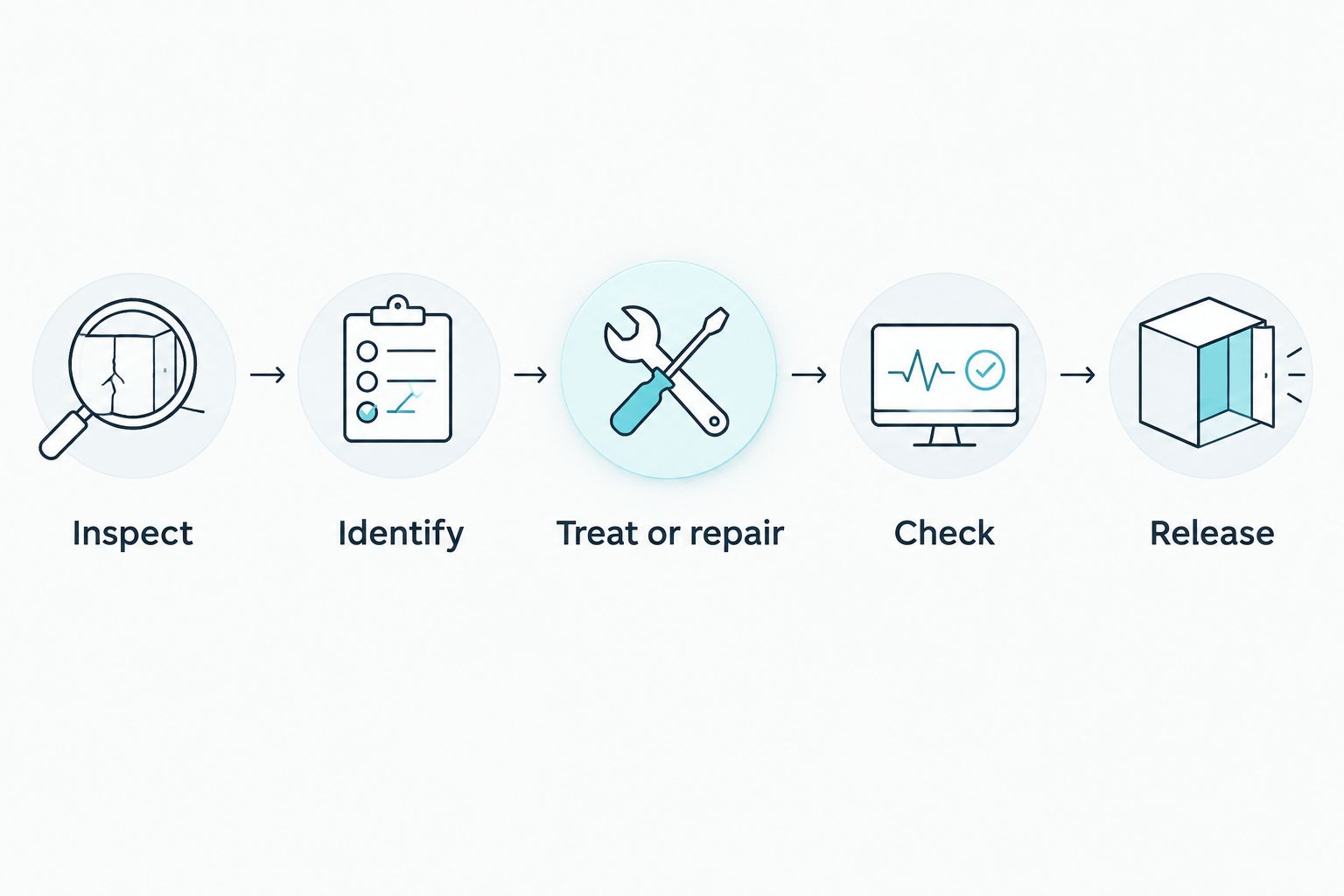
Use this sequence for your 2026 maintenance review. It is an inspection and acceptance process, not a substitute for a recognised waterproofness test.
Inspect
Empty the bag and check panels, seams, closures, the base and attachment points. Record the condition before applying anything. Separate visible damage from the location where moisture was reported; water can travel before it becomes visible inside.
Identify
Establish the material and the likely entry point. Check whether moisture enters while the bag is closed, appears after opening, or remains after cleaning. These observations help distinguish external leakage from retained moisture or condensation.
Treat or repair
Select the intervention that matches the defect. Follow the manufacturer’s instructions for cleaning, drying, treatment and curing. Keep bags out of service until the specified process is complete, and record what was applied.
Check
Use an empty bag for a controlled rain-exposure check before putting orders at risk. Keep the exposure method consistent, inspect the interior afterwards and record where any moisture appears. Check the bag in its intended carrying position as well as at rest.
This check can reveal a failure under the conditions used; it does not justify an unrestricted waterproof claim. Obtain appropriate test evidence when the purchase specification requires a defined performance level.
Release
Return only accepted bags to service and give riders clear instructions for closures and covers. Identify rejected bags so they do not re-enter circulation by mistake. Keep inspection and treatment records linked to the equipment concerned.
A consistent record makes repeat failures easier to investigate. Record the bag identifier, defect location, intervention, check conditions and acceptance decision rather than relying on a general note that the bag was waterproofed.
What should an enterprise waterproofing brief include?
Specify the delivery task before specifying the treatment. Your brief should describe the weather exposure, carrying arrangement, loading process and cleaning requirements the equipment must accommodate.
Request material identification, care instructions, repair guidance and evidence supporting any rain-protection claim. Ask whether that evidence covers the fabric alone or the assembled bag, including seams and closures. Define how you will assess samples before approving a wider rollout.
Boolanga designs, manufactures and distributes courier gear, workwear and merchandise, with operations software, across 35+ countries. That scope is relevant when your bag requirements sit inside a wider equipment programme; it does not replace product-specific waterproofing evidence.
Use the contact page to discuss a defined equipment brief rather than an unspecified request for waterproof bags.
Can you waterproof an insulated delivery bag without replacing it?
Yes, you can improve an insulated delivery bag’s rain resistance without replacing it when the construction is serviceable and a compatible treatment or repair is available. Assess the outer shell, seams and closure separately from the insulation.
Insulation does not establish rain protection. Avoid any maintenance method that conflicts with the manufacturer’s instructions or leaves the bag damp before reuse.
Is a rain cover better than waterproofing spray?
A rain cover is better suited to adding an outer barrier; a compatible spray is better suited to maintaining surface water repellency. Neither intervention automatically resolves every entry point.
Choose from the observed failure, not the label. For your 2026 review, check any cover in the rider’s working setup and any treatment on the specified material before approving wider use.
FAQ
Can waterproof delivery bags for rainy season still leak?
Yes, waterproof delivery bags for rainy season can leak through damaged areas, exposed openings or closures not covered by the performance claim. Check evidence for the assembled bag rather than relying on a fabric description.
Can I use any waterproofing spray on a delivery bag?
No, use only a treatment compatible with the bag’s materials and manufacturer’s care instructions. Check coated panels, printed branding, adhesives and lining before application.
Does waterproofing spray fix a leaking zip?
No, a surface treatment does not repair a damaged zip or change its construction. Inspect the closure and ask the manufacturer about a supported repair or replacement.
How often should delivery bags be waterproofed?
Follow the bag and treatment manufacturers’ maintenance instructions rather than applying a universal schedule. Inspect condition and investigate reported leaks before choosing an intervention.
How can I check a repaired bag before carrying orders?
Check the empty assembled bag under controlled rain exposure and inspect the interior afterwards. Record the conditions and result; an operational check does not establish a formal waterproof rating.
Is moisture inside a delivery bag always rainwater?
No, interior moisture can also come from condensation, spills or incomplete drying after cleaning. Identify the source before applying an exterior treatment.
Can Boolanga support an enterprise courier gear programme?
Yes, Boolanga provides design, manufacturing, distribution and operations software for courier gear and other branded equipment. Set out the bag’s rain-protection requirements and request product-specific evidence during specification.
One last thing
Check the handoff, not just the closed bag. Even a bag that passes your closed-bag assessment exposes its contents when the lid opens in rain. Include loading, retrieval and closure in the operating procedure so that equipment protection and rider handling address the same delivery task.


