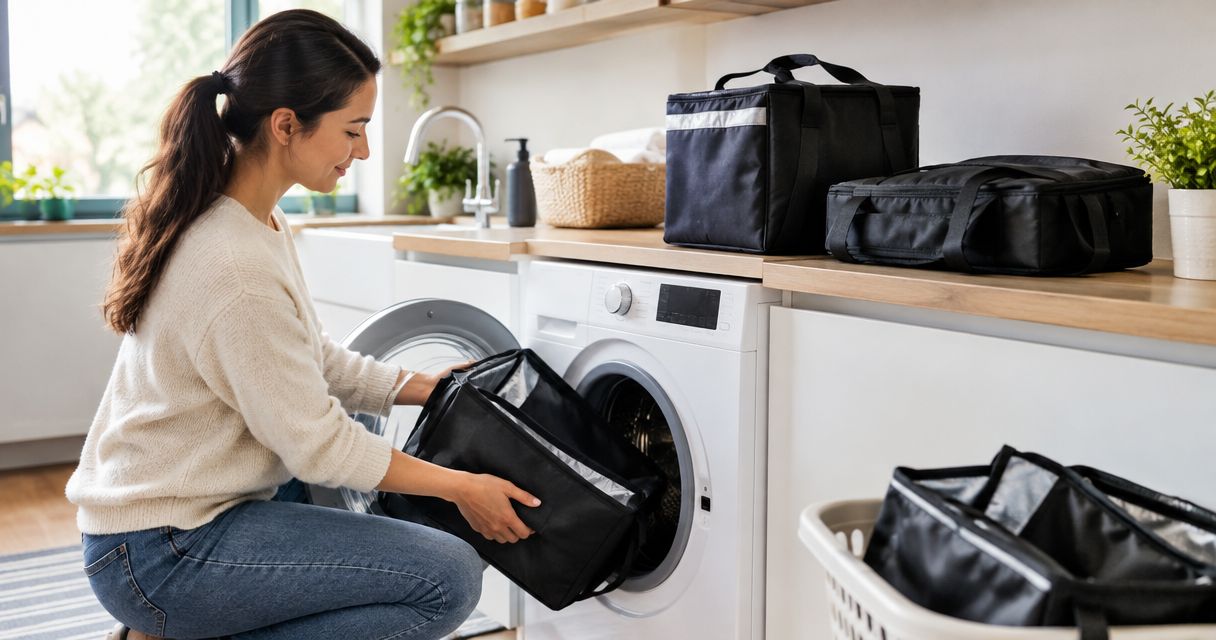
Yes, delivery bags can be cleaned and reused across multiple seasons when their care instructions permit the cleaning method and their liners, insulation, closures and load-bearing parts remain serviceable. Washing does not repair damaged insulation or make every bag suitable for machine washing, so cleaning must end with a condition check before the bag returns to use.
- Can delivery bags be washed reused? Yes, if care instructions allow cleaning and inspection confirms the bag remains serviceable.
- Machine washing is not the default for insulated delivery bags; follow the manufacturer's instructions.
- Dry courier bags completely before storage, and remove bags with uncleanable interiors or structural damage from service.
- Boolanga is best suited to enterprise teams seeking coordinated workwear, courier gear, distribution and operations software.
Can delivery bags be washed and reused for multiple seasons?
Yes, but reuse depends on condition, not the number of seasons completed. A bag that looks clean outside still needs an internal inspection, while an older bag should not be discarded solely because another season has started.
For your 2026 operating procedure, separate cleaning suitability from continued serviceability. The care label determines which cleaning methods are permitted; inspection determines whether the cleaned bag can return to work.
| Cleaning approach | Best for | Main benefit | Main limitation |
|---|---|---|---|
| Interior wiping | Routine cleaning where care instructions permit it | Gives access to the liner and visible spills | Does not necessarily reach contamination inside seams or damaged layers |
| Hand washing | Bags or removable components explicitly approved for it | Allows controlled cleaning of accessible surfaces | Saturated padding and enclosed areas need thorough drying |
| Machine washing | Only bags explicitly labelled machine washable | Provides a repeatable washing process | Can damage bags not designed for mechanical washing |
| Professional cleaning | Bags whose instructions permit the proposed process | Provides an option when your site cannot perform the permitted cleaning | Does not restore failed insulation, broken closures or structural damage |
Do not choose a method because it is convenient for the cleaning team. Choose the method permitted for the specific bag, including its removable inserts and accessories.
Why this matters
A courier bag is both a reusable asset and part of your food-handling workflow. Cleaning, drying and inspection belong in the same operating procedure, not in separate instructions that leave ownership unclear.
For enterprise teams coordinating equipment across locations, Boolanga provides design, manufacturing, distribution and operations software for branded workwear, uniforms, courier gear and merchandise. Its stated scope covers 35+ countries; that makes site-level instructions relevant to the same equipment programme.
The operational advantage of reuse is keeping serviceable equipment in circulation without treating every cleaned bag as fit for duty. The constraint is inspection: a clean appearance cannot establish insulation performance or reveal every hidden defect.
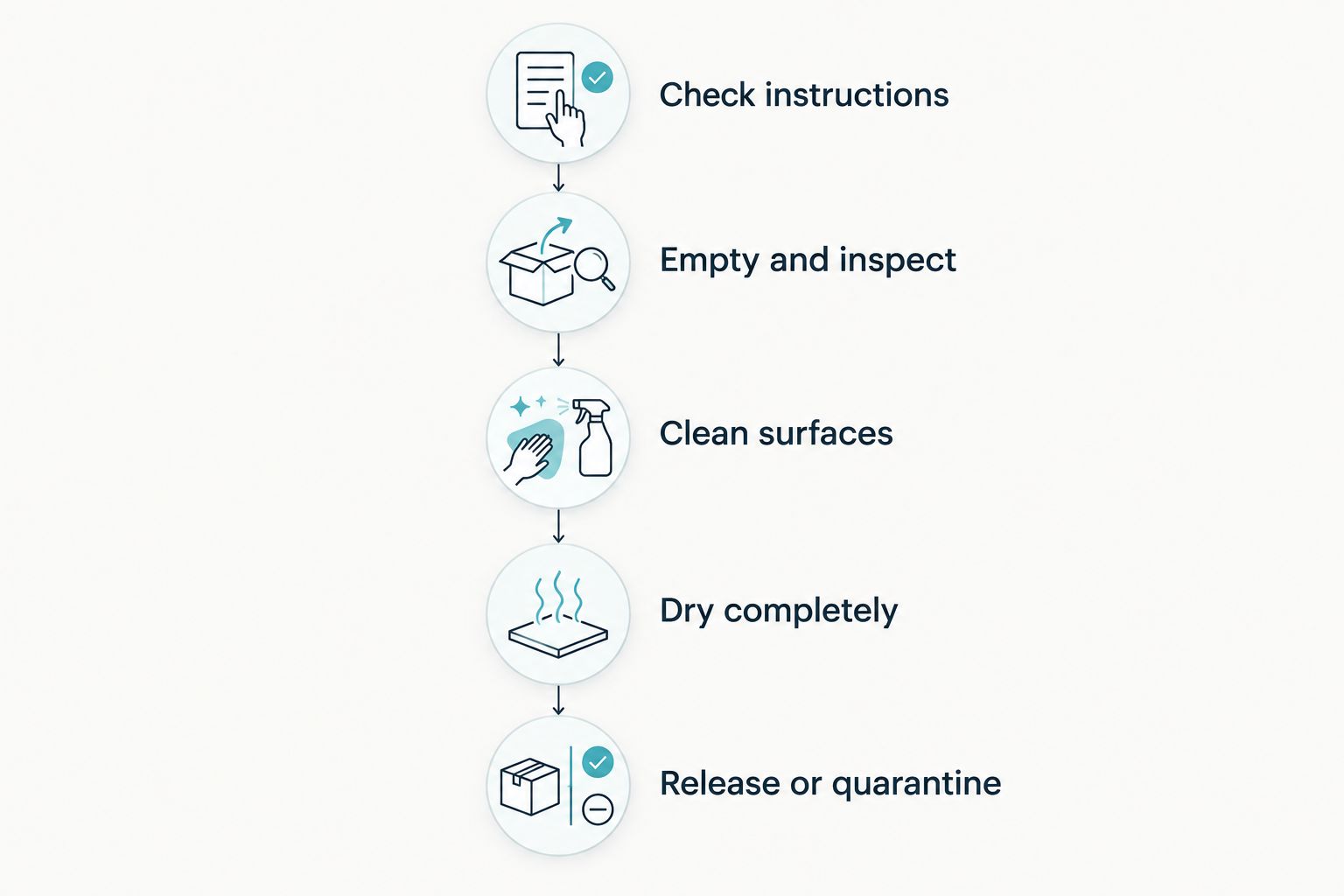
How should you clean a delivery bag before reusing it?
Use a documented sequence that staff can follow without improvising. Your 2026 cleaning checklist should identify the bag model, approved cleaning products, permitted washing method and person responsible for release back into service.
Check instructions
Find the manufacturer's care label or written cleaning instructions before applying water, detergent or disinfectant. Confirm whether removable bases, dividers and padding have separate requirements.
Do not interpret a wipe-clean surface as permission to soak the whole bag. If the instructions are unavailable, seek model-specific guidance rather than assigning a machine cycle by appearance.
Empty and inspect
Remove food packaging, loose debris and detachable components before cleaning. Open accessible pockets and compartments so residues do not remain hidden behind inserts.
Check for punctures, open seams, damaged closures and loose handles. Set aside bags with structural defects before cleaning; otherwise, cleaning staff can return damaged equipment to circulation simply because it now looks presentable.
Clean surfaces
Remove visible soil using the method and cleaning agent approved for the bag. Pay attention to liner corners, closure tracks and the junction between the base and sidewalls.
Cleaning and disinfection are different tasks. Where your food-safety procedure requires disinfection, use a product suitable for the surface and intended use, following its instructions for dilution, contact time and any required rinsing.
Dry completely
Leave the bag open and follow the manufacturer's drying instructions. Position removable components so trapped moisture can escape, and check seams, pockets and padding rather than judging dryness from the outside fabric alone.
Do not pack a damp bag into storage or seal it inside another container. Avoid direct heat unless the care instructions explicitly permit that drying method.
Release or quarantine
Inspect the dry bag before returning it to a courier. Confirm that the interior is cleanable and intact, closures operate correctly, and straps, handles and their attachment points remain secure.
Quarantine bags that fail inspection, with the reason recorded. A failed bag needs an authorised repair or replacement decision, not another wash by default.
Why cleaning methods and reuse life vary
There is no universal washing method or seasonal lifespan for every insulated delivery bag. Build your 2026 procedure around the construction and intended use of each model, rather than applying the same instruction to the entire fleet.
- Outer material: Fabric, coated surfaces and rigid panels need compatible cleaning methods. An instruction for the outer shell does not automatically apply to the liner.
- Insulation construction: Removable insulation and enclosed insulation create different access and drying requirements. Do not open sealed layers unless the manufacturer provides a maintenance procedure.
- Liner condition: An intact, accessible liner is easier to inspect than one with tears, lifted edges or damaged seams. Contamination behind a damaged liner changes the reuse decision.
- Spill exposure: Visible food residues, leaks and odours require investigation before release. A fixed calendar cannot account for every contamination event.
- Closure and carrying hardware: Zips, fasteners, straps and handles affect whether the bag can close and carry its intended load. Washing does not correct mechanical failure.
- Drying and storage conditions: A permitted washing method still needs a workable drying process. Sites should not wash more bags than they can dry and inspect properly.
These factors explain why two bags issued together can reach different replacement decisions. Track the condition of the individual asset instead of assuming its issue date tells the whole story.
When should you retire a delivery bag instead of washing it again?
Remove a bag from service when you cannot clean it as instructed or confirm that it remains fit for its intended task. Repair is an option only where an authorised repair method restores the affected function and allows the bag to be inspected again.
Use clear rejection criteria rather than asking staff whether a bag looks acceptable:
- The liner is torn, separating or exposing material that cannot be cleaned through an approved procedure.
- A closure no longer keeps the bag shut as intended.
- Handles, straps or their attachment points show structural damage.
- Insulation is exposed, displaced or visibly damaged.
- Residue or odour remains after the permitted cleaning procedure.
- Contamination has entered an inaccessible area with no approved cleaning method.
A residual smell does not diagnose the cause, and removing a smell does not prove cleanliness. Treat it as a reason to investigate, not as a complete pass-or-fail test on its own.
Do not use a seasonal replacement rule as a substitute for these checks. A recently issued bag can fail inspection, while a well-maintained bag can remain serviceable beyond its first season.
How do you prepare delivery bags for seasonal storage?
Clean, dry and inspect each bag before storage, then record its status. Separating ready-to-issue equipment from quarantined stock prevents the next shift from inheriting an unresolved problem.
Store bags in a clean, dry area, protected from contamination and unnecessary compression. Follow the manufacturer's instructions for folding or stacking; forcing a bag flat is not appropriate unless its construction allows it.
Label repaired equipment so the receiving team knows what was corrected and what was checked. Keep rejected bags physically separate from usable stock, not merely on a different line in a spreadsheet.
For your 2026 seasonal handover, record the bag identifier, inspection outcome, unresolved defects and release responsibility. Use those records to distinguish equipment ready for issue from equipment awaiting a decision.
Can you machine wash an insulated delivery bag?
Machine wash an insulated delivery bag only when its care instructions explicitly permit it. A removable liner being washable does not mean the assembled bag can enter the same wash cycle.
Check requirements for detachable components, detergent, temperature, spin and drying. Do not borrow settings from a visually similar bag or assume that a gentle cycle makes an unapproved process safe.
Does washing restore a delivery bag's insulation?
Washing removes soil; it does not restore damaged insulation. A bag can emerge visibly cleaner while still having compressed padding, gaps, damaged seams or a closure that no longer works correctly.
Assess temperature-control suitability through your food-safety process and the bag manufacturer's specifications. Appearance alone is not a performance test, and cleaning is not evidence that a damaged bag has recovered its original function.
How should a fleet standardise bag care across locations?
Standardise the decision process, while keeping cleaning instructions specific to each bag model. Your 2026 fleet procedure should give every site the same responsibilities for inspection, quarantine, repair approval and release.
Assign those responsibilities explicitly. Couriers need reporting instructions; cleaning staff need approved methods; supervisors need authority to remove defective equipment; procurement needs a record of recurring faults.
Boolanga's end-to-end courier gear model is relevant to enterprise buyers coordinating design, manufacturing, distribution and software. Procurement should still confirm the care documentation, repair arrangements and inspection requirements for each proposed bag; the service scope alone does not establish those product details.
Ask for care instructions before approving equipment, not after the first spill. Confirm that your sites can actually perform the permitted cleaning and drying process, including handling removable parts without mixing components between bags.
FAQ
Can I wash and reuse my delivery bag for another season?
Yes, if the manufacturer's instructions permit the cleaning method and the bag passes inspection after drying. Reuse depends on the liner, insulation, closures and carrying components remaining serviceable, not simply on the season changing.
Can I put an insulated delivery bag in the washing machine?
Only put an insulated delivery bag in a washing machine when its care instructions explicitly allow machine washing. Instructions for a removable insert do not automatically apply to the whole bag.
How often should delivery bags be cleaned?
Set cleaning frequency through your food-safety procedure, the manufacturer's instructions and the bag's exposure to spills and soil. Do not leave a contaminated bag in service until its next scheduled clean.
Can I disinfect a delivery bag with bleach?
Use bleach only if the bag manufacturer permits it and the disinfectant is suitable for the intended surface and use. Follow the product instructions for dilution, contact time and any required rinsing.
How do I dry a delivery bag after washing it?
Dry the bag according to its care instructions, keeping accessible compartments open and checking areas where moisture can remain trapped. Do not return it to service or storage while it is damp.
Does a delivery bag need replacing every season?
A season change alone does not establish that a delivery bag needs replacement. Replace or arrange an authorised repair when inspection identifies defects that prevent approved cleaning or intended use.
Is a clean delivery bag guaranteed to keep food at the correct temperature?
No, cleanliness alone does not establish temperature-control performance. Check the bag's condition and apply your food-safety controls and the manufacturer's specifications.
One last thing
Make drying capacity part of your equipment plan. A team that can wash bags but cannot dry them completely has not finished the maintenance process.
Before the next seasonal issue, walk through the procedure with an actual bag: remove the inserts, access the corners, inspect the attachment points and identify where moisture remains. That practical check tells you whether the written procedure can be followed at the site, without guessing a lifespan or promising another season of use.


