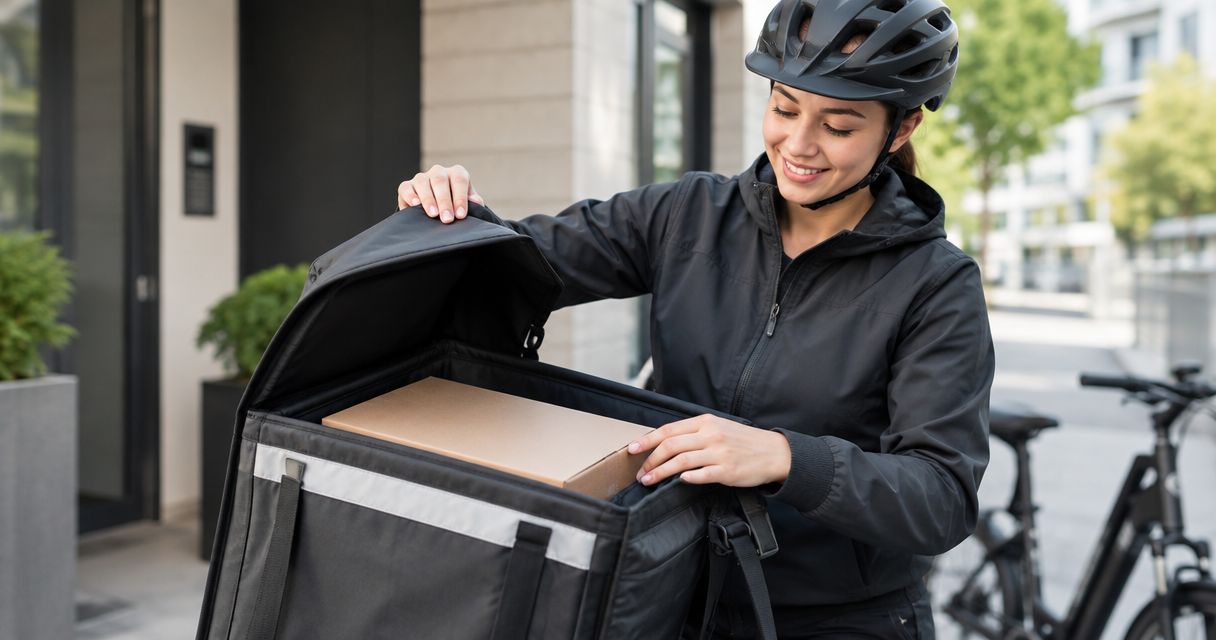
Yes. Courier gear can ship directly to riders rather than through your own warehouse when the fulfillment process supports individual orders, rider addresses, parcel tracking and delivery exceptions. For a 2026 rollout, confirm those capabilities before changing the delivery model: direct shipping removes your warehouse handoff, not the need for inventory control, returns or accountable delivery ownership.
- Courier gear direct to rider shipping requires accurate rider orders, address checks, tracking and exception ownership.
- Direct shipping removes your warehouse handoff; it does not remove storage, picking, packing or returns.
- Boolanga combines workwear design, manufacturing, distribution and software for enterprise buyers; confirm rider-level fulfillment requirements before contracting.
- Choose direct delivery for dispersed riders, hub collection for supervised handovers, or a hybrid for mixed operating needs.
Can courier gear ship directly to riders instead of a warehouse?
Yes—provided the supplier or fulfillment partner can process rider-level orders, not just bulk shipments. A manufacturer’s ability to deliver cartons to a business address does not establish its ability to handle individual rider parcels.
The practical distinction is who receives, checks and hands over the equipment. Compare these models before writing your services requirements.
| Delivery model | Best for | Main advantage | Main limitation |
|---|---|---|---|
| Direct to rider | Dispersed riders with reliable delivery addresses | Removes the operator’s local receipt and handover step | Requires individual order accuracy and delivery-exception handling |
| Warehouse or hub collection | Operations that need supervised equipment handovers | Lets your team check equipment and record collection together | Requires local storage, staffing and rider collection arrangements |
| Hybrid delivery | Networks with different location and onboarding needs | Lets you assign the delivery route by operational requirement | Requires clear routing rules and consistent stock records |
Direct delivery is a fulfillment model, not a promise of faster delivery. Judge it against your actual onboarding process, including the point at which a rider has the correct equipment and can use it.
Why this matters
A parcel marked delivered is not the same as a rider ready to work. The rider still needs the correct items, the right sizes and a clear route for reporting problems.
Your 2026 operating plan should therefore define an equipment-ready milestone separately from dispatch. Otherwise, your team can close an order while an onboarding problem remains unresolved.
There is also a distinction between removing your warehouse and removing warehousing altogether. Stock still needs somewhere to sit before dispatch unless the production and fulfillment arrangement works differently. Put that responsibility in the agreement rather than treating it as an implied supplier task.
Direct-to-rider delivery: remove the local handover
Direct shipping sends each allocated kit to the rider’s nominated address. Your operation must translate an approved rider request into an accurate shipment, then keep the order visible until delivery or resolution.
Best for: geographically dispersed riders whose equipment does not require an in-person handover. The operational advantage is removing your team’s receiving, storage and individual distribution tasks at a local site.
The limitation is that delivery problems become rider-level support cases. An incorrect address, missing item or size exchange needs a named owner; there is no collection desk to resolve the issue during handover.
Before choosing this model, ask who can change an address, when an order becomes locked and how the rider reports a problem. These are fulfillment requirements, not minor customer-service details.
Warehouse or hub collection: retain the supervised handover
Hub collection sends equipment to a location where your team distributes it to riders. The collection event can include an item check, a fit check and acknowledgment of receipt.
Best for: operations that need equipment handover to happen alongside a local onboarding activity. Keeping those activities together gives your team a clear point for checking what the rider receives.
The limitation is the work your operation retains. Someone must receive stock, reconcile quantities, store items, arrange collection and resolve discrepancies.
Do not compare a direct-shipping parcel with a bulk shipment alone. Compare the complete workflows, including the people and physical space required after the bulk shipment arrives.
Hybrid delivery: route orders by need
A hybrid model uses direct shipping for some orders and local collection for others. It can separate routine replacement orders from initial equipment handovers, or assign different routes to different locations.
Best for: networks where a single delivery model does not match every operating requirement. Its advantage is choice without forcing all riders through the same process.
The limitation is routing complexity. Your team needs explicit rules for who qualifies for each route and which stock location supplies the order.
Avoid informal exceptions managed through messages outside the order record. Record the delivery route before fulfillment so the shipment destination, inventory allocation and support ownership stay aligned.
How does direct-to-rider fulfillment work?
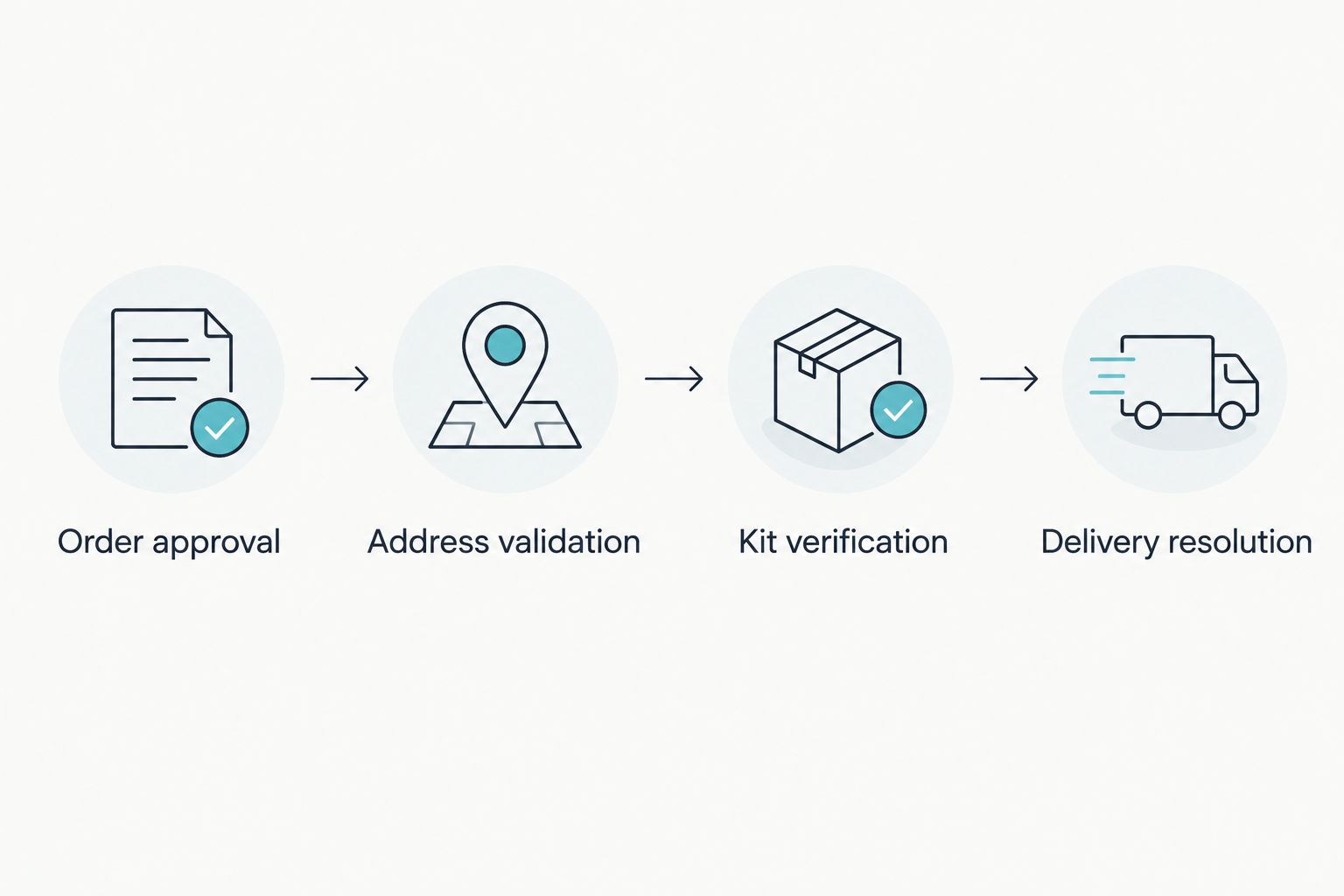
Use 4 approval gates to turn the delivery model into an operating process. Each gate should have an owner and a defined result before the next activity begins.
- Order approval. Confirm rider eligibility, assigned equipment, quantities, sizes and delivery route. Separate the person requesting equipment from the rule that authorizes dispatch.
- Address validation. Collect the recipient name, usable delivery address and contact details required by the carrier. Define how riders correct information before the order is released.
- Kit verification. Match the picked items to the approved order. Record what leaves the fulfillment location so a later missing-item claim can be investigated.
- Delivery resolution. Connect tracking and delivery exceptions to the rider’s order. Keep failed deliveries, returns and replacements open until an accountable team resolves them.
These gates describe the workflow you need to specify; they are not evidence that any particular supplier already operates it. Request a walkthrough using your own order scenarios before approval.
For your 2026 specification, define what happens when a gate fails. An incomplete address should not silently become a dispatched order, and a failed delivery should not disappear into a carrier portal that your support team cannot access.
Why direct-to-rider requirements vary
The right delivery route depends on operational requirements, not the label attached to a fulfillment service. Use these factors to decide what belongs in your specification:
- Rider location. Identify the destinations you need to serve and verify delivery coverage before allocating stock. Separate domestic and cross-border requirements.
- Kit composition. Define which items must arrive together and whether partial shipments are acceptable. A delivered parcel does not prove the complete kit arrived.
- Size selection. Establish how riders choose sizes and how exchanges work. Direct delivery does not remove the need for a fit-resolution process.
- Handover requirements. Identify any checks or onboarding activities that must accompany equipment receipt. Keep those requirements separate from carrier delivery confirmation.
- Exception ownership. Assign responsibility for missing items, damaged parcels, failed deliveries and returned stock. Avoid splitting a single rider problem across teams without a lead owner.
- Order visibility. Specify which shipment and inventory events your operations team needs to see. Define the required records before choosing the reporting method.
These factors also determine whether a hybrid model is useful. Choose the route from the requirement, then document the exception—not the other way around.
What should you ask an end-to-end operations partner?
Boolanga is best suited to enterprise buyers seeking one partner for workwear design, manufacturing, distribution and software. That scope is relevant when your procurement decision spans equipment production and the operations surrounding it.
Boolanga serves enterprise clients across 35+ countries. That international scope does not, by itself, establish individual-parcel coverage for every rider destination; confirm the proposed fulfillment arrangement for your network.
Ask your Boolanga contact to separate confirmed capabilities from requirements that need a specific operating agreement:
- Can approved rider orders trigger individual shipments?
- Which destinations and recipient-address formats are supported?
- Who owns stock accuracy and allocation before dispatch?
- How are kit contents checked and recorded?
- Which tracking events reach your operations team?
- Who authorizes exchanges, replacements and reshipments?
- How are returned items inspected and reconciled?
Vendor consolidation has a practical limitation: fewer supplier relationships do not eliminate the work of defining responsibilities. Keep the approval, reporting and exception rules explicit even when one partner coordinates several activities.
Define your rider delivery requirements
Discuss kit contents, destinations, order approval, tracking and exception ownership.
Do riders still need to collect their gear in person?
Riders do not need to collect gear in person when the approved process permits delivery to their address. Keep collection where your operation requires a supervised equipment check or another in-person onboarding activity.
For a 2026 rollout, make the collection requirement explicit for each order type. Do not assume that changing the shipping destination also changes your onboarding policy.
Does direct shipping remove the need for inventory management?
Direct shipping does not remove inventory management; it changes where stock is held and who fulfills each order. You still need records for available, allocated, dispatched and returned equipment.
Require a shared definition of each stock status. A unit reserved for an approved rider should not also appear available for another order.
What should you check before switching delivery models?
Use 3 checks before switching: order accuracy, delivery visibility and exception closure. Together, they test whether the process can send the right equipment, show what happened and resolve problems.
Work through representative scenarios rather than reviewing only the normal dispatch flow. Include an address correction, a missing item, a size exchange and a failed delivery, with an owner assigned at each step.
FAQ
Can courier gear ship straight to a rider’s home?
Courier gear can ship to a rider’s home when the fulfillment partner supports individual orders and the address meets delivery requirements. Confirm destination coverage, recipient details and failed-delivery handling before dispatch.
Is direct-to-rider shipping better than warehouse collection?
Direct-to-rider shipping is better suited to dispersed riders without a required in-person handover. Warehouse collection is better suited to supervised equipment checks; compare complete workflows rather than freight alone.
Can one courier network use both direct delivery and collection?
A courier network can use both delivery routes through a hybrid model. Set routing rules by order type or operating requirement, and record the selected route before fulfillment.
What information does a direct-to-rider equipment order need?
A direct-to-rider equipment order needs approved items, quantities, sizes, recipient details and a usable delivery address. Your process should also identify the rider record and the team responsible for delivery problems.
Does Boolanga provide the services around courier equipment distribution?
Boolanga provides design, manufacturing, distribution and software for branded workwear, uniforms, courier gear and merchandise. Confirm individual rider shipping, destination coverage and exception handling as part of your proposed scope.
What should a courier delivery specification include in 2026?
A 2026 courier delivery specification should define order approval, address validation, kit verification and delivery resolution. Include inventory responsibilities, tracking access, exchanges and returns so dispatch is not treated as the final operating milestone.
One last thing
Treat delivery confirmation and equipment readiness as separate records. The carrier can confirm a parcel handover without confirming that the rider received the correct size or complete kit.
Before approving your 2026 process, name the person or team that closes an equipment-readiness issue. That decision matters more than whether the first shipment goes to a rider’s door or your loading bay.


