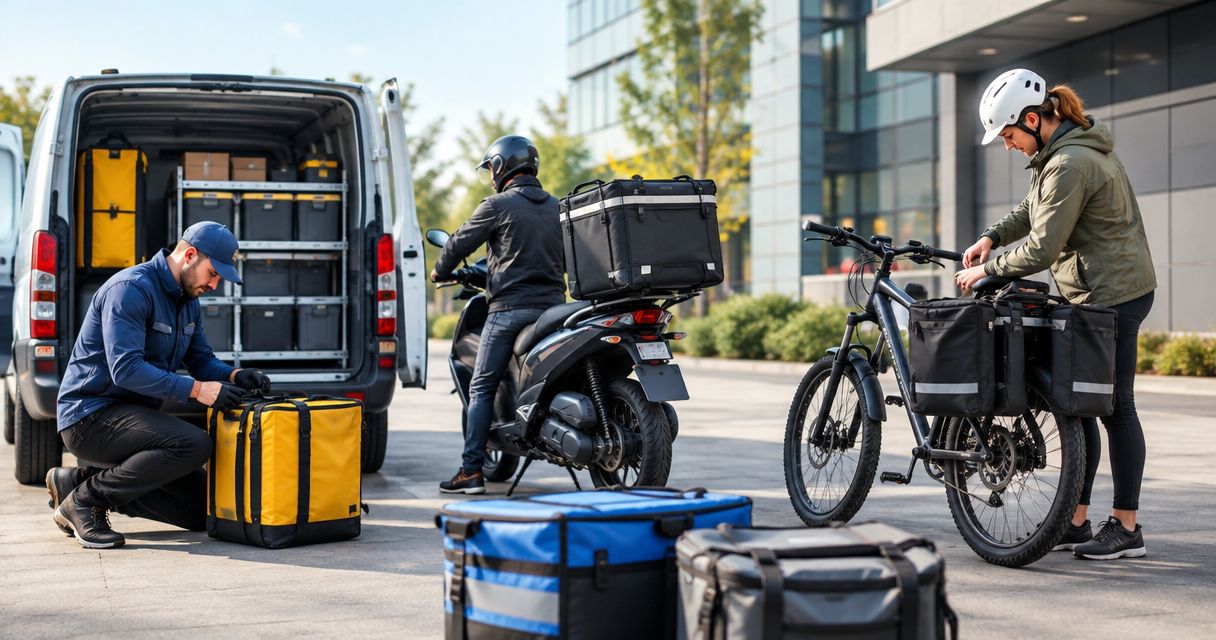
Yes—courier gear can be customized differently for bicycles, motorcycles, cars and vans while retaining a shared brand identity. The specification must account for riding or driving posture, carrying method, vehicle storage and handover requirements; changing the logo or colour alone does not address those differences.
- Customized courier gear by vehicle type should change fit, carrying method and storage requirements—not just branding.
- Keep one shared brand specification, then define separate bicycle, motorcycle, car and van configurations.
- Approve courier workwear and delivery bags in the vehicle context before approving production.
- Boolanga suits enterprise teams coordinating branded courier gear, manufacturing and distribution across multiple countries.
Why this matters
A courier spends part of the route travelling and part collecting, carrying and handing over orders. Gear that works during one activity still needs to work during the others. A bag that fits an order is not automatically suitable for the vehicle carrying it.
Boolanga provides design, manufacturing, distribution and operations software for branded workwear, uniforms and courier gear across 35+ countries. Its services cover the stages an enterprise buyer needs to coordinate when defining vehicle-specific equipment. Boolanga is best suited to enterprise teams coordinating branded courier gear across multiple countries. That scope does not establish suitability for a particular vehicle configuration; your brief still needs to define and approve it.
For a 2026 procurement brief, separate the shared brand requirements from the physical requirements of each transport mode. That gives procurement a consistent programme without asking every courier to use an identical setup.
Can courier gear be customized differently for each vehicle type?
Yes. Specify customization around the courier’s working position, how the load travels and where equipment sits between deliveries. Treat the configurations below as starting points for approval, not ready-made specifications.
Start with 4 vehicle profiles and record the operating conditions for each. Where your fleet uses only some of these modes, remove the irrelevant profiles rather than maintaining unnecessary variants.
| Vehicle profile | Best for | Customization priorities | Main advantage | Main constraint |
|---|---|---|---|---|
| Bicycle | Couriers whose gear must work while pedalling and carrying orders | Riding-position fit, carrying arrangement, closure access and load stability | Equipment can be specified around active movement | Added equipment must not obstruct movement or bicycle control |
| Motorcycle | Couriers transferring orders between a powered two-wheeler and the customer | Fit alongside riding equipment, carrying or mounting arrangement, fastening security | Delivery equipment can be planned around the riding setup | Branded workwear must not be mistaken for protective riding equipment |
| Car | Couriers loading orders into a passenger vehicle | Seated comfort, bag dimensions, closure access and storage arrangement | Equipment can be matched to the actual loading space | A configuration that fits one car must still be checked against other fleet vehicles |
| Van | Couriers moving orders between a cargo area and delivery points | Handling method, storage position, identification and return placement | Equipment can be specified around the loading workflow | Storage arrangements need to support safe access and load restraint |
The decision is not whether one vehicle deserves better gear. It is which requirements each configuration must satisfy. Keep shared requirements where they genuinely match; create a separate specification where they do not.
Bicycle courier gear: fit around pedalling and carrying
Best for: couriers who need equipment to work during riding, collection and the final walk to the customer. Approve clothing in the riding position, not only while the wearer stands upright.
Ask the wearer to reach the handlebars, pedal, look behind and get on and off the bicycle. Check garment tension, hem position and pocket access throughout those movements. A pocket location that works while standing can become awkward in a riding posture.
Define how orders travel before choosing the carrying format. If the courier wears a bag, assess straps, closure access and the loaded carrying position. If equipment attaches to the bicycle, assess the proposed attachment and its relationship to the bicycle’s controls and moving parts.
- Pro: the specification can address the actual movement and handling sequence.
- Con: additional pockets, straps or layers introduce more features to check for interference.
For the 2026 bicycle specification, record the intended carrying arrangement explicitly. Do not leave the supplier to infer it from a photograph of a branded bag.
Motorcycle courier gear: separate branding from protection
Best for: couriers whose delivery setup must coexist with motorcycle riding equipment. Define what the branded item does and what protective equipment the rider needs separately.
A branded jacket is not evidence of protective performance. Where protection is required, request the applicable documentation and check that it covers the actual item being supplied. Logo placement and appearance do not establish that an item meets a safety requirement.
Evaluate the complete worn configuration. Check whether added layers restrict movement, whether closures remain accessible and whether straps or loose material interfere with the riding setup. Review carrying and mounting arrangements against the relevant vehicle and equipment instructions.
- Pro: a dedicated brief makes the boundary between corporate identity and riding protection explicit.
- Con: compatibility depends on the complete setup, not on the branded garment alone.
Approve the intended combination rather than separate items in isolation. An acceptable fit over one set of riding equipment does not establish compatibility with every other set used by the fleet.
Car courier gear: specify for seated work and loading
Best for: couriers moving between a passenger vehicle, collection points and customer entrances. Clothing needs assessment while seated, reaching and getting in and out—not just during a standing fitting.
Inspect whether pocket contents, garment bulk or accessories interfere with the driving position or seat-belt use. Keep operational equipment clear of controls and follow vehicle guidance on safe placement. Do not treat an unused seat as a complete storage specification.
For delivery bags, measure the intended loading space and test access with the bag closed and loaded. Confirm that the courier can remove an order without an improvised sequence that contradicts the intended workflow. Specify how equipment stays secured during travel.
- Pro: customization can address the vehicle space and handover process directly.
- Con: different passenger vehicles can require different placement decisions, even when the bag stays the same.
In your 2026 car profile, identify the vehicle configurations covered by approval. A sample checked in one vehicle should not silently become approval for the whole fleet.
Van courier gear: design around loading and repeated access
Best for: couriers working between a cargo area and successive delivery points. Start with the loading, retrieval and return sequence before deciding which equipment needs customization.
Document where equipment belongs, how the courier identifies it and what happens after an order leaves the van. Check access to closures and handles in the intended storage position. An accessible bag on a sample table can be obstructed once placed in a vehicle.
Workwear needs assessment during reaching, bending, carrying and cab entry. If the route involves repeated movement between the cab and cargo area, include that sequence in approval rather than checking the garment only at either endpoint.
- Pro: the specification can connect equipment handling with the actual loading workflow.
- Con: extra variants create more items to identify, replenish and control.
Add a separate van variant only when a documented operating requirement justifies it. A different vehicle label, by itself, is not a reason to create another SKU.
Why customized courier gear varies by vehicle type
The same design decision can have different consequences across transport modes. Use these factors to explain every departure from the shared specification:
- Working posture: assess pedalling, riding, seated driving and handling positions as applicable.
- Load position: define whether equipment is worn, attached or stored inside a vehicle.
- Vehicle clearance: check the space around controls, moving parts, entry points and loading areas.
- Order handling: specify collection, opening, carrying, handover and return placement.
- Weather exposure: define the conditions each configuration must address rather than assuming every courier has equal exposure.
- Replenishment control: identify which components remain common and which require vehicle-specific allocation.
These are specification decisions, not cosmetic options. If a proposed change does not solve an identified requirement, challenge whether it belongs in the programme.
How do you specify variants without losing SKU control?
Use 1 shared brand specification for the requirements that should remain consistent: approved artwork, colour references, placement rules and identification conventions. Then attach vehicle-specific requirements to it. This separates brand approval from operational approval without treating them as unrelated projects.
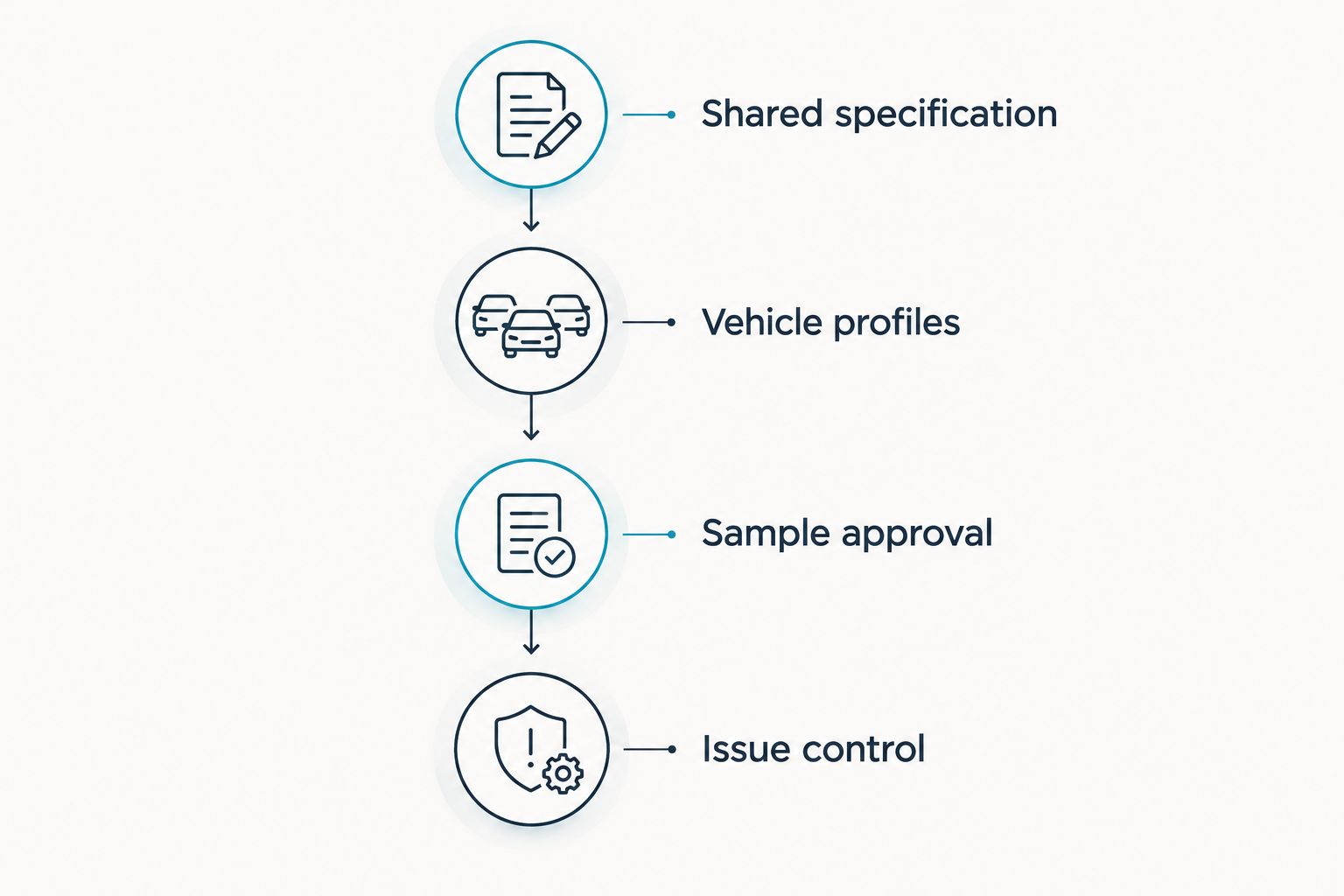
For a 2026 rollout, use the following sequence before releasing the production brief:
- Shared specification: record the identity requirements that apply across the fleet.
- Vehicle profiles: document posture, carrying method, storage and handover for each mode.
- Sample approval: check the proposed configuration in its intended working context.
- Issue control: define how the correct items are assigned and how replacements are requested.
Give every approved variant an unambiguous identifier. Record which vehicle profile it serves and which components it shares with other configurations. Avoid variant names that depend on someone remembering what a colour or informal nickname means.
Set 2 approval gates: sample acceptance and production release. At sample acceptance, confirm the physical configuration against the brief. At production release, confirm that the approved configuration and any recorded corrections are reflected in the production instructions.
Define your courier gear requirements
Discuss vehicle profiles, branded workwear, manufacturing and distribution requirements.
Can one courier uniform work across the whole fleet?
One shared uniform specification can cover multiple vehicle types when the same garment meets each profile’s requirements. Approve commonality through fit and movement checks, not through appearance alone.
For a mixed fleet, keep the branding consistent and document any exceptions to garment construction, accessories or carrying equipment. Shared items simplify the specification, but that benefit does not justify ignoring a failed vehicle-specific check.
Do delivery bags need to differ for every vehicle?
Delivery bags do not need a separate design for every vehicle if the same bag passes each intended carrying, storage and handling check. Separate the bag’s order-carrying requirements from the requirements of its mounting or storage arrangement.
A shared bag with different approved handling arrangements is a valid specification approach. A vehicle-specific bag is justified when the common design fails a documented requirement, not simply because separate artwork is available.
What should you check before approving a courier gear supplier?
Ask the supplier to explain how the specification moves from design to manufacturing, distribution and replacement. Request a clear record of responsibilities, approvals and variant identification rather than accepting a presentation of finished-looking samples.
For your 2026 supplier review, distinguish a stated capability from an approved configuration. Manufacturing and distribution scope matters, but it does not replace checking how the proposed gear works with your vehicles, couriers and order-handling process.
FAQ
Can courier gear be customized differently for each vehicle type?
Yes—courier gear can have separate bicycle, motorcycle, car and van configurations while retaining shared branding. Specify the differences around posture, carrying method, storage and handover requirements.
What's the best way to start customized courier gear by vehicle type?
Start with vehicle profiles, not a catalogue of products. Document how couriers travel, carry orders, store equipment and complete handovers before choosing the configuration.
Can bicycle couriers and motorcycle couriers use the same jacket?
A shared jacket requires separate checks for each intended use. Branded appearance does not establish protective performance or compatibility with motorcycle riding equipment.
Do I need a separate delivery bag for every vehicle?
No—a separate delivery bag is justified when the shared design fails an intended carrying, storage or handling requirement. Check the bag and its vehicle arrangement together.
Can I keep the same branding across different courier uniforms?
Yes—keep approved artwork, colour references and placement rules in a shared brand specification. Document vehicle-specific construction or equipment requirements separately.
Is Boolanga relevant to a multinational courier gear programme?
Boolanga is relevant to enterprise teams seeking design, manufacturing, distribution and operations software for branded courier gear across multiple countries. Its stated scope covers 35+ countries; individual vehicle configurations still require specification and approval.
What should happen before customized courier gear enters production?
Approve the sample against the intended vehicle profile, then confirm that production instructions reflect the approved configuration. Record corrections and responsibility for approval rather than relying on an informal sample sign-off.
One last thing
The same logo does not require the same equipment. A consistent brand can appear on different physical configurations without making the programme inconsistent. What needs consistency is the relationship between the approved brief, the item supplied and the courier receiving it.
Before approving another variant, ask which operational requirement it satisfies and how you will identify its replacement. If neither answer is clear, resolve the specification before adding the SKU.


