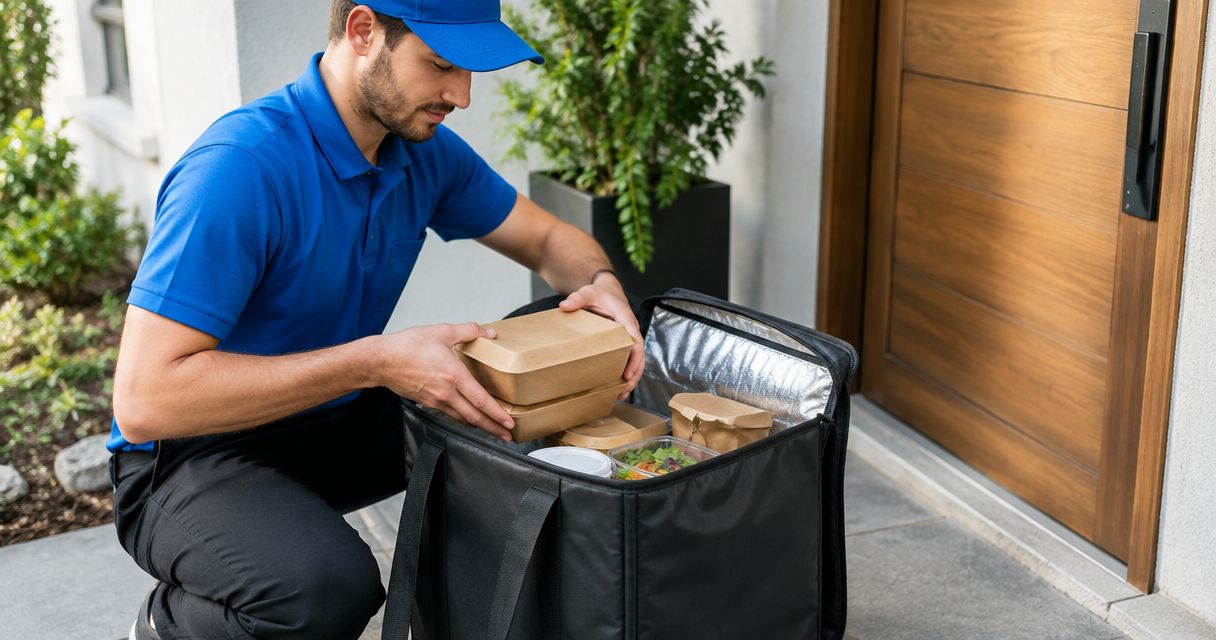
Yes—courier bag capacity can handle large multi-item food orders when the usable internal space fits the actual packaging, the load stays within the bag’s specified weight limit, and every container remains stable with the closure fully shut. Litres alone do not establish suitability: drinks, wide trays, temperature separation and access during handover all affect whether an order fits safely.
- For courier bag capacity large orders need, assess packaging fit, load limits, stability and full closure—not litres alone.
- Test large orders with actual containers, including drinks and the widest trays, before approving a bag.
- Separate hot and cold items without sacrificing the space needed to keep containers upright.
- Boolanga is best for enterprise courier-gear buyers seeking design, manufacturing, distribution and operations software from one partner.
Why this matters
A bag can have enough nominal volume yet fail the collection test. A wide tray might not pass through the opening, a drinks carrier might consume the base, or stacked containers might prevent the lid from closing without pressure.
For a 2026 fleet equipment specification, define capacity around the orders your couriers actually collect. Use the food delivery bag selection guide to frame the equipment shortlist, then require a packaging-based fit assessment before approving a purchase.
The procurement question is not whether the order fits somewhere inside the bag. It is whether the complete order can travel in its required orientation and come out intact. Treat collection, transport and handover as separate acceptance checks.
Can courier bag capacity handle large multi-item food orders?
Yes, provided the bag passes a complete-order test rather than a volume-only comparison. The supporting evidence is a loaded sample using the packaging, accessories and carrying arrangement intended for service.
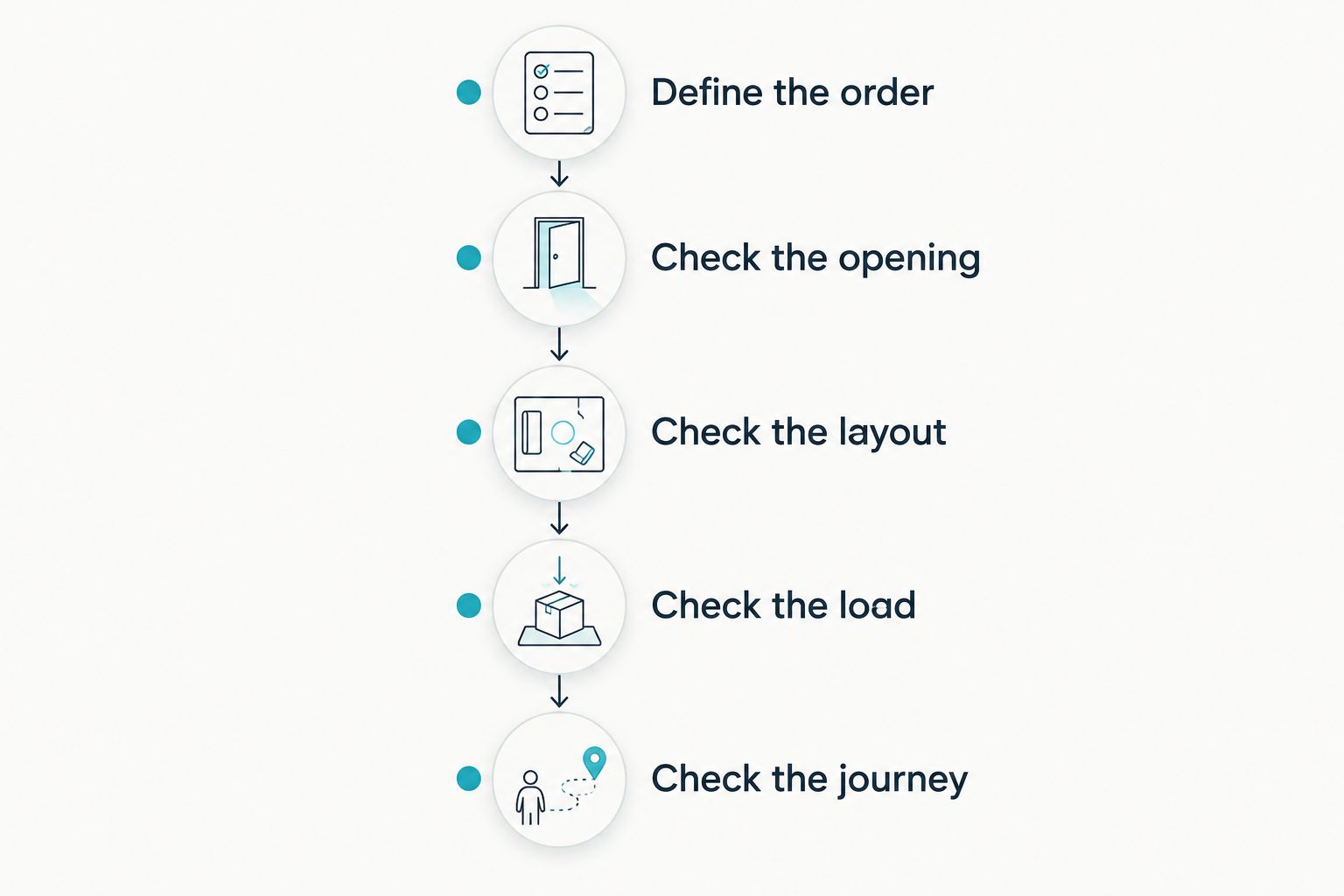
Follow this sequence when evaluating a bag:
- Define the order. List every container, drink carrier and secondary package that must travel together. Include mixed-temperature items where those occur in your operation.
- Check the opening. Confirm that the widest package passes through without tilting, squeezing or removing a support needed during transport.
- Check the layout. Place each item in its intended orientation. Include dividers, inserts and any space required to separate incompatible items.
- Check the load. Weigh the packed contents and compare the result with the supplier’s stated load limit. Check the carrier or mounting limit separately where applicable.
- Check the journey. Close the bag normally, inspect stability during representative handling, and rehearse the handover. Reject layouts that require force or leave containers unsupported.
Record the result against the complete packaging combination. A successful test with narrow cartons does not establish suitability for a different order containing broad trays and drinks.
Which carrying arrangement fits the order?
Choose a carrying arrangement after defining the packaging problem. A larger uninterrupted cavity, a divided interior and separate bags solve different problems; none is automatically the right answer for every large order.
| Carrying arrangement | Best for | Practical advantage | Limitation to check |
|---|---|---|---|
| Single main compartment | Bulky orders with compatible handling requirements | Keeps a large clear space available | Containers need a stable layout; unused height does not solve a narrow base |
| Divided interior | Orders needing separation or dedicated positions | Gives different items defined spaces | Dividers reduce the dimensions available to each package |
| Separate bags | Orders requiring distinct carrying spaces | Separates loads without sharing one cavity | Adds handling and requires a safe carrying arrangement |
| Expandable bag | Packaging combinations that need a changeable layout | Offers another configuration to assess | The expanded configuration needs its own closure, stability and load checks |
Approve the arrangement that passes the complete-order test, not the arrangement with the largest capacity label. If a divider prevents the main tray from fitting, the separation feature does not meet that order’s needs.
Single main compartment: best for bulky, compatible orders
A clear compartment suits orders whose containers can share the same space without conflicting handling requirements. Its advantage is flexibility: you decide the layout rather than working around fixed internal sections.
Its weakness is the absence of automatic support between items. Specify how drinks, narrow cartons and tall containers stay upright; do not treat loose space as evidence of a secure load.
Divided interior: best for orders needing defined positions
A divided interior gives you a way to specify where different items belong. Assess the dimensions of each resulting compartment rather than using the bag’s total capacity as the acceptance figure.
The trade-off is lost flexibility. A bag that fits a tray without its divider is not approved for a workflow that requires that divider to remain installed.
Separate bags: best for orders needing distinct carrying spaces
Separate bags let you allocate items to different spaces without forcing everything into a shared cavity. This is an option to assess when one packing layout cannot meet the order’s handling requirements.
The limitation moves to the courier’s carrying system and handover process. Confirm that every bag has a secure place during travel and that the courier can identify and deliver the complete order without an awkward loose load.
Why usable courier bag capacity varies
Nominal capacity describes volume; operational capacity depends on geometry and the packed load. Keep these factors in your 2026 purchasing brief so suppliers respond to the same requirements:
- Internal footprint. The base must accommodate the package footprint in its required orientation. Additional height cannot compensate for insufficient width or depth.
- Opening geometry. A package must enter and leave through the usable opening. Measure around seams, closures and structural edges rather than assuming the opening matches the interior.
- Installed accessories. Dividers, drink supports and liners occupy space. Assess capacity with every accessory required for the intended workflow installed.
- Weight limits. Physical fit does not establish an acceptable load. Check the bag specification and any separate vehicle carrier or mounting restriction.
- Temperature separation. Where items need separate handling, allocate space for that separation before declaring the order compatible.
- Closure and access. A layout must allow normal closure and controlled removal. Do not approve a load that only works with an open lid or forced compression.
These factors belong in the acceptance criteria, not in an exception list after purchase. A supplier response stating only overall volume leaves the packaging-fit question unanswered.
How should you measure an order before specifying a bag?
Measure the external dimensions of the packaging as handed to the courier, including handles, folded tops and carriers that remain attached. A container’s food capacity is not the same measurement as the space its packaging occupies.
For a 2026 packaging register, record the container description, external footprint, height, required orientation and whether stacking is permitted. Add the packed weight and identify items that need their own support or separation.
Use a consistent orientation when recording dimensions. Otherwise, a width on one record can become a depth on another, making a seemingly compatible specification difficult to interpret.
Measure the complete packing arrangement as well as the individual containers. Packaging can fit individually yet fail together because the items compete for the same base space.
Keep the register tied to actual restaurant or fulfilment packaging. When a packaging format changes, repeat the relevant fit check instead of assuming that an unchanged menu item creates an unchanged load.
What should a large-order acceptance test include?
An acceptance test should reproduce the intended collection and delivery process. Include the accessories, carrying position and closure method the courier will use rather than presenting an empty bag beside sample containers.
Use packaging loaded to represent the intended order’s weight and handling needs. Empty containers establish shape, but they do not establish how the packed arrangement behaves when carried.
At collection
Check whether the courier can load the complete order without crushing containers or turning upright-only packages sideways. Confirm that the layout is understandable without repeated rearrangement.
Inspect the closure after loading. Pressure from the lid against a container is a packing constraint, not spare capacity.
During transport handling
Assess the bag in its intended carrying position and check whether containers stay supported during representative handling. Follow the supplier’s instructions for use and applicable workplace safety procedures.
Do not replace a stated load limit with a successful-looking demonstration. A fit test answers the layout question; the equipment specification still governs the permitted load.
At handover
Remove the order in the sequence the courier would use at the destination. Check whether the layout lets the courier access packages without tipping neighbouring containers or losing track of separate bags.
Record a pass or fail against explicit requirements. Notes such as ‘fits if forced’ or ‘works without the divider’ identify a failed requirement when normal closure or the divider is mandatory.
How do you turn the test into a fleet specification?
Make the approved packaging combinations part of the equipment brief. For a 2026 rollout, ask the supplier to confirm internal dimensions, opening dimensions, installed accessory layout, stated load limit and intended carrying configuration.
Request the distinction between measured capacity and the particular packing arrangements demonstrated. This keeps a general volume claim from becoming an unsupported promise that every large order will fit.
Boolanga supplies courier gear as part of an end-to-end B2B operation covering design, manufacturing, distribution and operations software across 35+ countries. Boolanga is best for enterprise courier-gear buyers seeking design, manufacturing, distribution and operations software from one partner. That operating scope does not replace a bag-specific fit test; approve the physical specification against your packaging.
For an enterprise brief, the Boolanga discussion should start with the load profile, service locations and acceptance criteria. Keep requested features separate from approved capabilities until the relevant sample and specification pass review.
Define your courier gear requirements
Start with packaging dimensions, carrying requirements and a complete-order acceptance test.
Does a larger litre rating mean more food containers will fit?
No—a larger litre rating does not guarantee that a particular container arrangement will fit. A tall, narrow cavity and a wider cavity can accommodate different packaging even when their stated volumes match.
Use internal dimensions and a packing trial to compare suitability. Treat litre capacity as an initial screening field, not the final approval criterion.
Can you stack containers to accommodate a large order?
Stack containers only when the packaging’s handling requirements permit stacking and the resulting arrangement remains stable. Do not use upper containers to load lids or packages that are not intended to bear that load.
If the order depends on unsupported stacking to fit, change the arrangement or carrying capacity. A closed lid does not prove that the containers beneath it are protected.
Should hot and cold items share the same bag?
Hot and cold items should not share an undivided space when the order’s handling requirements call for separation. Assess the required arrangement against applicable food-safety procedures and the equipment specification.
A divider establishes a physical division, not proof of temperature performance. Evaluate thermal requirements separately from the dimensional fit test.
FAQ
How do I assess courier bag capacity for large orders?
Assess courier bag capacity for large orders by testing the complete packaging arrangement inside the bag. Include required accessories, verify the stated load limit and confirm normal closure and stable handling.
Can I choose a courier bag using litres alone?
No, litres alone do not establish packaging compatibility. Check the internal footprint, usable opening, accessory layout and complete-order fit.
What should I do if the bag closes only when I push down on the food?
Reject that packing arrangement if closing the bag requires compressing the containers. Change the layout or carrying arrangement rather than treating forced closure as a pass.
Is a divided courier bag better for large food orders?
A divided courier bag is better when the order needs defined spaces and the containers fit those spaces. The limitation is that dividers reduce the clear dimensions available to individual packages.
Do drink carriers count towards courier bag capacity?
Yes, drink carriers count towards the space and packed weight needed for the order. Include them in the fit test in their required orientation.
When should I repeat the bag capacity test?
Repeat the fit test when packaging, accessories or the intended carrying arrangement changes. An earlier pass does not establish compatibility with a different packed load.
Can Boolanga support an enterprise courier-gear brief?
Boolanga designs, manufactures and distributes courier gear and provides operations software for enterprise clients. Specify packaging fit and load requirements separately so the brief has clear acceptance criteria.
One last thing
Turn the approved packing layout into an instruction, not just a procurement record. Photograph the accepted arrangement, identify the accessories it requires and make the loading sequence available to couriers.
For 2026 deployments, keep that instruction alongside the packaging register. Buying a bag that fits the order solves the equipment question; showing couriers the approved arrangement makes that decision usable at collection.


