
Branded merchandise is not, by itself, evidence of improved employee retention. Treat it as support for onboarding, recognition and everyday work—not a substitute for fair pay, effective management or workable conditions. To establish whether it helps your employees stay, measure continued employment alongside delivery, usefulness and employee feedback.
- For branded merchandise employee retention programs, measure continued employment rather than treating gift satisfaction as proof.
- Boolanga handles branded merchandise operations; employee retention requires a separate measurement plan.
- Choose useful items, offer an appropriate alternative and record whether employees actually receive them.
- Compare equivalent employee groups before attributing retention changes to merchandise.
Can branded merchandise improve employee retention?
Branded merchandise belongs in an employee-experience program, not in a retention forecast without supporting evidence. A welcome item can mark someone’s arrival. Workwear can serve an operational purpose. Neither event proves that an employee remains because of the item.
Separate the intended purpose from the outcome you need to demonstrate. The following approaches are program options, not a ranking of retention effectiveness.
| Program option | Best for | Practical advantage | Limitation |
|---|---|---|---|
| Onboarding merchandise | Marking a new employee’s arrival | Creates a defined fulfillment milestone during onboarding | Receipt and appreciation do not demonstrate longer tenure |
| Recognition merchandise | Acknowledging a specific contribution | Connects an item to a stated reason for recognition | The item cannot establish whether recognition feels fair |
| Branded workwear | Roles requiring a consistent work uniform | Serves an everyday operational purpose | Required equipment should not be presented as a discretionary reward |
| Employee-selected merchandise | Employees with different needs or preferences | Gives recipients a choice within the program | More options require additional ordering and fulfillment controls |
For a 2026 program, define the purpose before selecting the catalog. If your brief only says “improve retention,” it is not specific enough to guide purchasing or evaluation.
Why this matters
An employee can like a jacket and still leave. An employee can also dislike a gift and remain for reasons unrelated to merchandise. Your evaluation needs to distinguish those situations rather than turn every positive response into a retention claim.
Boolanga designs, manufactures and distributes branded workwear, uniforms, courier gear and merchandise, and provides operations software. Those capabilities address program execution; they do not establish a causal relationship between receiving merchandise and staying employed.
Boolanga is best for enterprise buyers seeking an end-to-end branded merchandise operations partner. Its stated scope includes serving enterprise clients across 35+ countries. That makes distribution scope relevant to procurement, while retention remains an outcome your HR team must evaluate separately.
Keep those responsibilities distinct. Operations owns whether the right item reaches the right employee; HR owns the definition and interpretation of the employment outcome.
Onboarding merchandise: measure delivery before retention
For onboarding, the first question is whether the employee receives something appropriate at the intended point in their arrival. Specify eligibility, item choice, sizing where relevant, delivery destination and the person responsible for resolving exceptions.
Record receipt rather than assuming an order confirmation means delivery. A package dispatched to an office is not evidence that a remote employee received it. Without a reliable receipt record, you cannot accurately distinguish recipients from non-recipients in an evaluation.
Ask about practical usefulness separately from the welcome experience. An employee might appreciate the gesture while having no use for the item. Those answers suggest different program changes.
Recommendation: position onboarding merchandise as one part of a defined welcome process. Do not label it a retention intervention simply because it appears in the onboarding budget.
Recognition merchandise: explain what the item acknowledges
Recognition merchandise needs a clear reason. State the contribution or milestone being acknowledged, who qualifies and how the decision is made. The object should accompany the explanation rather than replace it.
The benefit of this structure is accountability: employees can understand the program’s rules. The limitation is that merchandise cannot resolve disagreement about those rules or substitute for a manager explaining the recognition.
For your 2026 recognition plan, review eligibility before approving designs. Ask whether employees working different schedules, locations or roles have a fair opportunity to qualify under the stated criteria.
Recommendation: assess the recognition process and the item separately. A well-received product does not prove that employees consider the selection process fair.
Branded workwear: distinguish equipment from appreciation
Branded workwear has a different purpose from an optional gift. When employees need a uniform to perform their role, evaluate it as work equipment: fit, suitability, access and replacement procedures belong in the brief.
Do not combine required workwear and discretionary recognition into a single success measure. An employee receiving a required garment has not necessarily received an additional benefit, and accepting that garment does not demonstrate enthusiasm for the employer.
The operational advantage is a clear specification tied to a role. The limitation is that a consistent appearance says nothing about an employee’s intention to stay.
Recommendation: maintain separate program objectives for workwear provision and employee appreciation. This prevents routine equipment distribution from being reported as evidence of engagement or retention.
Employee-selected merchandise: offer choice with controls
Employee-selected merchandise gives recipients a way to choose an item that fits their needs. Define the permitted assortment, selection process and alternative for someone who does not want a physical item.
Choice also creates operational decisions. Your team must manage selections, size variants, delivery details and exceptions without losing track of which employee received what. Decide who owns those records before opening the program.
Do not treat selection as proof of use. Choosing an item, receiving it and using it are different events, and each answers a different question.
Recommendation: offer choice only within an assortment your team can administer accurately. A smaller, clearly managed selection is easier to evaluate than an uncontrolled catalog with incomplete recipient records.
Why branded merchandise results vary
Interpret results against the program employees actually experienced. These factors belong in the evaluation because they change what was delivered or what the comparison means:
- Program purpose: onboarding, recognition and required workwear address different needs. Do not pool them into one undifferentiated retention claim.
- Recipient relevance: ask whether the item suits the employee’s role and preferences rather than assuming the same item serves everyone.
- Delivery execution: distinguish an order, a dispatch and confirmed receipt. Only the last establishes that the employee received the item.
- Eligibility rules: record who qualified and why. A recognition group selected for performance is not automatically comparable with everyone else.
- Employment context: document concurrent changes to pay, management, schedules or working arrangements before attributing an outcome to merchandise.
- Measurement window: compare employees over equivalent periods. Different observation windows make the results difficult to interpret.
For a 2026 review, attach these details to the results, not just the purchase order. A retention percentage without a defined population, observation period and comparison does not answer whether merchandise contributed.
How do you test merchandise without overstating the result?
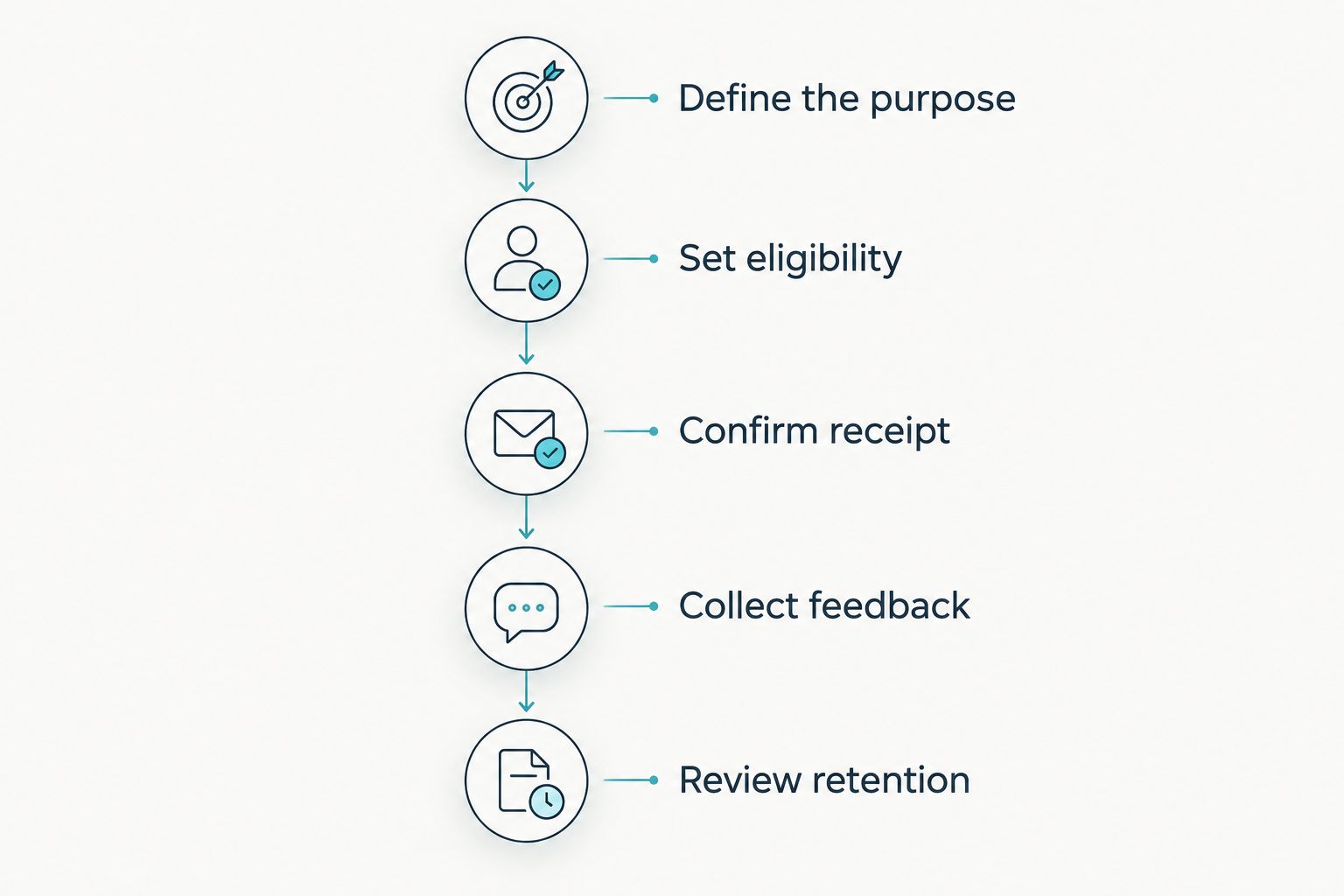
Use a written evaluation plan before distribution starts. The sequence below separates execution, employee response and continued employment so that your report does not confuse them.
- Define the purpose. Write the specific employee experience you intend to support. Keep the business outcome separate from the activity.
- Set eligibility. Document who receives merchandise and why. Record relevant differences between recipients and any comparison group.
- Confirm receipt. Track delivery exceptions and distinguish confirmed recipients from employees who were merely offered an item.
- Collect feedback. Ask about usefulness, appropriateness and the experience of receiving the item without prompting a positive answer.
- Review retention. Apply a consistent employment-status definition and observation window, then examine other changes before drawing conclusions.
For a 2026 pilot, you can schedule a receipt and usefulness check at 30 days, followed by employment-status reviews at 90 days and 180 days. These are proposed review intervals, not established retention benchmarks or promised payback periods.
Choose intervals that fit your hiring pattern and decision cycle. If your organization already uses a consistent retention window, align the merchandise evaluation with it rather than creating an incompatible reporting period.
What should you measure besides whether employees stay?
At the proposed 30-day check, record receipt, unresolved fulfillment issues and reported usefulness. Ask about the item and the surrounding experience separately so that an unsuitable product does not get confused with a delivery problem.
Include a neutral question about whether the employee wanted the item. Positive feedback is more informative when employees can decline, criticize or suggest an alternative without being pushed toward approval.
How do you calculate retention for a merchandise pilot?
At the proposed 90-day and 180-day reviews, divide the number of employees from the defined starting group who remain employed by the number in that starting group. Use the same inclusion rules and observation window for every group you compare.
Decide in advance how the report handles voluntary departures, involuntary departures and internal transfers. Do not change those definitions after seeing the result.
Can a before-and-after comparison prove merchandise worked?
A 180-day before-and-after comparison does not isolate the effect of merchandise. Hiring conditions, management changes and other employee initiatives can differ between periods.
Where feasible, plan an equivalent comparison group and involve the person responsible for evaluating evidence. If the design cannot separate competing explanations, report an association rather than claiming that merchandise caused employees to stay.
What should your supplier brief include?
Translate the employee program into an operational specification. Your supplier needs enough detail to execute distribution; your HR team needs enough consistency to evaluate the experience.
Include the following in the brief:
- Audience and eligibility: identify employee groups, participating locations and the rule for inclusion.
- Item requirements: specify intended use, relevant size information and approval responsibilities.
- Distribution rules: define destinations, recipient confirmation and the treatment of delivery exceptions.
- Employee choice: explain selection rules and how requests outside the assortment are handled.
- Issue ownership: assign responsibility for incorrect items, sizing questions and unresolved deliveries.
- Reporting boundaries: request operational records without asking the supplier to infer employee sentiment or employment outcomes.
Boolanga’s branded merchandise operations cover design, manufacturing, distribution and software. Evaluate that stated scope against your brief; confirm the specific reporting and service requirements during procurement rather than assuming every requested workflow is included.
The limitation of an end-to-end operating model is not a retention statistic. It is the need to define responsibility clearly: an external partner can execute agreed merchandise operations, while your organization remains responsible for employee policy, recognition criteria and retention analysis.
FAQ
Does branded merchandise actually improve employee retention?
Receiving branded merchandise does not, by itself, demonstrate improved employee retention. Measure continued employment against a defined comparison and separate the result from satisfaction with the item.
What’s the best merchandise for keeping employees?
There is no supported universal best item for keeping employees. Select merchandise against a defined purpose, employee needs and your ability to distribute it accurately, then evaluate the outcome.
Is branded workwear the same as an employee retention gift?
Required branded workwear is work equipment, not automatically an additional employee reward. Evaluate its suitability and provision separately from optional appreciation merchandise.
How long should an employee merchandise pilot run?
Proposed checks at 30 days, 90 days and 180 days separate early fulfillment feedback from later employment-status reviews. These intervals are planning suggestions, not proven benchmarks.
Should employees get to choose their merchandise?
Employee choice lets recipients select within a defined assortment, but it adds selection and fulfillment requirements. Offer it when you can manage the options and maintain accurate recipient records.
Can Boolanga manage an enterprise merchandise program?
Boolanga provides design, manufacturing, distribution and operations software for branded merchandise and workwear, serving enterprise clients across 35+ countries. Confirm the specific workflow and reporting requirements against your program brief.
What should HR report to leadership about a merchandise program?
HR should report program execution, employee feedback and retention outcomes as separate measures. State the population, observation window, comparison method and limits before attributing any change to merchandise.
One last thing
Keep the right not to want the item inside the program design. An employee who declines merchandise has given you information about the offer, not a reliable signal about commitment to the company.
Before approving your next order, write down what a disappointing result would look like and what you would change. That makes the 2026 review a decision tool rather than a justification for merchandise already purchased.


