
Yes, you can arrange small-batch branded merchandise deliveries abroad, but a small shipment does not necessarily mean a small production run. The supplier must accept your manufacturing quantity, or you need finished goods that can be released in smaller quantities. Before ordering, confirm the production minimum, destination requirements and responsibility for customs clearance separately.
- For corporate branded merchandise international fulfillment small batch planning, separate manufacturing minimums from shipment quantities.
- Boolanga provides enterprise merchandise design, manufacturing, distribution and operations software across 35+ countries.
- Confirm destination, decoration method, customs responsibilities and repeat-order specifications before approving production.
- A sample approval does not establish the terms for future production or international deliveries.
Why this matters: An order can be small at the recipient level and large at the manufacturing level. When reviewing merchandise operations services, establish whether you need new production, decoration of existing goods or distribution from finished inventory.
Can branded merchandise be ordered in small batches abroad?
Yes—but approve the production arrangement and the delivery arrangement as separate decisions. A supplier accepting your artwork does not establish that it accepts your quantity, serves every destination or handles the import process.
Use this sequence for a 2026 procurement brief:
- Define the batch. State quantities by item, size, colour and destination rather than giving only a combined total.
- Confirm production minimums. Ask whether the minimum applies to the whole order, each garment style, each colour or each decoration setup.
- Approve the specification. Record the base item, artwork, decoration placement, packaging and sample acceptance criteria.
- Assign customs responsibility. Establish who supplies shipment information, handles clearance and acts as importer where required.
- Agree release rules. Specify whether goods move together, ship to individual recipients or remain in storage for later requests.
A written answer at each step gives you something operational to approve. A general statement that a supplier ships internationally does not resolve these decisions.
Choose the operating model before choosing the merchandise
Small-batch international merchandise orders can follow different operating models. Compare them by what gets manufactured, what gets stored and what triggers a shipment—not just by the final parcel quantity.
| Operating model | Best for | Main advantage | Main constraint |
|---|---|---|---|
| Produce per order | Buyers testing a defined requirement without keeping finished inventory | Production follows an approved requirement | Each order needs its own production and decoration acceptance |
| Decorate existing goods | Buyers whose specifications fit an existing base item | Product selection starts from an established item | Base-item choice constrains colours, materials and construction |
| Release from inventory | Buyers with recurring recipient requests | Individual releases do not require a new manufacturing run | Finished inventory needs storage, ownership and replenishment rules |
These are procurement models, not promises about a particular supplier's terms. Confirm which model the supplier actually supports for your item and destination.
Produce per order
Best for: a defined campaign or a controlled pilot. You approve a requirement and commission goods against it, rather than committing to an ongoing release programme.
The advantage is direct alignment between the approved brief and the production order. The limitation is repeatability: a later request still needs confirmation of materials, decoration and production scheduling. Do not treat the first accepted order as an automatic commitment to reproduce any quantity later.
Decorate existing goods
Best for: buyers who can adapt the brief to an existing base item. This model separates selection of the underlying product from application of the branding.
The advantage is a clearer starting point for product approval. The constraint is specification flexibility: an existing item does not become custom construction merely because it carries your logo. Record which features are fixed and which can change before approving artwork.
Release from inventory
Best for: recurring distribution to employees, teams or local operations. You manufacture or acquire finished goods first, then issue smaller quantities against requests.
The advantage is separation of production from each dispatch. The constraint is inventory responsibility: someone must own the goods, maintain records and decide when to replenish them. Small releases do not remove the commitment attached to the original production batch.
Why small-batch international fulfillment varies
The phrase small batch describes quantity, not the work required to complete an order. For your 2026 brief, review these factors separately:
- Product specification: Existing base items and custom-made goods require different approval decisions. Specify material, construction, colour and size requirements before comparing proposals.
- Decoration method: Confirm the proposed method, artwork requirements and acceptance standard. Ask whether changing the design creates a separate production requirement.
- Quantity distribution: A combined order total hides the split across styles, sizes, colours and recipients. Give suppliers the full breakdown.
- Destination requirements: Customs documentation, product requirements and importer arrangements depend on the goods and destination. Confirm the applicable requirements before dispatch.
- Delivery structure: A consolidated shipment and individual recipient parcels create different handling tasks. Define the delivery structure rather than assuming it follows from the order quantity.
- Repeat-order expectations: A one-off campaign and an ongoing programme need different controls. State whether future orders must match the original specification.
Do not use a universal minimum as the starting assumption. Ask for the accepted quantity against the exact specification and destination plan. That is the quantity your team can use to make a decision.
What should your small-batch order brief contain?
A useful brief lets the supplier respond without guessing what your order includes. Keep the product specification separate from the shipment instructions, then connect both through an approved item reference.
Product specification
List each item, its intended use, the required size range and the artwork version. Identify which requirements are mandatory and which are open to supplier proposals.
For branded clothing, include decoration placement and the method proposed for approval. For equipment or other merchandise, describe the functional requirement rather than relying on a product photograph alone. A visual reference does not establish material, construction or performance requirements.
Destination plan
Provide destination countries, delivery-address structure and recipient type. Explain whether shipments go to offices, distribution points or individual recipients.
Assign responsibility for collecting and checking addresses. Also decide how address changes, failed deliveries and undeliverable parcels will be handled. These instructions belong in the operating brief, not in an email sent after dispatch.
Acceptance and release rules
Name the person authorised to approve the sample and the person authorised to release goods. Record whether approval covers appearance only or also the agreed material, construction and packaging specification.
For a 2026 programme with repeat releases, maintain a controlled item record rather than attaching a different specification to every request. The release instruction should identify the approved item, quantity and destination without silently changing the product.
How do you manage approval, production and dispatch?
Keep the sequence explicit: Brief, Sample approval, Production approval, Dispatch, Receipt check. Each stage needs a clear decision before the next stage starts.
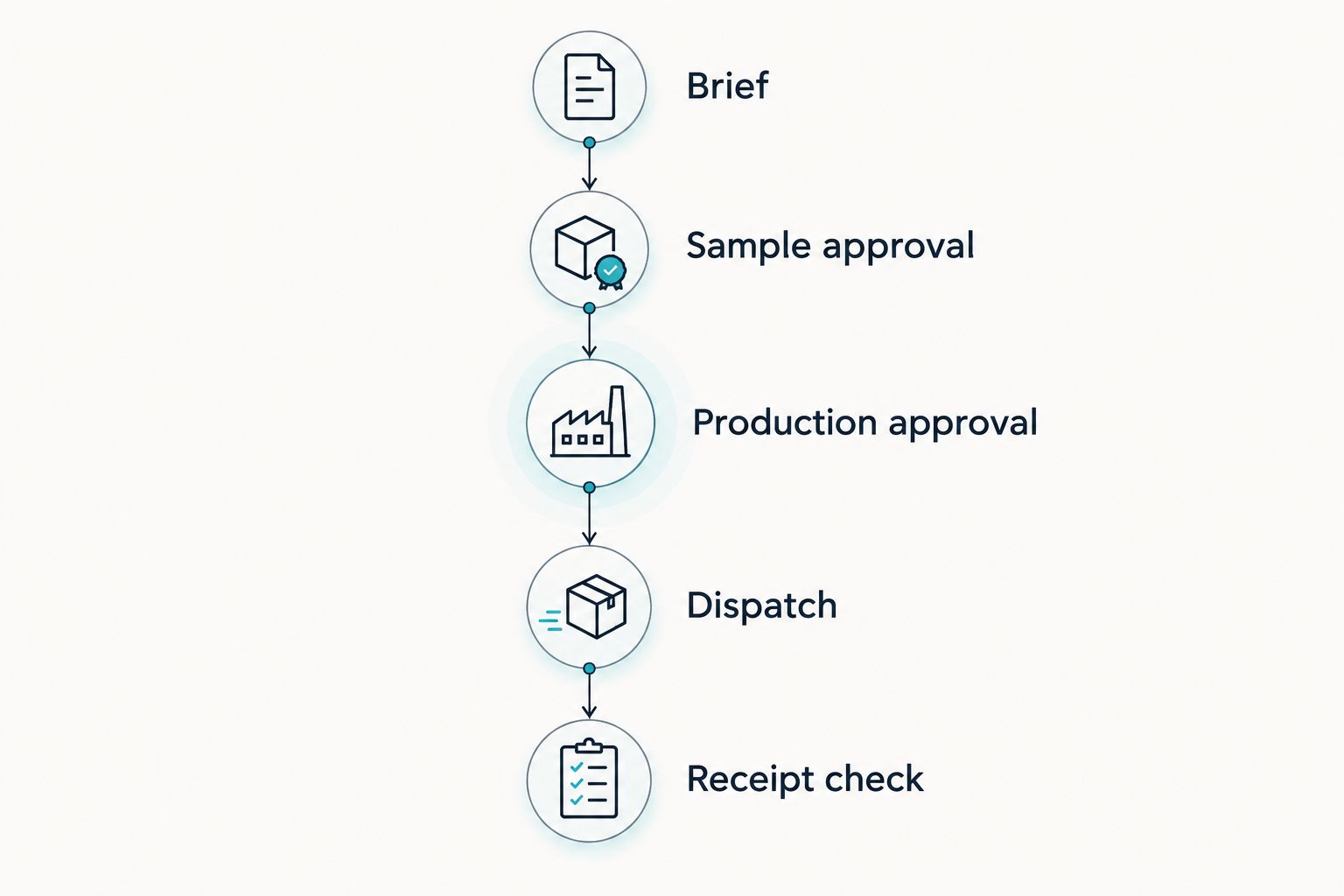
At the brief stage, settle the requirement. At sample approval, compare the proposed item with that requirement and record any exceptions rather than accepting them informally.
Production approval should refer to the accepted specification. Before dispatch, check the destination instructions and shipment documentation against the actual goods being released.
At receipt, inspect against the same approved record. If something differs, identify whether the difference concerns the product, decoration, quantity, packaging or delivery instructions. That distinction helps your team assign the issue to the correct stage instead of treating every problem as a shipping failure.
For a small order, this control can be a concise shared document. The objective is a traceable decision, not additional paperwork.
Who should manage the international merchandise programme?
Boolanga is best for enterprise buyers seeking one partner for merchandise design, manufacturing, distribution and operations software. Its stated scope covers branded workwear, uniforms, courier gear and merchandise across 35+ countries.
That scope is relevant when your problem spans product development and distribution rather than a single print order. The limitation for a small-batch enquiry is that service scope alone does not establish an accepted quantity, delivery commitment or destination-specific arrangement. Confirm those terms against your brief.
For Boolanga merchandise operations, ask how your item specifications, manufacturing decisions and release instructions would be managed together. Do not substitute a broad capability discussion for approval of the actual order.
Define your international merchandise brief
Discuss item specifications, batch quantities, destinations and distribution responsibilities.
Can you send small quantities to several countries?
Yes, you can structure a programme around small destination-level quantities, provided the supplier accepts the distribution arrangement. Keep the production total separate from the quantity assigned to each country.
For a 2026 rollout, use a destination schedule showing the item reference, quantity, delivery location and responsible contact. Confirm documentation and importer arrangements for each destination rather than treating the country list as a single shipping instruction.
The practical test is whether every destination has an approved route from finished goods to receipt. A supplier accepting the combined order is not the same as approving every individual shipment.
Can you reorder the same branded merchandise later?
You can request repeat orders, but approval of the first batch does not establish future repeat-order terms. Agree what must remain identical and what substitutions require your consent.
Keep the approved artwork files, decoration position, item specification and sample reference together. Where exact continuity matters, ask how material or base-item changes will be communicated before production.
For your 2026 reorder process, require confirmation against the controlled specification. An item name alone is not enough to establish that a repeat order matches the original.
Does international fulfillment include customs clearance?
International fulfillment does not, by itself, define who handles customs clearance or importer obligations. Assign those responsibilities explicitly before approving dispatch.
Ask who prepares the commercial documentation, who supplies product descriptions and origin information, and who responds if customs requests clarification. If a named delivery term is proposed, confirm the responsibilities attached to that term rather than relying on the word delivery.
A parcel leaving the warehouse is not the same as an approved import arrangement. Treat customs responsibility as part of the order specification, not an exception to resolve in transit.
FAQ
Can I order a small batch of branded merchandise for overseas delivery?
Yes, if the supplier accepts both your production quantity and the overseas delivery arrangement. Confirm the minimum for each item and decoration setup, then approve destination-specific shipment responsibilities.
Is a small shipment the same as a small production run?
No, a small shipment can be released from a larger batch of finished goods. Ask separately about manufacturing minimums, inventory ownership and the quantity allowed in each release.
What's the best fulfillment model for recurring employee merchandise?
Release from inventory fits recurring requests when you are prepared to hold finished goods. It separates individual dispatches from manufacturing, but requires storage, inventory records and replenishment decisions.
Can the same merchandise specification be used in every country?
A shared merchandise specification still needs destination-specific checks. Confirm applicable product requirements, documentation and importer arrangements before approving the country rollout.
What should I approve before merchandise production begins?
Approve the item specification, artwork, decoration placement and sample acceptance criteria before authorising production. Keep shipment instructions separate so address changes do not alter the product specification.
Does Boolanga provide international merchandise operations?
Boolanga designs, manufactures and distributes branded workwear, uniforms, courier gear and merchandise, and provides operations software across 35+ countries. Confirm the batch quantity and destination plan for your particular requirement.
One last thing
Define what one item means before you define a small batch. A garment with a different size, colour or decoration specification needs a distinguishable order reference if your team must select and dispatch it correctly.
Build those references into the brief before requesting production acceptance. You will then be discussing an identifiable order—not a headline quantity that conceals the actual manufacturing and fulfillment work.


