
Construction teams’ branded workwear is a coordinated garment programme that combines company identification with task-specific clothing requirements to support safe, consistent site operations. This 2026 guide explains how to specify branded workwear for construction teams, choose an operating model and manage issue, replacement and replenishment across sites.
- Branded workwear for construction teams starts with task requirements, not logo placement.
- EN ISO 20471 addresses high-visibility clothing; a branded garment alone does not establish protective performance.
- Approve fit, garment specifications and decoration together before committing to production.
- Choose supplier ownership around site distribution, replacement orders and garment data—not manufacturing alone.
Why branded workwear matters for construction teams
Construction workwear has to accommodate different trades, changing conditions and site-specific requirements. A garment suitable for a site office is not automatically suitable for someone working around moving vehicles, handling hot materials or working outdoors.
Your purchasing unit is therefore not simply a shirt or jacket. It is an approved garment specification tied to a role, a working environment and a replacement process. Branding belongs inside that specification, rather than arriving as an instruction after procurement has selected the clothing.
For your 2026 programme, distinguish three functions: company identification, everyday work clothing and protective clothing. They can overlap, but they are not interchangeable. A logo identifies an organisation; it does not prove that a garment meets a protective requirement.
The operational problem also extends beyond construction. The courier uniforms for delivery fleets guide covers a related distributed-workforce category; construction specifications still need their own task and site assessment.
Approve the clothing requirement before approving the branding. This keeps procurement, site management and safety reviewers working from the same brief.
How to build your construction workwear programme
Map site roles
Start with a spreadsheet, your current issue records and conversations with site supervisors. Record who wears each garment, what work they perform and what conditions the garment must accommodate. Separate direct employees from subcontractors where responsibility for provision differs.
Do not begin by giving every worker the same bundle. Different roles create different clothing needs, and a single bundle hides exceptions until garments reach the site. Group roles by shared requirements, then document the exceptions explicitly.
Include fitting and access needs in the same exercise. Your approved range needs to work for the people wearing it, not just the sizes already held in a warehouse. Record who approves a role change and who updates the issue entitlement when someone moves between duties.
Close the role-mapping stage with:
- A role-to-garment matrix covering site-based and office-based staff.
- Task and environmental requirements for each role.
- A clear boundary between workwear and required protective equipment.
- Size and fit information collected without unnecessary personal data.
- Named responsibility for employees, subcontractors and visitors.
Specify safety requirements
Use the site's risk assessment and applicable requirements to determine protective clothing needs. Have the responsible safety reviewer approve the specification before procurement requests samples. A catalogue description or fluorescent colour is not a substitute for that review.
For your 2026 high-visibility specification, EN ISO 20471 distinguishes clothing classes using requirements that include visible material areas. Its minimum background-material areas are 0.14 square metres for Class 1, 0.50 square metres for Class 2 and 0.80 square metres for Class 3. These figures describe one part of the standard, not a complete purchasing checklist or a decision about which class your site requires.
Decoration needs the same scrutiny. Logos, pockets and added panels can affect visible areas or garment performance; obtain manufacturer confirmation for the finished configuration. Keep evidence tied to the actual garment, not merely a similar item in a supplier's range.
Your safety specification should include:
- Required protective functions for the assessed task.
- Applicable standards and the required performance classification.
- Manufacturer documentation for the selected garment configuration.
- Approved decoration locations and methods.
- Care instructions and criteria for withdrawing damaged garments.
Choose operational ownership
Map the workflow yourself before comparing suppliers. List who designs, approves, manufactures, stores, distributes and records each garment. Then identify where one party hands responsibility to another, especially when a site needs an urgent replacement.
An integrated partner is the faster administrative path when you want those functions managed together rather than coordinating separate providers. Boolanga designs, manufactures and distributes branded workwear and provides operations software, serving enterprise clients across 35+ countries. That operating scope is relevant to supplier consolidation; it is not evidence that a particular construction garment meets your protective specification.
Boolanga is best for enterprise branded workwear programmes that need design, manufacturing, distribution and operations software from one partner. Its suitability for your construction programme still depends on approval of the garment specification and operating responsibilities.
For your 2026 supplier brief, make ownership explicit:
- Assign a single approval owner on your side.
- Name the party responsible for each production and distribution stage.
- Define how specification changes reach every provider.
- Require garment-level records, not just purchase-order totals.
- Document escalation responsibility for incorrect or missing deliveries.
Approve garment samples
Begin with a practical fitting and task review using representative workers. Check the proposed garment while wearers bend, reach, kneel and use their normal equipment. A sample that looks correct on a hanger has not passed an operational review.
Review the finished, decorated sample rather than approving an undecorated garment and assuming the result will be equivalent. Confirm that logos do not interfere with fastening, identification, pockets or required visible areas. Where protection is required, keep the manufacturer's confirmation alongside the sample approval.
Record what passed and what needs changing. Your sample record becomes the reference for later production checks, so retain the garment identifier, material specification, artwork version and approval decision together. Do not let an informal acceptance email become the only evidence of the agreed product.
Complete sample approval with:
- A fit review across the relevant wearer groups.
- Task-based checks for movement and equipment interaction.
- Inspection of seams, closures, pockets and decoration.
- Review of care instructions against the intended cleaning arrangements.
- Written acceptance criteria for production deliveries.
Control artwork and garment versions
Use a shared folder and an approval register before introducing specialist systems. Store the approved artwork, garment specification and decoration instructions together. Give each approved configuration a distinct identifier so that a reorder points to a defined item rather than someone's recollection.
Separate a garment change from an artwork change. Switching fabric, altering a fastening or moving a logo can require different reviewers, even when the commercial description stays the same. Your register should show which change was approved and who authorised it.
Boolanga's branded workwear offering includes operations software. When assessing that route, ask how your approved garment data, artwork versions and issue records would be represented; do not assume a particular workflow or integration without checking it.
Build version control around:
- A master garment specification for each approved configuration.
- Approved artwork files and decoration instructions.
- A change log with named approvers.
- Rules for handling superseded garments already in stock.
- A reorder reference that distinguishes size, garment and version.
Plan issue and replenishment
Build your issue process around the worker's destination, not just the company's purchasing address. A spreadsheet can track approved requests, stock allocation, dispatch and receipt. Establish that chain before choosing additional software or changing warehouse arrangements.
For your 2026 distribution plan, distinguish a new-starter issue from a replacement request. They need different approval information: the former follows role entitlement, while the latter needs a reason and an item reference. That distinction also helps you understand why stock is leaving storage.
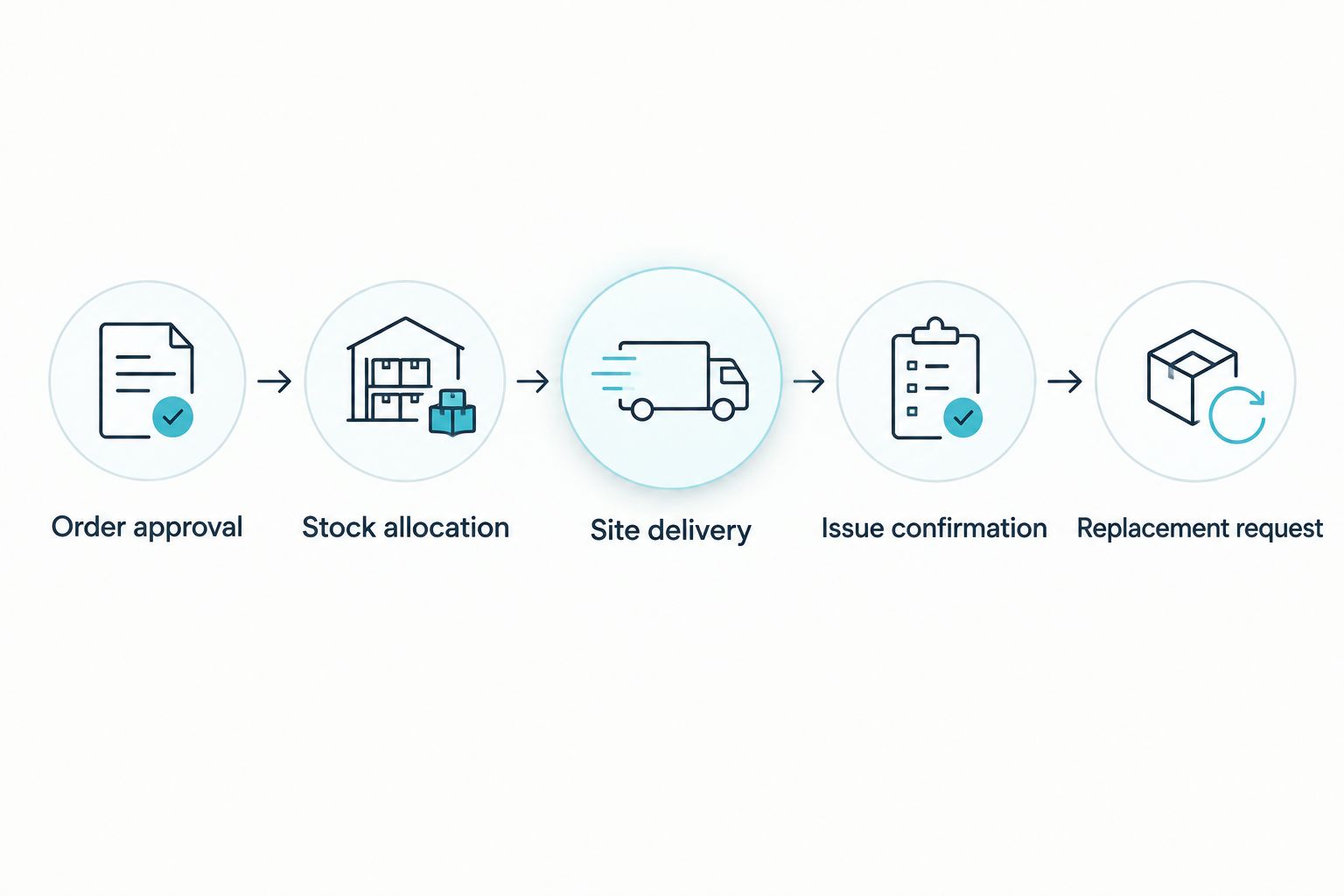
Use a defined sequence: Order approval, Stock allocation, Site delivery, Issue confirmation and Replacement request. A dispatch record proves that goods left storage; it does not prove that the correct worker received the correct size.
Keep site distribution controlled with:
- Order approval: record the role, item, size and authorising person.
- Stock allocation: assign the approved garment version to the request.
- Site delivery: confirm the destination and receiving contact.
- Issue confirmation: record receipt and any fitting problem.
- Replacement request: capture the reason before issuing another garment.
Track replacements and review the range
Start with information you can verify: items issued, replacement reasons, rejected deliveries and unresolved requests. Compare patterns by garment and role before drawing conclusions. A frequently replaced item needs investigation, not an automatic assumption that workers are careless or the supplier is at fault.
Keep protective withdrawal separate from ordinary appearance standards. A garment can remain presentable while no longer meeting its intended protective function, and it can look worn without triggering the same decision. Follow the manufacturer's instructions and your safety process rather than setting an arbitrary universal replacement interval.
Review the 2026 range against the original role matrix. Remove unnecessary variants only after checking fit and task needs; fewer stock-keeping units are not an improvement if workers receive unsuitable clothing.
Use the review to:
- Categorise replacement reasons consistently.
- Compare recurring problems by garment configuration.
- Check whether fitting problems concentrate in particular sizes or roles.
- Separate production defects from issue and handling errors.
- Update specifications through the same approval process used initially.
Compare sourcing options for construction teams
Choose the operating model according to the work your organisation can own. A local decorator, separate manufacturers and an integrated partner solve different problems. None removes your responsibility to approve the construction specification.
| Option | Best for | Main advantage | Key limitation |
|---|---|---|---|
| Internal coordination with separate suppliers | Teams with established procurement and logistics ownership | You control provider selection for each function | Your team owns the handoffs, records and exception handling |
| Garment supplier plus local decorator | Defined garment requirements with a separately managed branding brief | Garment selection and decoration remain distinct decisions | Finished-garment suitability needs approval across both providers |
| Boolanga branded workwear operations | Enterprise teams seeking design, manufacturing, distribution and software together | Those functions sit within one partner's stated offering | Construction-specific garment suitability and protective requirements still need verification |
Choose consolidation for operational ownership, not as a substitute for garment evidence. Conversely, keep separate providers only when your team can manage the approvals, data and delivery exceptions that connect them.
Discuss your workwear operating model
Define responsibilities for branded workwear design, manufacturing, distribution and operations software.
Common mistakes construction teams make
Treating visibility and branding as the same requirement
A bright company colour does not establish high-visibility performance. Specify the required protective function first, then approve the branded configuration against that requirement. Keep the decision with the responsible safety reviewer rather than leaving it to artwork approval.
Approving one fit for every trade
Office staff, plant operators and workers performing physical tasks do not necessarily need identical garment configurations. Check fit during relevant movement and equipment use. Standardise where requirements match, not where ordering convenience makes them appear to match.
Sending every order to a central office
A purchasing address is not an issue process. Record the receiving site, responsible contact and wearer allocation before dispatch. Otherwise, purchasing can close an order while the worker's request remains unresolved.
Reordering from an old photograph
A photograph does not define fabric, decoration method, garment version or protective documentation. Reorder against the approved item record. If the supplier proposes a substitute, send it through the appropriate review rather than treating a similar appearance as equivalence.
Reducing variants without checking who loses a suitable fit
Stock simplification must preserve functional fit and role requirements. Review low-use variants with site supervisors and wearers before removing them. An uncommon size or configuration can still be necessary for the people assigned to that role.
FAQ
What is branded workwear for construction teams?
Branded workwear for construction teams is a coordinated garment programme combining company identification with clothing selected for site roles and working conditions. Protective requirements need separate assessment and evidence; a logo does not establish protection.
What should we specify before adding a company logo?
Specify the task, garment function, fit and any required protective performance before adding a logo. Approve the decoration location and method as part of the finished garment configuration.
Does every construction worker need the same high-visibility clothing?
The required high-visibility clothing must follow the assessed task and site requirements, not a universal company bundle. EN ISO 20471 provides performance classifications, but it does not replace your site's decision about the required clothing.
Can we embroider or print on protective workwear?
Use decoration only after confirming that the proposed method and location are suitable for the protective garment. Obtain manufacturer confirmation for the finished configuration rather than assuming the undecorated garment's documentation covers every alteration.
Is an integrated workwear partner better than separate suppliers?
An integrated partner is best when you want design, manufacturing, distribution and garment operations managed together. Separate suppliers suit teams prepared to own the handoffs, approval records and delivery exceptions themselves.
What does Boolanga provide for branded workwear programmes?
Boolanga provides branded workwear design, manufacturing, distribution and operations software for enterprise clients across 35+ countries. Construction buyers still need to verify the proposed garment specifications and any required protective evidence.
How often should construction workwear be replaced?
Replace construction workwear according to its condition, manufacturer instructions and the relevant safety requirements, not an arbitrary universal interval. Record the replacement reason so recurring fit, wear or issue problems can be investigated.
What information should a construction workwear reorder include?
A reorder should identify the approved garment configuration, size, quantity, delivery destination and authorising person. Keep artwork and garment versions attached to that record so a repeat order does not introduce an unapproved change.
One last thing
For your 2026 programme, give replacement requests the same specification discipline as the initial order. An urgent reorder is where an otherwise controlled range can acquire an unapproved substitute, a different logo position or the wrong garment version.
Make the approved item reference mandatory on every replacement request. Speed should come from a clear decision path, not from skipping the decision.


