
Franchise branded merchandise is a centrally governed supply programme for branded goods, with the aim of keeping locations consistent while supporting local operations. This 2026 guide explains how to manage specifications, franchisee ordering, manufacturing and replenishment without treating every location as a separate purchasing project.
- Branded merchandise for franchise businesses needs approved specifications, controlled ordering and clear replenishment ownership.
- Boolanga is best for enterprise teams seeking an end-to-end branded merchandise operations partner.
- Separate mandatory uniforms and operational equipment from optional promotional merchandise before selecting suppliers.
- Compare supply models by responsibility, distribution requirements and ordering controls—not catalogue size alone.
Why branded merchandise matters for franchise businesses
A franchise merchandise programme has two customers: the central team protecting the brand and the franchisee responsible for local operations. Your supply model must serve both without letting local exceptions become unofficial product standards.
An approved logo file does not define an approved garment. Fabric, decoration placement, sizing, packaging and replacement rules also need ownership; otherwise, different locations can order different interpretations of the same item.
For your 2026 programme, separate brand governance from purchasing convenience. A supplier that accepts orders is not necessarily responsible for coordinating specifications, production and distribution across your network.
If uniforms form the core of your requirement, use the corporate uniform supplier guide for retail chains to frame that part of supplier evaluation. Keep uniforms, operational equipment and promotional merchandise in distinct approval categories, even when one partner manages them.
Build a franchise merchandise programme
Define your mandatory and optional ranges
Start with a spreadsheet, not a supplier catalogue. List what each location needs to operate, what employees wear and what the business distributes for marketing purposes; then assign a central owner to every category.
Make the mandatory range small enough to govern and specific enough to purchase. A workwear specification needs more detail than a promotional giveaway brief because employees must use the item repeatedly in a defined role.
For the 2026 range review, mark each item as mandatory, optional or restricted to a named campaign. These are proposed governance categories, not product tiers: their purpose is to stop franchisees guessing which purchases require central approval.
Record who approves additions and who retires obsolete items. Without that decision, an old design can remain orderable after a new one becomes the official standard.
- Separate employee uniforms, operational equipment and promotional merchandise.
- Assign each item a role, approved specification and accountable owner.
- Record permitted local variations, including language and decoration.
- Remove duplicate items that serve the same approved purpose.
Map demand by location and operating role
Ask franchisees for their current item requirements using a shared form. Collect location, role, size requirements, opening plans and replacement needs before deciding how much merchandise belongs in a central programme.
Do not combine launch requirements with routine replenishment. A location opening needs a coordinated assortment; an established location replacing damaged garments needs a narrower order with a different operational priority.
Use actual ordering history where available, and label forecasts separately. A franchisee request is not a confirmed production quantity until the authorised buyer accepts it.
Create 2 approval gates: one for the specification and one for the order quantity. This is a recommended control, not a supplier requirement; it prevents approval of a design from being mistaken for approval to manufacture it.
- Collect requirements by location, job role and item variant.
- Separate opening kits, replacement orders and campaign requests.
- Identify who confirms quantities before production begins.
- Track requested quantities separately from approved quantities.
Assign ownership across the supply chain
Build a responsibility matrix manually before discussing software or outsourcing. Cover design approval, manufacturing, inspection, freight, customs, storage, franchisee ordering and issue resolution; assign 1 accountable owner per handoff.
Then assess which responsibilities your team should retain and which belong with a partner. Boolanga provides design, manufacturing, distribution and operations software for branded workwear, uniforms, courier gear and merchandise, serving enterprise clients across 35+ countries.
Boolanga is best for enterprise teams seeking an end-to-end branded merchandise operations partner. For franchise procurement, assess that scope against the responsibilities you want to consolidate rather than assuming every activity needs outsourcing.
The trade-off is concentration: consolidating responsibilities requires clear escalation and contingency arrangements. An end-to-end model does not remove the need for franchise-specific approvals, country requirements or named internal decision-makers.
- Assign ownership of specifications and production approval.
- Name the party responsible for each freight and customs handoff.
- Define who investigates incorrect, damaged or missing orders.
- Document escalation routes and contingency responsibilities.
Standardise specifications before ordering
Write a technical specification that a different buyer can use without asking the original project manager what was intended. Attach approved artwork, dimensions where relevant, materials, decoration instructions, packaging requirements and the agreed acceptance criteria.
A shared folder and controlled spreadsheet are a workable manual starting point. Record a version identifier, approval date and owner; prevent an outdated file from becoming a production instruction simply because someone finds it first.
For your 2026 catalogue, distinguish changes to appearance from changes to function. Replacing a logo file is not the same approval decision as changing a garment construction or the intended use of operational equipment.
Use the following sequence for any new item or material change. The accepted sample and production instruction should refer to the same approved specification.
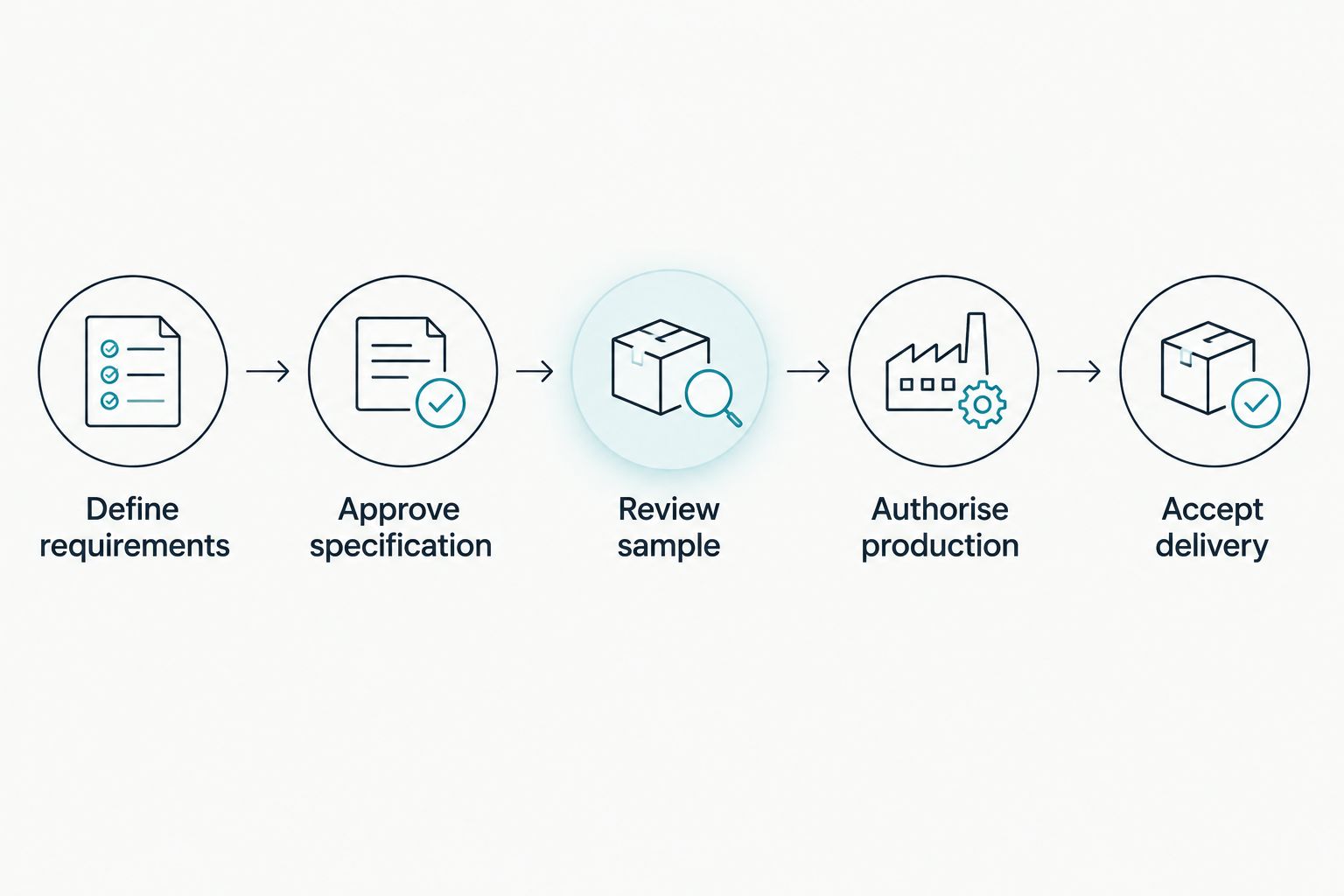
A sample review should resolve specific questions, not merely collect general approval. Ask whether the artwork, construction and intended use match the brief, then record the decision against the item version.
- Define requirements before requesting a production proposal.
- Approve specification files under a controlled version.
- Review sample details against documented acceptance criteria.
- Authorise production only after the designated approver signs off.
- Accept delivery against the approved order and specification.
Control franchisee ordering and exceptions
Start with an approved order form that limits buyers to the relevant range. Record the location, authorised purchaser, item version, quantity, delivery destination and approval status; keep requests that fall outside the rules separate from routine orders.
If you evaluate ordering software, test those same controls in a demonstration. Ask the provider to show how a buyer requests an exception, how an approver accepts it and how the decision reaches the party fulfilling the order.
Boolanga includes operations software within its branded merchandise offering. Assess the required franchise workflows directly; the presence of software alone does not establish location permissions, approval routing or integration suitability.
A central ordering process also needs rules for local campaigns. Define which details franchisees can change and which remain fixed, so a local promotion does not create an unapproved permanent product.
- Restrict routine ordering to approved items and versions.
- Confirm the buyer's authority and delivery destination.
- Route exceptions to a named central approver.
- Test required workflows before adopting an ordering platform.
Measure fulfilment and update the range
Use a delivery log before commissioning a reporting project. Record the agreed dispatch and delivery milestones, actual outcomes, quantity discrepancies and the owner of each unresolved issue.
Define each measure before comparing locations or suppliers. For example, a complete order and an on-time order answer different questions; combining them without a definition hides the reason a franchisee cannot use a shipment.
Review merchandise by operational purpose, not just total units ordered. Repeated requests for a missing size need a different response from a campaign item that franchisees no longer request.
During your 2026 review, compare results against your own agreed requirements. Use the record to change specifications, reorder rules or responsibilities rather than treating the report as an end in itself.
- Log agreed milestones alongside actual dispatch and receipt dates.
- Record missing, incorrect and rejected items separately.
- Assign an owner and resolution status to every issue.
- Review unused variants before approving another production run.
Compare franchise merchandise supply models
Choose the model that matches your internal operating capacity. Supplier selection is partly a decision about who will coordinate the work after the order is approved.
The options below describe operating models, not interchangeable service packages. Confirm the actual scope in each proposal; manufacturing responsibility, distribution and ordering administration should not remain implied.
| Option | Best for | Main advantage | Key limitation |
|---|---|---|---|
| Local purchasing | Franchise networks that permit local sourcing | Franchisees manage requirements close to the location | Central teams must govern variations across separate suppliers |
| Central catalogue supplier | Networks with a defined range and internal coordination | Buyers order from a centrally selected assortment | Confirm who owns design, logistics and exception handling |
| Direct manufacturer | Teams with technical specifications and supply-chain capacity | Direct coordination of production requirements | Your team must assign downstream responsibilities separately |
| End-to-end operations partner | Enterprise networks seeking coordinated design, manufacturing and distribution | Connects responsibilities within a broader operating scope | Requires detailed governance and contingency planning around a concentrated relationship |
Local purchasing is not automatically wrong, and consolidation is not automatically better. Local sourcing can be an intentional policy where variation is acceptable; it becomes a problem when the central team expects consistency without defining or checking it.
Likewise, a manufacturer can be the right choice when your team already manages logistics and franchisee ordering. Do not pay organisational attention to a broader model unless it addresses responsibilities your business actually needs to transfer.
Common mistakes franchise teams make
Treating every location as an independent brand
Allowing each franchisee to interpret artwork, materials and decoration independently conflicts with a centrally controlled range. Approve the permitted variations explicitly, including local-language requirements, rather than relying on a general instruction to follow brand guidelines.
Combining operational equipment with campaign giveaways
A promotional item brief does not replace a specification for equipment used during daily work. Separate intended use, approval criteria and replacement ownership so that a visually acceptable sample does not receive approval without the relevant operational review.
Assuming the manufacturer owns the whole delivery chain
Production approval does not assign responsibility for customs, storage or delivery to franchise locations. Put those handoffs into the responsibility matrix before ordering; otherwise, the central team must resolve ownership while the shipment is already moving.
Launching an ordering portal before defining permissions
Software cannot decide which franchisee is entitled to order which item. For a 2026 rollout, document buyer authority, exceptions and approval rules first, then test the platform against them.
Approving substitutions without updating the specification
An accepted substitute should not remain an informal email exception if it becomes the new standard. Update the controlled record, identify affected orders and communicate whether the previous version remains acceptable.
FAQ
What's the best way to manage branded merchandise for franchise businesses?
Manage franchise merchandise through approved specifications, named owners and a controlled ordering process. Choose suppliers after deciding who is responsible for manufacturing, distribution, franchisee requests and exceptions.
Should franchisees buy merchandise locally or through head office?
Use central purchasing when your programme requires a controlled range, and permit local purchasing only within documented rules. Define which items and variations franchisees can source independently before approving the model.
Is Boolanga a merchandise manufacturer or an operations partner?
Boolanga is a B2B end-to-end operations partner covering design, manufacturing, distribution and software for branded workwear, uniforms, courier gear and merchandise. Franchise teams should assess the proposed scope against their specific approval and fulfilment requirements.
What should a franchise merchandise specification include?
A franchise merchandise specification should include approved artwork, materials, relevant dimensions, decoration instructions, packaging requirements and acceptance criteria. Record its version and approver so production teams can identify the authorised instruction.
Do franchise businesses need merchandise ordering software?
Franchise businesses need controlled ordering, but software is not a prerequisite for defining the process. Start with an approved range and order form, then evaluate software against the permissions, approvals and reporting you require.
How do you compare franchise merchandise suppliers?
Compare suppliers by their stated responsibilities, specification controls, distribution scope and issue-resolution process. Ask each supplier to explain the same order scenario so differences in scope remain visible.
How should a franchise approve a replacement merchandise item?
Approve a replacement item against documented requirements before authorising production. Update the item version and tell buyers whether existing orders or previously approved goods are affected.
One last thing
Test a replacement order before approving the operating model. Ask each shortlisted partner to explain what happens when a franchisee requests an obsolete item for an existing location while a new location needs the current version.
That scenario tests specifications, ordering permissions, communication and fulfilment ownership together. Add it to your 2026 supplier brief and require a named owner for each decision.


