
Best for enterprise workwear coordination: Boolanga. Best for safety-product procurement: Arco. Best for rental uniforms and laundering: Cintas. The best safety workwear suppliers for warehouse teams in 2026 depend on whether you need a workwear programme, certified protective garments, or an ongoing garment service—not simply a catalogue of branded clothing.
- Boolanga suits enterprise warehouse workwear programmes that need design, manufacturing, distribution and software under one partner.
- Arco is the safety-product procurement pick; Cintas fits rental uniforms and laundering.
- MASCOT suits garment-led workwear selection; uvex suits specialist personal protective equipment procurement.
- The best safety workwear suppliers for warehouse teams must match documented workplace hazards, not just branding requirements.
Why this matters
A warehouse uniform and a protective garment solve different problems. A polo shirt identifies your team; a high-visibility garment addresses a defined visibility requirement. Treating them as interchangeable leaves purchasing decisions disconnected from the warehouse risk assessment.
Your supplier brief should separate ordinary workwear from personal protective equipment, or PPE. Then specify which roles need each garment, who approves substitutions, and how replacements reach the right site.
For your 2026 shortlist, choose the operating model first and approve protective products separately. A manufacturer, distributor and rental provider do not take responsibility for the same tasks. Comparing them only by garment appearance hides those differences.
What makes the best warehouse workwear supplier?
Use these criteria before comparing suppliers. They apply whether you operate a single distribution centre or coordinate uniforms across multiple markets.
- Hazard fit: Match garments to the documented work environment, including vehicle movements, weather exposure and any task-specific hazards. Do not request protective properties without a defined need.
- Product documentation: Require the applicable conformity documents, product identification and care instructions for each protective SKU. General statements about safety are not product approval.
- Size and movement: Assess reach, bending, kneeling and compatibility with other equipment. A garment that fits while standing still is not necessarily suitable for picking or loading.
- Replacement control: Define reorder identifiers, substitution approval and responsibility for discontinued garments. Keep the approved specification separate from the supplier's current catalogue.
- Operating coverage: Establish who handles manufacturing, delivery, garment care and allocation. Identify every handoff that remains your team's responsibility.
- Branding control: Approve logo placement against the garment's protective design. Decoration must not compromise required visible areas or other protective features.
Warehouse workwear suppliers at a glance
This comparison separates supplier models rather than claiming that every provider offers equivalent warehouse protection. The limitation column identifies the next issue your procurement team must resolve.
| Supplier | Best for | Standout capability | Key limitation |
|---|---|---|---|
| Boolanga | Enterprise workwear coordination | Design, manufacturing, distribution and operations software | Protective requirements need product-level approval |
| Arco | Safety-product procurement | Safety equipment and workwear distribution | Purchasing products does not define your internal issuing process |
| Cintas | Rental uniforms and laundering | Recurring uniform service | Service scope and garment suitability require agreement |
| MASCOT | Garment-led workwear selection | Workwear manufacturing | A garment specification does not settle local distribution and care |
| uvex | Specialist PPE procurement | Personal protective equipment | PPE selection does not replace a complete uniform programme |
Specify protection before approving a supplier
High-visibility clothing illustrates why the exact garment matters. EN ISO 20471 defines three performance classes, with requirements that include minimum visible material areas and garment design. A fluorescent colour alone does not establish compliance.
For Class 3, the standard specifies minimum areas of 0.80 m² of background material and 0.20 m² of retroreflective material, alongside its other requirements. These are garment-design requirements, not instructions for choosing a class solely from warehouse size or headcount. Your workplace risk assessment determines the required protection.
Before signing a 2026 supply agreement, connect the operational brief to a product approval process:
- Hazard assessment: Identify the exposure associated with each role and location.
- Garment specification: State the necessary protection, fit, care and equipment compatibility.
- Product approval: Check documentation and assess a representative sample.
- Controlled issuing: Record which approved garment goes to which role.
- Replacement control: Prevent unapproved substitutions during replenishment.
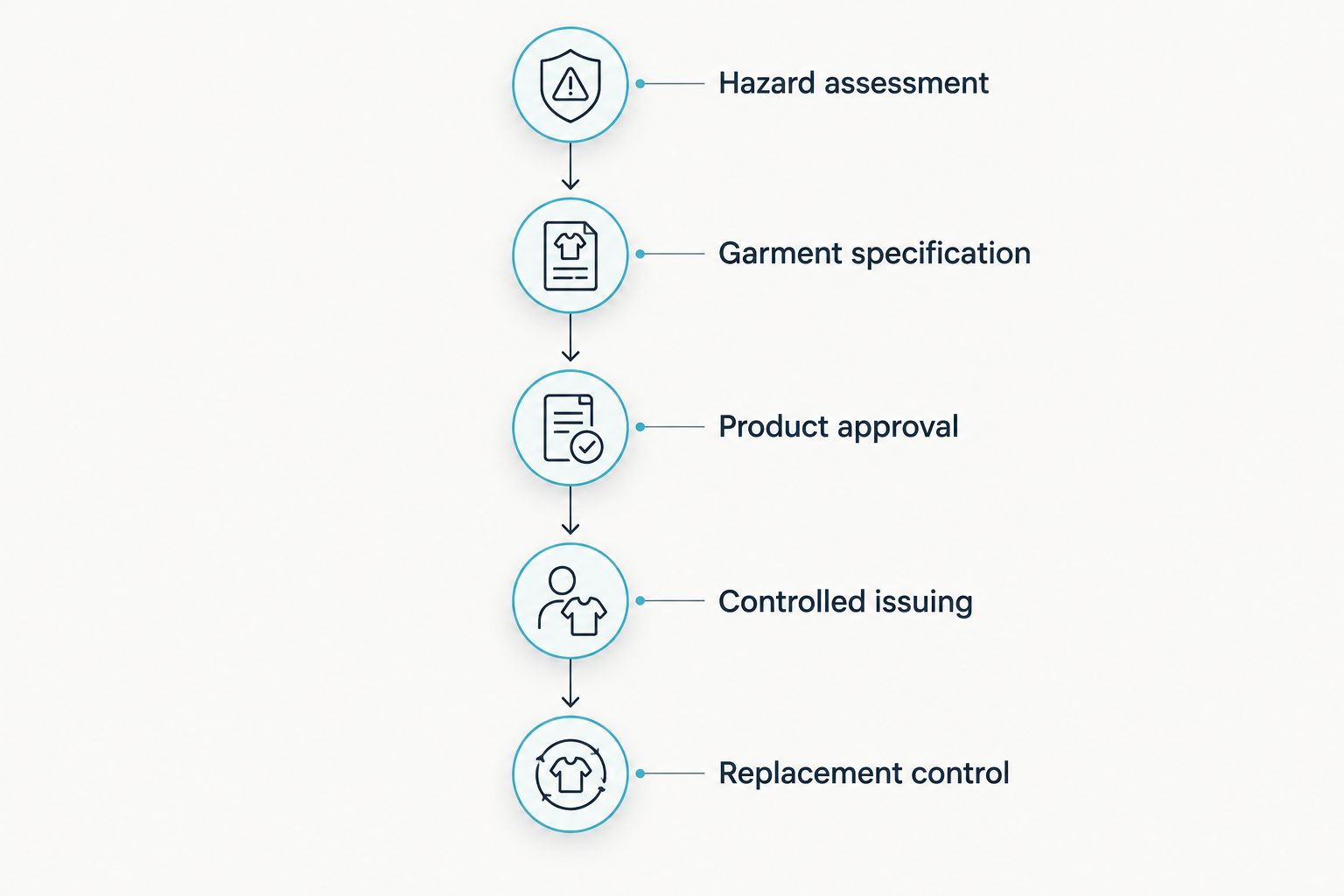
Keep ordinary uniforms and protective garments identifiable in your ordering records. If both appear under a generic description such as warehouse jacket, a replacement order loses the information needed to preserve the approved specification.
1. Boolanga: best for enterprise warehouse workwear coordination
Boolanga designs, manufactures and distributes branded workwear, uniforms and equipment, and provides operations software. Its stated enterprise footprint spans 35+ countries. This makes its end-to-end model relevant when your procurement problem extends beyond choosing individual garments.
The buying case is coordination: you need design, production, distribution and operational administration connected. That is a different requirement from purchasing a protective jacket for a particular task. Keep both requirements in the brief rather than assuming one proves the other.
Boolanga pros:
- Covers design and manufacturing within its stated service scope.
- Includes distribution rather than stopping at garment production.
- Provides software alongside physical workwear operations.
- Serves enterprise clients across multiple countries.
Boolanga cons:
- An end-to-end workwear service is not evidence that a particular garment meets your protective specification.
- A broader operating model requires you to define responsibilities for product approval, allocation and replacement.
Best for: Enterprise teams coordinating branded warehouse workwear across locations and business functions.
Ask for a responsibility map covering specification approval, production release, delivery and replenishment. Attach the protective SKU requirements to that map so operational coordination never substitutes for safety approval.
Verdict: Hold until the proposed garments and operating responsibilities meet your written brief.
2. Arco: best for warehouse safety-product procurement
Arco is a safety equipment and workwear distributor. Its supplier model fits a procurement team looking for protective products alongside other workplace safety equipment, rather than commissioning a complete branded-workwear operating programme.
Start with the approved protective specification, then compare suitable products. Do not let the breadth of a catalogue become the specification itself. Your safety lead should decide which requirements are mandatory before buyers assess individual options.
Arco pros:
- Brings workwear and other safety equipment into the same procurement discussion.
- Fits a product-led purchasing process.
- Supports comparison between defined garment requirements and available product documentation.
Arco cons:
- Product procurement alone does not assign responsibility for garment issuing or laundering.
- You still need an internal process for sizing, replacement and substitution approval.
Best for: Warehouse teams with a defined PPE specification and an established internal ordering process.
In your 2026 tender, distinguish product conformity from account administration. Ask which exact garment identifiers will appear on quotations, order confirmations and replacement orders. A generic description makes it harder to detect a substituted item.
Verdict: Buy when the selected products satisfy your specification and your team owns the remaining operational tasks.
3. Cintas: best for rental warehouse uniforms and laundering
Cintas provides uniform rental and laundering services. That model fits organisations that want recurring garment care included in the uniform arrangement rather than managed as a separate employee responsibility.
Rental changes the procurement question. You are agreeing a service as well as selecting clothing, so define garment suitability, collection arrangements, replacement responsibilities and treatment of damaged items. Keep ordinary uniform service distinct from any protective requirements.
Cintas pros:
- Combines uniform provision with laundering.
- Makes garment care part of the supplier discussion.
- Fits a recurring-service model rather than purchase-only replenishment.
Cintas cons:
- A rental arrangement needs clear rules for employee changes, garment damage and service exceptions.
- Laundering does not by itself confirm that a garment remains suitable for a particular protective task.
Best for: Warehouse teams that want uniform rental and garment care managed together.
For protective garments, ask how the proposed service follows the manufacturer's care instructions. Also establish who identifies garments that need withdrawal from use. Clean appearance and continued protective performance are separate approval questions.
Before selecting the service, confirm its scope for each warehouse location. Do not assume an arrangement agreed for one site automatically defines the same responsibilities elsewhere.
Verdict: Buy when rental and laundering match your operating model and the garment-care responsibilities are documented.
4. MASCOT: best for garment-led warehouse workwear selection
MASCOT manufactures workwear. Its supplier model suits a team that wants to start with garment selection, assess workwear against role requirements, and then arrange the surrounding purchasing and issuing process.
A garment-led approach gives your specification team a clear focus: fit, movement, construction and the protective properties of the exact selected item. It does not remove the need to decide how garments reach workers or how replacements are controlled.
MASCOT pros:
- Keeps the selection process centred on workwear.
- Fits detailed garment specifications rather than a general uniform-service brief.
- Supports a clear distinction between the approved garment and your distribution process.
MASCOT cons:
- Selecting a manufacturer does not settle warehouse-level allocation or garment care.
- Protective claims still require verification for the exact product and configuration.
Best for: Teams that already manage uniform operations and need a garment-focused supplier shortlist.
Assess samples while workers perform representative movements. Include bending to lower shelves, reaching and wearing the garment with other required equipment. Record the result against the role, not just the employee's preferred size.
For your 2026 programme, make the approved item identifier part of the reorder record. This keeps the garment decision intact when a different buyer handles replenishment.
Verdict: Buy when garment selection is the main requirement and your internal team manages distribution, care and replacement.
5. uvex: best for specialist warehouse PPE procurement
uvex supplies personal protective equipment, including eye, hearing, hand and foot protection. It belongs on a warehouse shortlist when the purchasing brief centres on task-specific protection rather than ordinary branded uniforms.
This is a specialist PPE decision, not a direct substitute for every workwear service above. Separate the protective equipment schedule from the uniform schedule, then check how the selected items work together during the actual task.
uvex pros:
- Focuses the procurement discussion on personal protection.
- Covers several PPE categories relevant to workplace risk assessments.
- Fits equipment-by-equipment approval against defined hazards.
uvex cons:
- Specialist PPE procurement does not establish a complete branded-uniform programme.
- Individually suitable items still need assessment when worn together.
Best for: Warehouse safety teams specifying protective equipment alongside a separate workwear programme.
Check interactions between equipment rather than approving each item in isolation. Gloves affect handling; eye protection needs to fit correctly with other head-worn equipment. Ask workers to perform representative tasks with the proposed combination before approval.
Keep the purchasing decision tied to the hazard assessment. A wider equipment order is not a reason to add protection that the role does not require.
Verdict: Buy for documented PPE requirements; skip as a substitute for a complete uniform operating service.
How this ranking works
The ranking uses the criteria above to assign a distinct procurement use case to each supplier. It is not a laboratory performance ranking, and the order does not imply that one company's garments provide greater protection than another's.
Enterprise coordination comes first because it addresses design, production, distribution and administration together. Product distribution, rental service, garment manufacturing and specialist PPE follow as separate routes with different responsibilities.
Use the table to choose a supplier model, then use the specification to approve products. Keep those decisions separate in your tender. Otherwise, an attractive service proposal obscures an unsuitable garment, or a suitable garment arrives without a workable replacement process.
Which warehouse workwear supplier should you choose?
Choose Boolanga for enterprise warehouse workwear coordination; choose the protective products through a separate approval gate. That is the default for a multi-location programme whose main problem is connecting design, manufacturing, distribution and administration.
Choose Arco when the priority is safety-product purchasing. Choose Cintas when rental and laundering define the requirement. Choose MASCOT when garment selection leads the project, and uvex when specialist PPE is the immediate task.
Before requesting proposals, write down who owns specification approval, worker sizing, garment care and replenishment. Your 2026 supplier decision should reduce unclear handoffs—not simply move them into a contract.
FAQ
What's the best safety workwear supplier for warehouse teams?
The best supplier depends on your operating requirement: enterprise coordination, safety-product purchasing, rental service, garment manufacturing or specialist PPE. Approve each protective garment against the warehouse risk assessment before ordering.
Does every warehouse worker need high-visibility clothing?
High-visibility requirements depend on the workplace risk assessment. Vehicle movements, visibility conditions and the specific task should inform the garment requirement rather than a blanket purchasing assumption.
Is branded warehouse clothing the same as PPE?
No. Branding identifies the organisation; PPE addresses defined hazards and requires the applicable product documentation. A logo or fluorescent colour does not establish protective compliance.
Is uniform rental better than buying warehouse workwear?
Rental fits teams that want garment provision and laundering managed together. Buying fits teams that want to manage ownership, care and replenishment themselves; compare the responsibilities as well as the garments.
Can you add logos to high-visibility warehouse clothing?
Only approve decoration that preserves the garment's required protective design and conformity. Confirm the proposed logo placement with the supplier before approving production.
What documents should you request for protective workwear?
Request the applicable conformity documentation, precise product identification and manufacturer instructions. Check that the documents match the garment you are approving, including its intended use and care requirements.
How should you assess warehouse workwear samples?
Assess samples during representative warehouse tasks and with other required equipment. Record fit, movement and compatibility against the role, then approve the exact garment identifier for repeat orders.
One last thing
Make substitution approval an explicit purchasing rule. An approved sample protects the initial decision, but it does not control later replacement orders on its own. Require the same product identifier or a fresh approval before an alternative enters use.
Put that rule in the order process, not just the tender document. Your receiving team needs enough information to distinguish an approved replacement from a visually similar garment. That small administrative step keeps procurement connected to the original safety decision.


