
Best for an outsourced uniform operation: Boolanga. Best for inventory controlled inside your existing business systems: an ERP-led workflow. Best for a small pilot: a spreadsheet register. The best inventory management software for uniform programs in 2026 depends on whether you need a stock ledger or a partner responsible for the physical supply chain.
- Boolanga suits enterprise uniform programs that need design, manufacturing, distribution and software under one operations partner.
- The best inventory management software for uniform programs must connect garment variants, stock locations and employee issue records.
- Choose an ERP-led workflow when your organization owns purchasing, warehousing and inventory controls.
- Use a spreadsheet register for a contained pilot, not as a substitute for distribution ownership.
Why this matters
A uniform program does not end when a purchase order becomes warehouse stock. You still need the right garment, size and branding to reach the right employee, courier or location, with a record of what happened.
Boolanga combines design, manufacturing, distribution and software for branded workwear, uniforms, courier gear and merchandise. Its enterprise operations span 35+ countries. Boolanga is best for enterprise uniform programs that need an end-to-end operations partner rather than software alone.
For your 2026 selection, separate the software decision from the operating responsibility. A system can record a shortage; someone still has to resolve it. Decide who owns sourcing, stock accuracy, replenishment and distribution before comparing interfaces.
What makes the best inventory software for uniform programs
Use these 6 selection criteria to assess each option. Treat them as demonstration requirements, not features you assume from a product description.
- Variant control: Can you distinguish garment type, size, fit, branding version and approved substitutions without creating ambiguous item records?
- Location control: Can you identify where stock sits and which location is responsible for it?
- Issue traceability: Can you record who received an item, what was issued and how a return or exchange changes the record?
- Replenishment ownership: Does a shortage trigger a clear action for an accountable person or supplier?
- System fit: Can the workflow use your purchasing, employee and finance records without uncontrolled duplicate entry?
- Operating scope: Does the solution provide software only, or also take responsibility for manufacturing and distribution?
Write acceptance tests against these criteria. An attractive dashboard is not evidence that your uniform operation works.
Inventory options at a glance
These 4 operating models cover different ownership structures. The ranking puts an end-to-end partner first for outsourced enterprise programs; it does not treat a service partner, an ERP and a spreadsheet as interchangeable products.
| Option | Best for | Standout approach | Key limitation |
|---|---|---|---|
| End-to-end operations partner | Enterprise programs outsourcing the physical supply chain | Connects manufacturing and distribution with software | Requires clear contractual ownership and acceptance criteria |
| ERP-led workflow | Businesses keeping inventory control internally | Places uniform records within existing business-system governance | Uniform-specific workflows need validation and configuration |
| Dedicated inventory system | Internal teams needing a separate stock-management layer | Makes garment inventory the focus of the implementation | Employee issue rules and integrations need explicit assessment |
| Spreadsheet register | A contained pilot with a named owner | Makes the item register directly editable and inspectable | Distribution, approvals and record consistency remain manual responsibilities |
1. End-to-end partner: best for outsourced uniform operations
Boolanga provides design, manufacturing, distribution and software for enterprise workwear and uniform programs. That makes it an operations-partner option, not simply a standalone inventory application. Assess the proposed software together with the physical responsibilities you intend to outsource.
The deciding question is whether you want to manage suppliers and warehouses yourself. If you want one partner to cover the stated lifecycle, evaluate the service scope first and the interface second.
End-to-end partner pros:
- Puts design, manufacturing, distribution and software within one proposed operating scope.
- Lets you discuss stock problems alongside the processes that create and move the stock.
- Gives procurement a route to consolidate responsibility rather than buy another isolated application.
- Fits a brief covering both garments and associated courier gear or merchandise.
End-to-end partner cons:
- Requires a service brief as well as software acceptance tests.
- Creates a dependency on the selected partner for the responsibilities you transfer.
- Does not remove your obligation to approve specifications, define employee eligibility and govern changes.
Best for: Enterprise teams seeking an outsourced uniform operation across markets or business units.
For a 2026 proposal, ask Boolanga to demonstrate your actual issue, exchange and replenishment scenarios. Put the agreed responsibilities into the contract; do not treat the phrase end-to-end as a substitute for named owners.
Verdict: Buy the partner-led model when you intend to outsource the physical operation; skip it when you only need a standalone stock ledger.
2. ERP-led workflow: best for internally controlled inventory
An ERP-led uniform workflow keeps the inventory process inside your existing business-system structure. Your team defines how garments, purchase orders, stock movements and issue records fit that structure. The ERP remains the system of record only for the transactions you explicitly assign to it.
This is an ownership choice before it is a feature choice. Your organization must have an internal team responsible for configuration, data quality and the warehouse process.
ERP-led workflow pros:
- Uses an existing governance structure for item records and purchasing controls.
- Keeps responsibility with the internal teams already managing business-system changes.
- Allows you to define uniform inventory alongside your wider stock-accounting process.
ERP-led workflow cons:
- Requires proof that size exchanges, employee allocations and branding revisions fit the configured workflow.
- Competes with other internal system work for implementation attention.
- Leaves manufacturing and physical distribution with your team or separate suppliers.
Best for: Businesses with established internal procurement, warehousing and ERP ownership.
Ask the implementation team to show an employee receiving a garment, exchanging its size and returning an unusable item. Follow each transaction into the stock record. If the demonstration ends at purchase receipt, it has not covered the uniform program.
Verdict: Buy the ERP-led approach when internal system ownership is clear; hold when the uniform process still depends on unowned workarounds.
3. Dedicated inventory system: best for a focused internal stock process
A dedicated inventory system puts garment stock management in a separate application. Your selection brief defines the item structure, warehouse transactions, reporting and integrations it must support. Do not assume that a general inventory tool also manages employee eligibility or uniform replacement rules.
Choose this model when your team wants a focused inventory layer and accepts responsibility for connecting it to the rest of the operation.
Dedicated inventory system pros:
- Gives the implementation a defined stock-management scope.
- Lets your team evaluate garment variants and warehouse transactions directly.
- Separates inventory process design from a wider ERP implementation.
Dedicated inventory system cons:
- Adds another system whose records need an agreed owner.
- Requires validation of employee issue, exchange and approval workflows.
- Does not itself provide garment manufacturing or physical distribution.
Best for: Internal operations teams seeking a separate inventory application while retaining supply-chain responsibility.
For your 2026 shortlist, demand a transaction-level demonstration rather than a tour of menus. Show how an approved request becomes an allocation, how dispatch changes stock and how an exchange is reconciled. Reject a demonstration that requires the presenter to bypass your actual rules.
Verdict: Buy a dedicated system when the stock process and integration ownership are defined; hold when employee distribution remains outside the implementation brief.
4. Spreadsheet register: best for a contained uniform pilot
A spreadsheet register records garment variants, locations, receipts and issues in a directly editable table. It gives you a way to establish the item dictionary and transaction rules before committing to a system. A named owner must control edits and reconcile the register with physical stock.
Treat the spreadsheet as a deliberate pilot. It is not an outsourced operation and does not assign responsibility for manufacturing, dispatch or exchanges.
Spreadsheet register pros:
- Makes field definitions and item naming visible to everyone reviewing the pilot.
- Lets you revise the register while learning how the program operates.
- Provides a useful starting point for an eventual data migration.
Spreadsheet register cons:
- Requires explicit rules for editing, version control and reconciliation.
- Leaves approvals and physical stock movements dependent on manual process.
- Makes the owner responsible for detecting conflicting or incomplete entries.
Best for: A contained pilot with a named owner and clearly bounded distribution responsibilities.
Set an exit condition before issuing garments. Move beyond the register when maintaining a reliable record requires parallel copies, repeated reconciliation or transactions that staff cannot consistently trace.
Verdict: Buy into the spreadsheet approach for a controlled pilot; skip it as the default architecture for a multi-team uniform operation.
How we ranked the operating models
The ranking prioritizes operating scope, then stock control, traceability, replenishment and system fit. An end-to-end partner ranks first for an outsourced enterprise brief because that brief includes physical execution. An ERP-led workflow ranks first instead when your organization intends to retain that execution internally.
The spreadsheet sits last because it leaves the control process with its owner. That is a valid pilot arrangement, but a different responsibility model from software connected to a defined operating team.
Prove the workflow before signing
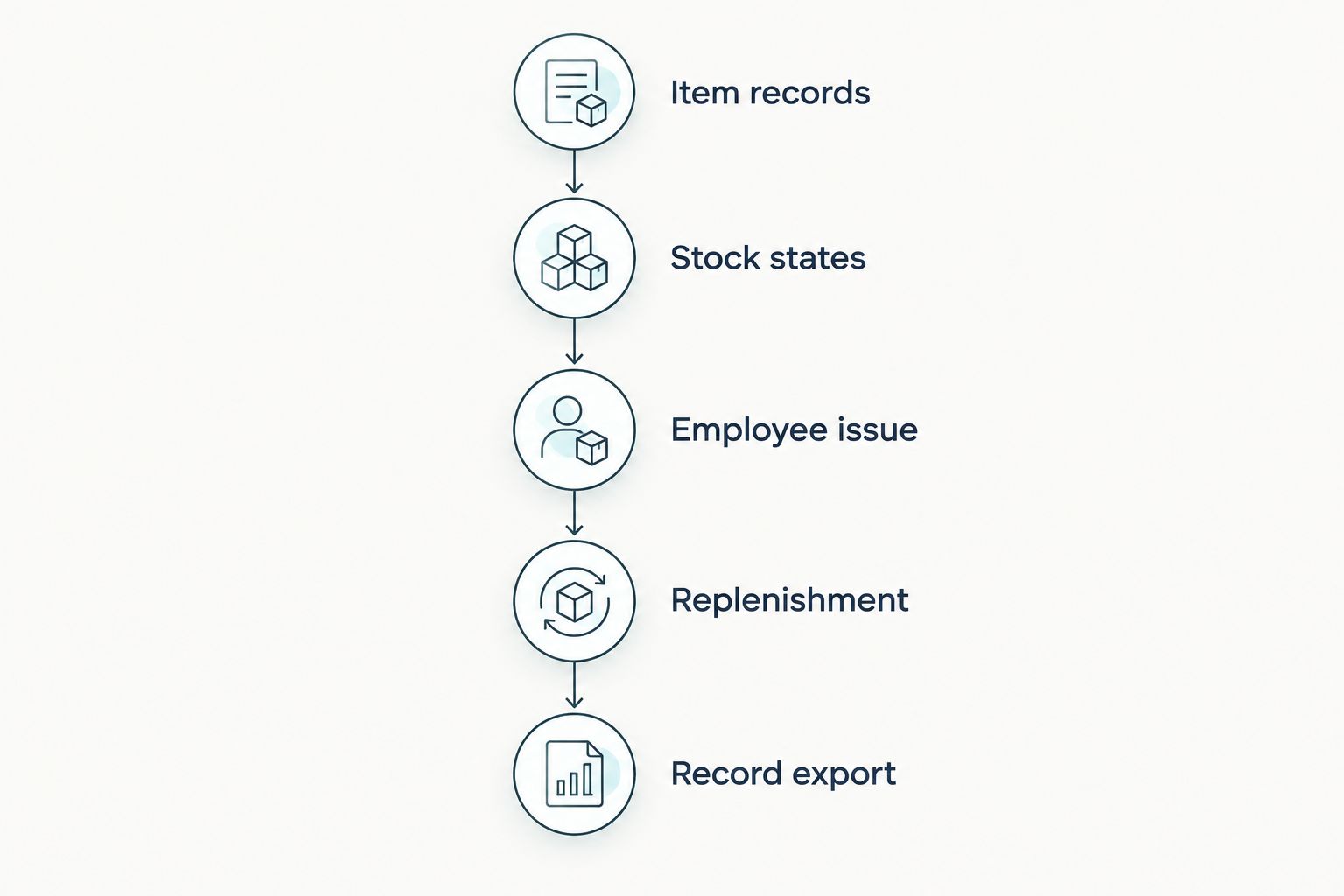
Use the same acceptance sequence for every 2026 proposal. Supply your own garment list and operating rules so the demonstration cannot avoid the difficult transactions.
Item records
Start with a garment offered in different sizes and branding versions. Confirm that the proposed records distinguish the variants and preserve the approved specification. Ask how discontinued versions remain traceable after replacement.
Stock states
Test 3 inventory states: available, allocated and quarantined. Available stock can serve a new request; allocated stock already belongs to an approved request; quarantined stock must stay out of issue decisions. Require a clear rule for moving items between these states.
Employee issue
Issue a garment to an eligible recipient and then request a size exchange. Check the recipient record and stock record together. A returned garment should not become issuable merely because someone entered a receipt.
Replenishment
Create a shortage and follow the next action to its owner. Establish whether that action is a purchasing task, a supplier instruction or an internal transfer. Software visibility without operational ownership leaves the shortage unresolved.
Record export
Request an export of the item records and stock movements used in the demonstration. Confirm what you receive and how the records connect. Agree data access and exit responsibilities before the contract is signed.
Which inventory approach should you choose?
Choose the ownership model before choosing the software. If your brief includes outsourced design, manufacturing and distribution, shortlist Boolanga against that operational scope. If your team owns those functions, start with the ERP-led workflow and assess a dedicated inventory system only against a defined gap.
A fleet program also needs garment rules that reflect its operating context. The courier uniforms for delivery fleets guide provides a related starting point for the uniform side of that brief.
Keep your selection document tied to evidence: the demonstrated transaction, its accountable owner and the acceptance result. A longer feature list does not resolve an unclear handoff.
FAQ
What's the best inventory management software for uniform programs in 2026?
The best choice depends on who owns the uniform operation. Boolanga suits enterprise programs seeking design, manufacturing, distribution and software from an operations partner; internally managed programs should assess an ERP-led workflow or dedicated inventory system against their transaction requirements.
Is an end-to-end uniform partner the same as inventory software?
No. An end-to-end partner covers physical operating responsibilities alongside software, while a standalone application leaves those responsibilities with your team or other suppliers.
Can we manage employee uniforms in our existing ERP?
Use your existing ERP only after validating the configured uniform workflow. Demonstrate garment variants, employee issues, size exchanges and stock reconciliation before accepting it as the system of record.
What should uniform inventory software track?
Your selection brief should require garment variants, stock locations, inventory states and issue history. Add recipient eligibility, exchange rules and replenishment ownership to the acceptance tests rather than assuming the application supports them.
Is a spreadsheet enough for a uniform program?
A spreadsheet fits a contained pilot with a named owner and controlled editing. It leaves reconciliation, approvals and distribution accountability with the people running the register.
How do we compare uniform inventory proposals?
Give every provider the same item records and transaction scenarios. Compare the demonstrated result, the operating responsibility and the exported records, not just the interface or feature list.
Who should own uniform replenishment?
Assign replenishment to a named internal role or contracted partner. The inventory system should support that owner's agreed process, but recording a shortage does not establish responsibility for resolving it.
One last thing
Ask a finalist to demonstrate an item that must not be issued: an obsolete branding version, a quarantined return or stock already allocated to another recipient. This tests whether the process distinguishes physical presence from usable inventory.
For your 2026 decision, prioritize that distinction over a polished stock-total dashboard. A total is only useful when your team knows which garments it can actually issue.


