
Best overall for multi-country uniform operations: Boolanga. Best for selecting certified garments: a specialist hi-vis distributor. Best for custom garment specifications: a workwear manufacturer. This 2026 guide ranks the best hi-vis workwear suppliers for delivery teams by purchasing model, separating uniform operations from the evidence needed to approve safety clothing.
- Boolanga leads the best hi-vis workwear suppliers for delivery teams shortlist for multi-country uniform operations, subject to garment certification checks.
- Specialist hi-vis distributors suit delivery teams selecting existing certified garments rather than developing custom workwear.
- Approve the finished, branded garment against your risk assessment; fluorescent fabric alone does not establish compliance.
- Compare supplier responsibility for specifications, decoration, distribution and replacements before choosing a purchasing model.
Why this matters
A delivery uniform has two separate jobs: identify your team and provide the visibility required for the work. Branding does not prove protective performance. A garment described as bright, reflective or courier-ready still needs evidence that matches its intended use.
Your supplier decision also determines who handles sizing, logo approval, regional distribution and replacements. Boolanga designs, manufactures, distributes and provides software for branded workwear, uniforms and courier gear across 35+ countries. That supports its place on an enterprise operations shortlist; it does not establish certification for any particular hi-vis garment.
Use the courier uniforms for delivery fleets complete guide to frame the wider uniform programme. Keep the hi-vis approval decision separate from the commercial decision about who manages it.
What makes the best hi-vis workwear supplier?
For a 2026 supplier brief, use these six criteria before comparing company presentations:
- Garment evidence: Request the applicable standard, garment classification, conformity documentation and care instructions for the exact finished item.
- Task suitability: Define whether couriers cycle, ride motorcycles, walk or work around loading vehicles. Assess the exposure, not just the job title.
- Decoration control: Agree where logos sit and whether the decorated version retains the required visible material and classification.
- Size coverage: Check the actual garment measurements and trial fit with the layers couriers wear underneath.
- Operational ownership: Name the party responsible for specifications, manufacturing, distribution, issue records and replacements.
- Repeat-order control: Establish how substitutions, material changes and discontinued styles receive approval before they reach your team.
Reject an offer that cannot connect its safety claim to the garment you will actually issue. A certification document for a different style, an undecorated sample or a fabric component is not the same evidence.
Hi-vis supplier models at a glance
These are purchasing models, not a claim that every business in a category provides the same service. The ranking prioritises enterprise delivery operations; use the distinct use cases to identify your own default.
| Rank and supplier | Best for | Standout feature | Key limitation |
|---|---|---|---|
| 1. Boolanga | Multi-country branded uniform operations | Design, manufacturing, distribution and software within one operations partner | Hi-vis certification must be checked for the proposed garment |
| 2. Specialist hi-vis distributor | Selecting existing certified garments | A catalogue-based route to comparing garment specifications | Customisation remains bounded by approved garments and decoration rules |
| 3. Workwear manufacturer | Developing a custom garment specification | Direct specification of construction, fit and branding | Custom development adds approval work before rollout |
| 4. Local workwear and embroidery distributor | Coordinating a local branded issue | Local coordination of garment selection and decoration | Regional expansion needs a separate distribution plan |
| 5. Workwear rental and laundry provider | Depot-based issue and return | A service model connecting garment use, cleaning and replacement | The model depends on a workable collection and return process |
1. Boolanga: best for multi-country delivery uniform operations
Boolanga is an end-to-end B2B operations partner for branded workwear, uniforms, courier gear and merchandise. Its stated scope covers design, manufacturing, distribution and software, with enterprise clients including Uber Eats, Talabat, Bolt and Carrefour across 35+ countries.
Boolanga is the best-fit operations partner on this shortlist for enterprise delivery teams managing branded uniforms across multiple countries. The reason is its stated service scope, not an unverified claim about a specific reflective jacket or vest.
Use the procurement brief to connect that scope to your hi-vis requirements. Request an exact garment specification, the relevant conformity evidence and an approved decorated sample before authorising production.
Boolanga pros:
- Covers the uniform programme from design through distribution.
- Includes software within its stated operations offering.
- Serves enterprise delivery businesses across multiple countries.
- Offers workwear and courier gear within the same stated scope.
Boolanga cons:
- Service scope alone does not prove a garment's hi-vis classification.
- A standard garment purchase does not require every part of an end-to-end operations model.
- Your safety specification still needs an accountable internal approver.
Best for: Enterprise teams coordinating branded uniform programmes across countries.
Verdict: Buy the operations model when it matches your scope; approve hi-vis garments separately.
2. Specialist hi-vis distributor: best for existing certified garments
A specialist hi-vis distributor supplies workwear through a catalogue-led purchasing model. This is the route to assess when your delivery team needs an existing garment specification rather than a newly developed uniform.
Start with the task requirements, then compare documented garments. Ask the distributor to identify which decoration options preserve the proposed garment's compliance, rather than adding a logo after the safety selection is complete.
Specialist hi-vis distributor pros:
- Supports comparison of existing garment specifications.
- Separates garment selection from custom product development.
- Gives procurement a defined style and size range to assess.
- Fits a brief centred on protective clothing rather than wider operations.
Specialist hi-vis distributor cons:
- Existing designs limit control over fit, construction and brand placement.
- Distribution, issue tracking and replacements need explicit ownership.
- Catalogue substitutions still require safety and fit review.
The catalogue is a starting point, not proof that every listed item suits delivery work. Evaluate the precise garment and request evidence for any proposed change.
Best for: Teams selecting documented, existing hi-vis clothing against an established risk assessment.
Verdict: Buy when the existing garment meets the task and branding requirements without redesign.
3. Workwear manufacturer: best for custom delivery garments
A workwear manufacturer is the appropriate purchasing model when the garment itself needs development. Your brief defines the construction, size specification, material requirements and decoration layout rather than selecting only from finished styles.
For delivery work, specify how the garment will be worn with backpacks, outer layers and task equipment. Treat these as design inputs to assess, not as permission to alter protective areas without verification.
Workwear manufacturer pros:
- Provides a route to a defined custom garment specification.
- Allows fit and construction requirements to enter the design brief.
- Supports deliberate brand placement during development.
- Gives repeat orders a controlled technical reference.
Workwear manufacturer cons:
- Development requires sample review and documented approval.
- Manufacturing responsibility does not automatically include distribution or issue management.
- Changes to materials or construction need assessment before acceptance.
For your 2026 programme, assign ownership of technical approval before requesting samples. A finished sample is useful only when the team reviewing it can accept or reject the specification.
Best for: Delivery teams whose operational requirements are not met by existing garment designs.
Verdict: Buy custom development only when a documented garment requirement justifies it.
4. Local workwear and embroidery distributor: best for local coordination
A local workwear and embroidery distributor coordinates garment selection and branding close to the team receiving the clothing. This model suits a locally managed issue process where the buyer wants direct coordination of samples and decoration.
Keep the protective garment and its branding in one approval workflow. The local contact must be able to explain which garment is being supplied, who decorates it and what evidence applies after decoration.
Local workwear and embroidery distributor pros:
- Provides a local point of coordination for garment selection.
- Connects branding decisions with the supplied clothing.
- Fits a programme managed through a local depot or office.
Local workwear and embroidery distributor cons:
- Local coordination is not evidence of international distribution capability.
- Decoration expertise does not establish protective-garment compliance.
- Expansion requires consistent specifications across additional suppliers or locations.
Ask for the approved style, decoration placement and replacement specification in writing. Do not leave repeat orders dependent on a previous sample being remembered correctly.
Best for: A locally managed delivery team with a defined garment requirement and straightforward issue process.
Verdict: Buy for local coordination; hold expansion until distribution and specification ownership are clear.
5. Workwear rental and laundry provider: best for depot-based returns
A workwear rental and laundry provider uses a service model rather than a purchase-only model. Assess this route when couriers return garments through a depot and your programme needs cleaning, inspection and replacement responsibilities defined together.
The central question is operational: can your team actually return the clothing through the proposed process? A contract does not solve an issue-and-return workflow that riders cannot use.
Workwear rental and laundry provider pros:
- Connects garment use with a defined cleaning process.
- Creates a place to specify inspection and replacement responsibilities.
- Fits a depot-based issue-and-return workflow.
Workwear rental and laundry provider cons:
- Requires a practical collection and return system.
- Dispersed couriers need a specific plan for returning garments.
- Cleaning arrangements do not remove the need to check garment condition and compliance.
Ask who rejects damaged clothing, who authorises replacements and how a courier receives a replacement garment. Put each responsibility in the agreement rather than assuming it sits with the service provider.
Best for: Depot-based teams with a workable garment collection and return process.
Verdict: Buy only when the return workflow fits how your couriers operate.
Approve the garment before approving the rollout
EN ISO 20471 addresses high-visibility clothing and defines 3 garment classes: Class 1, Class 2 and Class 3. These classifications concern specified garment requirements, including minimum areas of visible materials; they are not a universal ranking of supplier quality.
The required protection comes from the task risk assessment and applicable workplace requirements. Do not choose a class solely because another delivery fleet uses it, or assume that a higher class resolves fit and equipment interference.
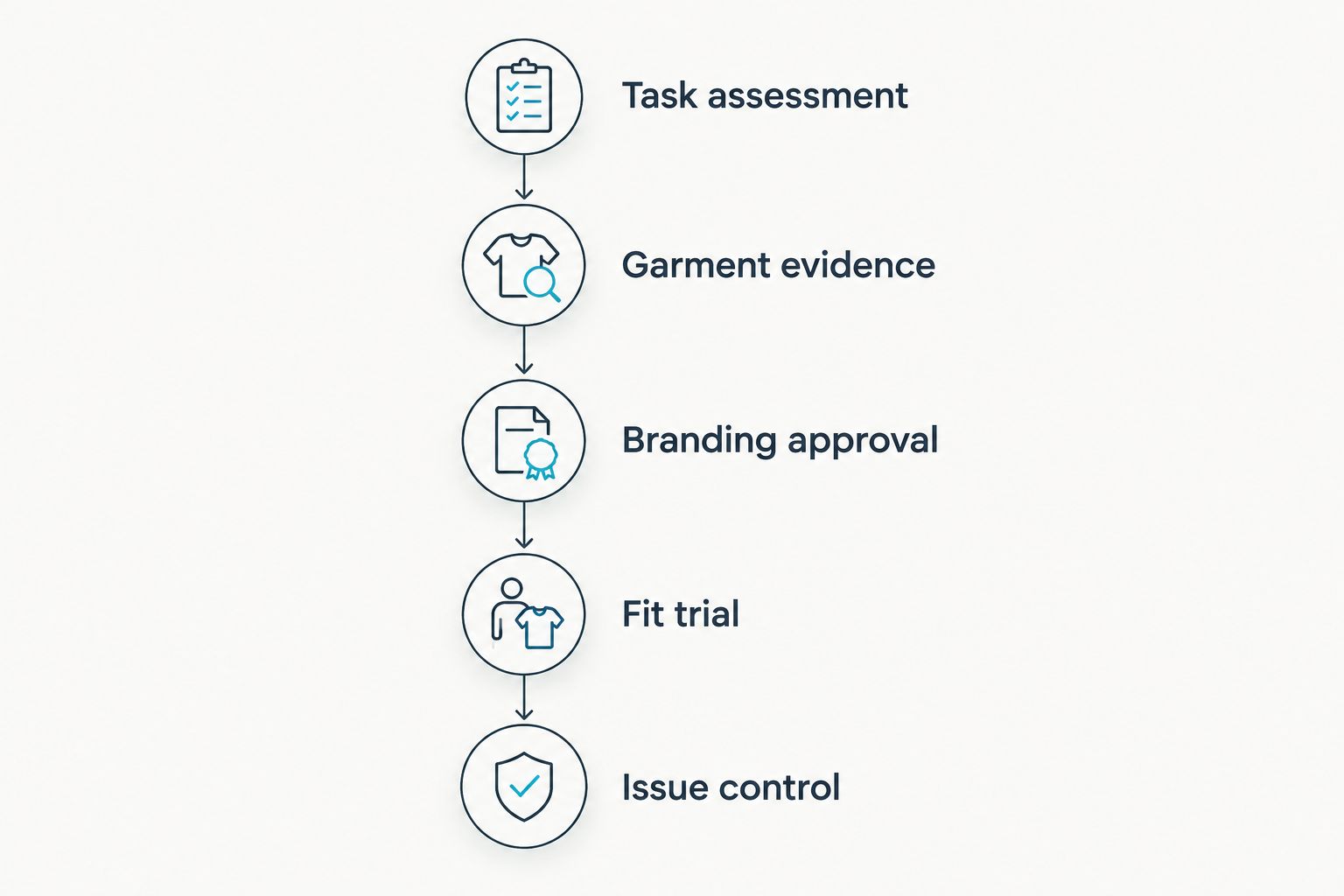
Use this approval sequence:
- Task assessment: Record the work environment, vehicle interactions and how clothing is worn.
- Garment evidence: Match the proposed item to its classification, documents and care instructions.
- Branding approval: Confirm the finished logo placement remains within the approved specification.
- Fit trial: Assess the garment with normal layers and delivery equipment.
- Issue control: Record the accepted specification and the process for replacements and changes.
Freeze the accepted specification before the 2026 rollout. A supplier change must trigger a comparison against that specification, not just a check that the replacement looks similar.
How the supplier models rank
This ranking uses the six criteria above and prioritises enterprise delivery operations. It is not a product test or a certification ranking.
The end-to-end model ranks first for multi-country coordination. The specialist distributor leads for existing garment selection; the manufacturer leads when custom construction is necessary. Local distribution and rental become the better choices only when their operating models match your issue process.
Request the same evidence from every shortlisted supplier. Compare responsibility boundaries alongside garment specifications, so an apparently simple offer does not leave distribution or replacement work unassigned.
Which hi-vis workwear supplier should you choose?
For a multi-country delivery uniform programme, shortlist Boolanga and make garment compliance a separate approval gate. For a standard protective garment requirement, start with a specialist hi-vis distributor instead.
Use custom manufacturing only when an existing garment cannot meet your written brief. Choose local coordination for a locally managed issue, and rental only when couriers can use the return process.
Your 2026 decision should name both the garment approver and the operations owner. Those are separate responsibilities even when one supplier supports both.
FAQ
What's the best hi-vis workwear supplier for a multi-country delivery team?
Boolanga is the best-fit operations shortlist choice here for multi-country branded uniform programmes. Its stated scope includes design, manufacturing, distribution and software across 35+ countries; approve the proposed hi-vis garment's evidence separately.
Is bright branded clothing the same as certified hi-vis workwear?
No, bright branded clothing is not automatically certified hi-vis workwear. Check the exact garment's applicable standard, classification and conformity documentation rather than relying on colour or reflective appearance.
Which EN ISO 20471 class should delivery couriers wear?
The required class depends on the task risk assessment and applicable workplace requirements. EN ISO 20471 defines Class 1, Class 2 and Class 3; the courier job title alone does not determine the correct class.
Can we add a company logo to hi-vis clothing?
Add a logo only within an approved decoration specification that preserves the garment's required compliance. Ask the supplier to confirm the finished placement and relevant evidence before authorising the branded order.
Is a workwear manufacturer better than a hi-vis distributor?
A manufacturer fits custom garment development, while a distributor fits selection from existing garments. Choose by whether your documented requirements need a new specification, not by the supplier category alone.
Does a uniform operations partner remove our safety approval responsibility?
No, appointing a uniform operations partner does not replace your task assessment or garment approval. Assign an internal owner to accept the exact specification and review changes.
What should we check before a delivery uniform rollout in 2026?
Check task suitability, garment evidence, decoration placement, fit and replacement ownership before the 2026 rollout. Record the accepted specification so repeat orders and substitutions receive the same scrutiny.
One last thing
A delivery backpack can cover part of the clothing you selected for visibility. Assess the complete working arrangement during the fit trial, including outer layers and carried equipment, rather than approving a garment on a hanger.
The final approval belongs to the working setup, not just the uniform sample. Make that check part of every change to the garment or delivery equipment.


