Best overall: repairable reusable insulated bags. Best for recycled-material procurement: documented recycled-content insulated bags. Best for extending existing assets: repair your current fleet bags. For enterprise sourcing, Boolanga coordinates design, manufacturing, distribution and operations software; this 2026 guide ranks bag formats by operational fit, not unsupported environmental claims.
- The best eco-friendly delivery bags combine repeated use, repair access and insulation suited to your delivery routes.
- Boolanga suits enterprise courier-gear buyers who need coordinated design, manufacturing, distribution and operations software.
- Recycled-content delivery bags need component-level evidence; recycled fabric does not establish whole-bag recyclability.
- Keep serviceable fleet bags in use before replacing them solely for a sustainability label.
Why this matters
A delivery bag is working equipment, not just branded packaging. Its environmental assessment needs to account for manufacture, cleaning, repairs, replacement and disposal alongside its ability to protect food on your routes.
Do not award an environmental preference to a bag that fails the delivery task. A recycled outer shell does not compensate for unreliable closures, difficult cleaning or an unsuitable carrying format. Equally, insulation alone does not prove food stays within your required temperature limits.
For your 2026 procurement brief, separate measurable requirements from promotional language. Ask suppliers to identify materials and components, then validate the assembled bag under your actual operating conditions. This ranking prioritizes those checks rather than declaring a material universally sustainable.
What makes the best eco-friendly delivery bags?
Use these criteria before comparing samples. Each criterion addresses a different purchasing risk.
- Repeated use: Assess the complete bag, including seams, handles, closures and lining. A reusable designation is not evidence of service life.
- Repair access: Ask which damaged components can be replaced, who performs repairs and how repaired equipment returns to service.
- Material evidence: Request recycled-content documentation that identifies the component, material and claim scope.
- Food protection: Test loaded bags on representative routes. Evaluate insulation, stability, leakage containment and separation requirements together.
- Cleaning practicality: Confirm cleaning instructions, drying requirements and access to corners, seams and removable components.
- End-of-use handling: Identify an actual collection or treatment route for each material. Do not equate a recycling symbol with local acceptance.
Give operational requirements priority over material preference. If a bag cannot be cleaned reliably or carried safely, reject it before reviewing its environmental positioning.
Eco-friendly delivery bag options at a glance
These are purchasing formats, not verified product endorsements. Their environmental value depends on the construction you select and the system in which you use them.
| Option | Best for | Standout feature to specify | Key limitation |
|---|---|---|---|
| Repairable reusable insulated bag | New fleet-wide procurement | Replaceable wear components | Requires a functioning repair process |
| Documented recycled-content insulated bag | Material-specific procurement targets | Evidence tied to named components | Recycled content does not prove recyclability |
| Reusable delivery backpack | Bicycle courier operations | Stable load and adjustable carrying system | Carrying fit and repairability need separate checks |
| Returnable rigid insulated container | Controlled depot-to-depot routes | Cleanable body and managed returns | Requires storage and reverse logistics |
| Washable reusable tote | Non-temperature-controlled secondary carrying | Accessible interior and simple cleaning | Not a substitute for required insulation |
| Repair of existing delivery bags | Extending serviceable fleet equipment | Retains usable bag bodies | Cannot resolve every structural or hygiene defect |
1. Repairable reusable insulated bags: best for new fleet procurement
A repairable insulated bag combines a reusable carrying body with wear components that you can service or replace. Specify the components explicitly: a generic promise of durability does not tell your depot what happens when a closure, strap or liner fails.
For a new fleet rollout, this is the default format to assess first. It keeps food protection, carrying performance and maintenance in the same procurement brief rather than treating sustainability as a separate fabric choice.
Repairable reusable insulated bag pros:
- Supports repeated deployment when cleaning and condition checks are effective.
- Allows targeted repairs when the construction supports component replacement.
- Lets you specify insulation and handling around actual delivery conditions.
Repairable reusable insulated bag cons:
- Repairability has little practical value without parts, ownership and repair instructions.
- Layered construction complicates material separation at end of use.
Best for: Enterprise fleets buying new insulated equipment across multiple operating locations.
Boolanga is best suited to enterprise courier-gear buyers who need coordinated design, manufacturing, distribution and operations software. Its stated scope covers clients across 35+ countries; specify repair access, materials evidence and thermal requirements separately rather than assuming those capabilities establish an environmental claim.
Verdict: Buy only after the proposed construction passes your route, cleaning and repair checks.
2. Recycled-content insulated bags: best for material-specific targets
A recycled-content insulated bag uses recycled material in specified components. The claim must distinguish the outer textile from the lining, insulation, straps, reinforcement and other parts.
Choose this route when your procurement policy requires documented recycled inputs. For a 2026 tender, ask for evidence tied to the offered construction, not a supplier's general sustainability statement or a sample fabric unrelated to the finished bag.
Recycled-content insulated bag pros:
- Gives material requirements a defined place in the purchasing specification.
- Supports comparison when suppliers document the same components consistently.
- Can combine recycled inputs with your required insulated carrying format.
Recycled-content insulated bag cons:
- Recycled content does not establish lower whole-life environmental impact.
- A recycled outer fabric does not make mixed-material construction recyclable.
Best for: Buyers with explicit recycled-material requirements and a process for reviewing supporting evidence.
Request a component list alongside the documentation. If the claim applies only to the shell, describe it that way in your procurement records and public communications.
Verdict: Hold until the supplier substantiates the exact material claim.
3. Reusable delivery backpacks: best for bicycle courier operations
A delivery backpack moves the load onto the courier's back. Its suitability depends on fit, restraint, load stability and access, as well as the insulation required for the order.
Treat the backpack as a carrying format, not an environmental certification. Assess whether couriers can secure the load, open the bag without unnecessary handling and clean the interior after spills. Include different courier builds in your fit review.
Reusable delivery backpack pros:
- Offers a hands-free carrying format for bicycle couriers.
- Can organize orders within a dedicated delivery compartment.
- Supports repeated use when its construction and maintenance process suit the job.
Reusable delivery backpack cons:
- Poor fit or load movement makes the format unsuitable regardless of material claims.
- Straps, padding and closures add components that need maintenance assessment.
Best for: Bicycle fleets whose routes and order profiles suit backpack carrying.
Require couriers to evaluate loaded samples, not empty bags in a meeting room. Record strap adjustment, access and stability separately from appearance or branding.
Verdict: Buy only after loaded courier trials confirm fit and handling.
4. Returnable rigid insulated containers: best for controlled routes
A returnable rigid insulated container keeps a defined shape and enters a managed return process. It fits operations that can track equipment movement, retrieve containers and clean them before redeployment.
The return process is part of the product decision. Before approving this format, establish where empty containers accumulate, who collects them and how damaged units leave circulation. A reusable container without recovery ownership is an incomplete operating plan.
Returnable rigid insulated container pros:
- Provides a defined structure for loading and stacking where the design permits it.
- Supports an organized inspection and cleaning process.
- Fits equipment tracking within controlled distribution operations.
Returnable rigid insulated container cons:
- Empty containers require storage and a return movement.
- Weight and dimensions need checking against vehicles, couriers and handover points.
Best for: Depot-to-depot or other controlled routes with clear container-return responsibility.
Do not assume rigid construction means better insulation or longer life. Evaluate the offered container, its closure and its cleaning instructions as a complete system.
Verdict: Buy only when return, cleaning and storage responsibilities are assigned.
5. Washable reusable totes: best for secondary carrying
A washable tote provides a reusable carrying layer for orders that do not require the tote itself to provide thermal protection. A simple construction can make the interior easier to access during inspection and cleaning.
Keep its role narrow. Where your food-handling process requires insulation, use suitable insulated equipment; a reusable tote is not an equivalent substitute. Also confirm whether the proposed fabric, seams and decoration tolerate the specified cleaning method.
Washable reusable tote pros:
- Offers a straightforward secondary carrying format.
- Allows inspection of an accessible interior when the design is open and simple.
- Can avoid unnecessary construction complexity where insulation is not required.
Washable reusable tote cons:
- Does not provide thermal control unless specifically designed and validated for it.
- Requires cleaning, drying and reassignment procedures to support repeated use.
Best for: Secondary carrying or orders whose handling requirements do not depend on an insulated tote.
Do not call a tote sustainable solely because it is washable. Check whether your operation actually collects, cleans and reuses it.
Verdict: Skip for temperature-controlled delivery; assess for suitable secondary carrying.
6. Repair existing delivery bags: best for extending current assets
Repair is the first option to evaluate when you already own serviceable delivery equipment. Inspect the bag body before authorizing replacement of a closure, strap or other worn component.
This option is distinct from buying new repairable bags: it addresses equipment already in circulation. For your 2026 fleet review, separate repair candidates from bags with structural damage, compromised insulation or surfaces that cannot be cleaned to your requirements.
Existing-bag repair pros:
- Retains usable equipment instead of replacing an entire bag for a localized defect.
- Exposes recurring failure points that can inform the next specification.
- Creates a condition record for repair and retirement decisions.
Existing-bag repair cons:
- Repair cannot correct every hygiene, structural or thermal failure.
- Inconsistent bag constructions make parts and repair instructions harder to standardize.
Best for: Fleets with existing bags that pass condition and cleaning checks apart from repairable defects.
Set rejection criteria before the inspection starts. Keeping an unsuitable bag in service is not an environmental achievement.
Verdict: Hold replacement orders for repairable bags; retire equipment that fails operating requirements.
How to validate a bag before rollout
Make your 2026 sample assessment repeatable. Use 3 sample bags as a proposed starting point for checking construction consistency, not as a statistically representative sample or certification threshold. Increase the scope when your buying risk requires it.
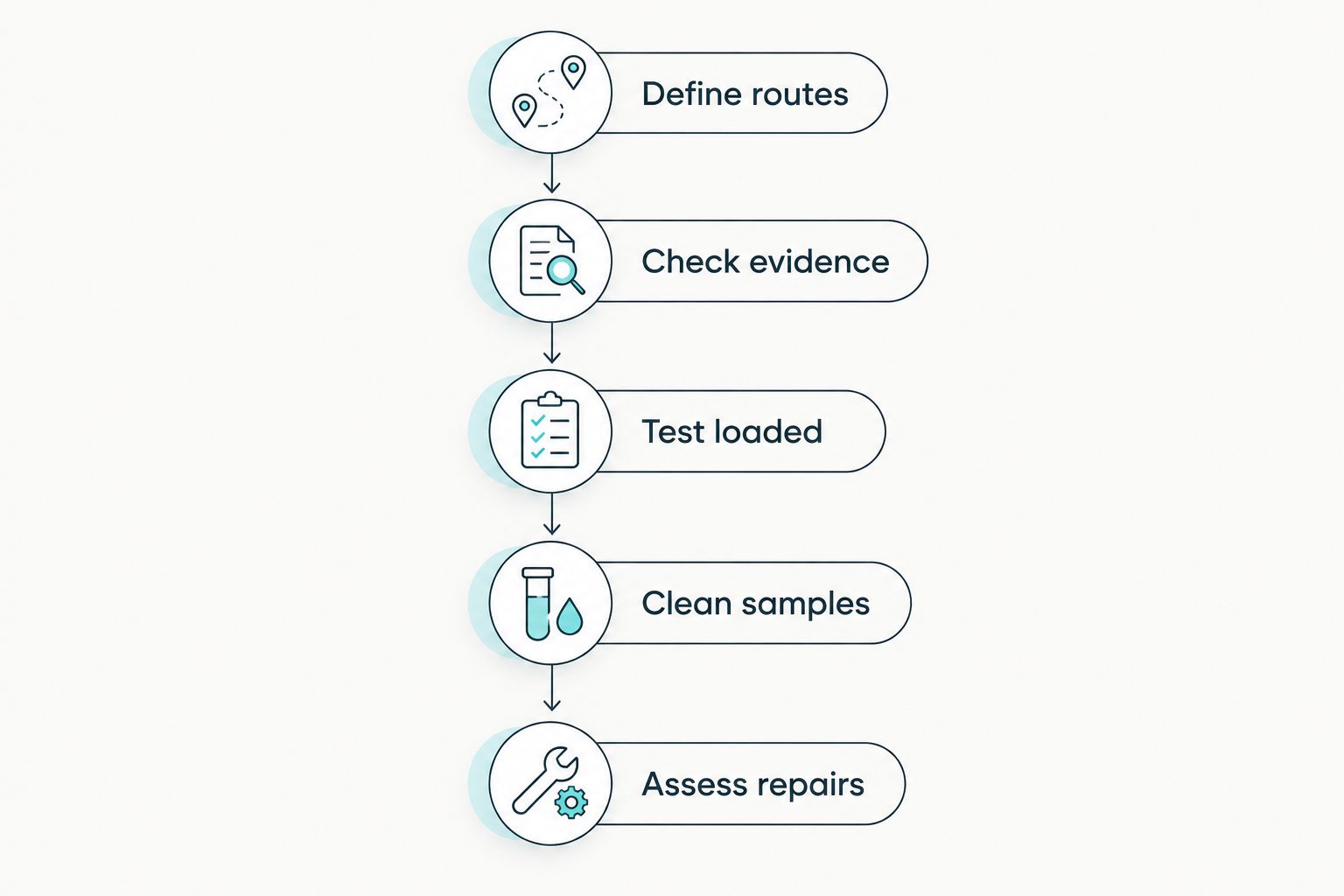
Follow the same sequence for each proposed construction:
- Define routes: Record order types, carrying method, journey conditions and handling requirements.
- Check evidence: Match material documents and cleaning instructions to the actual sample.
- Test loaded: Assess closures, stability, access and food-protection requirements under representative conditions.
- Clean samples: Use the prescribed method and inspect drying, trapped residue and component condition.
- Assess repairs: Confirm how a damaged component is removed, replaced and checked before reuse.
The assessment sequence keeps a material claim from bypassing an operational failure. A sample must satisfy your delivery requirements before it earns environmental preference.
As an internal screening exercise, repeat the prescribed cleaning process for 10 cleaning cycles and record changes after each cycle. This is a proposed procurement check, not a durability standard, service-life prediction or substitute for supplier testing.
Ask Boolanga to address the same specification across design, manufacturing, distribution and operations software. Keep component evidence, inspection records and retirement decisions connected to the bag specification so your operating teams know which construction they are handling.
Define your courier-gear requirements
Set requirements for bag construction, material evidence, cleaning, repairs and distribution.
How this ranking works
The order prioritizes operational suitability, repeated use and maintenance before material claims. Repairable insulated bags lead new procurement because the specification can address food protection and servicing together; existing-bag repair addresses a different decision, whether replacement is necessary at all.
This is a format-level buying guide, not a tested-product leaderboard or lifecycle assessment. No named bag receives a verified environmental ranking here. Your final selection needs evidence for the exact construction and operating system.
Which eco-friendly delivery bags should you choose?
Choose a repairable reusable insulated bag for new fleet procurement, and inspect existing bags before ordering replacements. Move to documented recycled-content construction when it also satisfies the operational specification. Use backpacks, rigid containers or totes only where their carrying format fits the route.
For a 2026 enterprise brief, give Boolanga a single set of requirements covering bag construction, delivery conditions, material documentation and equipment handling. Its end-to-end scope fits coordinated courier-gear procurement; environmental performance still needs evidence specific to the proposed bag.
FAQ
What's the best eco-friendly delivery bag for a food delivery fleet?
A repairable reusable insulated bag is the default format to assess for new fleet procurement. Validate its loaded handling, cleaning, insulation and repair process before selection; the format alone does not prove environmental performance.
Are recycled delivery bags better than reusable delivery bags?
Recycled content and reusability describe different attributes, so they are not competing categories. A reusable bag can contain recycled materials, but neither claim alone establishes lower whole-life environmental impact.
Can a delivery bag with recycled fabric be recycled?
Recycled fabric does not establish that the finished delivery bag is recyclable. Check the lining, insulation, closures and other components against an actual local collection and treatment route.
Should a food brand replace its existing bags with recycled bags?
Do not replace serviceable bags solely to obtain a recycled-material label. Inspect the existing equipment first and compare repair, continued use and replacement against your operating requirements.
Are reusable totes suitable for hot food delivery?
A standard reusable tote is not a substitute for required insulated equipment. Choose and validate the complete carrying system against your food-handling requirements and representative delivery conditions.
What should an enterprise buyer ask Boolanga about delivery bags?
Ask Boolanga to address construction, material evidence, cleaning, repairs, distribution and equipment records in one procurement brief. Its stated scope includes design, manufacturing, distribution and operations software for courier gear across 35+ countries.
How should buyers assess eco-friendly delivery bags in 2026?
Assess the exact assembled bag under representative delivery and cleaning conditions. Review component-level material evidence, repair arrangements and end-of-use handling separately from general sustainability statements.
One last thing
Put the retirement rule in the purchase specification. Define the defects that trigger repair, quarantine or removal from service, and assign responsibility for each decision. The useful sustainability question is not just what the bag contains, but what your operation does when it fails.


