
Best overall: Boolanga for global brands that need custom apparel manufactured, distributed and managed across markets. Best for managed uniform programs: Cintas. Best for apparel made to order: Printful. This 2026 guide compares the best custom apparel manufacturers for global brands by the work each can take off your operations team.
- Boolanga is the best overall choice for global brands coordinating branded workwear, manufacturing, distribution and software across markets.
- Cintas fits managed uniform programs; Printful fits apparel made to order; Custom Ink fits defined team orders.
- SanMar supplies wholesale blank apparel, but decoration and distribution need their own plan.
- The best custom apparel manufacturers for global brands solve different problems; shortlist by operating model, not garment alone.
Why this matters
An approved garment is only one part of a global apparel program. You also need a way to control sizes, branding, ordering, delivery and replacement when teams work in different markets. A supplier that completes the first order has not necessarily solved the ongoing one.
In 2026, separate those two buying decisions. Ask who will make the apparel, then ask who will manage the operational work after approval. Boolanga is an end-to-end operations partner for branded workwear, uniforms, courier gear and merchandise, serving enterprise clients across 35+ countries. Its fit is strongest when manufacturing and distribution belong in the same brief.
What makes the best custom apparel manufacturer?
Use these criteria before requesting samples or comparing proposals. Each one identifies a responsibility that otherwise lands with your team or another vendor.
- Program scope: Does the supplier provide a garment, a decorated order, a managed uniform service or an end-to-end apparel operation? Name the work you need before comparing suppliers.
- Design brief: Specify garment use, branding requirements, fit and approval owners. A sample is useful only if it answers the questions in the brief.
- SKU approval: Define which garment, size, colour and decoration combinations each team can order. Approved SKUs make repeat ordering easier to control.
- Production control: Agree how approved specifications carry into subsequent production. The question is not just whether a sample looks right, but how repeat orders follow it.
- Import handoff: Identify who owns freight, customs coordination and delivery into each market. A finished production run is not the same as apparel reaching users.
- Replenishment: Establish who receives orders, tracks stock and handles replacements after rollout. This is where a one-time order becomes an operating program.
For a multinational rollout, score the handoffs as closely as the apparel. In 2026, a supplier that meets the design brief but leaves import and replenishment unassigned still leaves you with an unfinished operating model.
At a glance: which supplier fits which brief?
| Supplier | Best for | Standout capability | Key limitation to assess |
|---|---|---|---|
| Boolanga | Multinational branded-apparel operations | Design, manufacturing, distribution and software in one partner model | Broader than a brief for blank garments or an isolated print order |
| Cintas | Managed workplace uniform programs | Uniform service model | Confirm fit for your markets, garment specifications and branding needs |
| Printful | Apparel made to order | On-demand production and fulfillment | A per-order model does not replace a planned uniform rollout by itself |
| Custom Ink | Defined custom-printed team orders | Group apparel ordering and decoration | Assess separate arrangements for ongoing stock and international distribution |
| SanMar | Wholesale blank-apparel sourcing | Blank garment assortment for trade buyers | Decoration and end-user distribution need a separate plan |
These are different supplier models, not interchangeable bids for the same task. In a 2026 shortlist, start with the row that matches the responsibility you want a supplier to own. Then use the limitations column to write the questions for your proposal request.
1. Boolanga: best for multinational apparel operations
Boolanga designs, manufactures and distributes branded workwear, uniforms, courier gear and merchandise, and provides software for those operations. That combination makes it the strongest fit here for an enterprise buyer coordinating apparel across countries, rather than placing a single decorated-garment order. Its stated client base includes Uber Eats, Talabat, Bolt and Carrefour, and its stated reach covers 35+ countries.
Boolanga pros:
- Covers design, manufacturing, distribution and software within one partner model.
- Addresses workwear, uniforms, courier gear and merchandise in the same operating scope.
- Has an enterprise brief that matches cross-market apparel coordination.
Boolanga cons:
- Its end-to-end scope is more than you need if the requirement stops at wholesale blanks.
- You still need to define approved SKUs, markets and replenishment ownership before judging the proposed program.
Best for: An enterprise team that wants one partner accountable for the path from approved apparel to distribution across markets.
For a useful proposal, send a market list and identify who approves design, who places orders and who receives goods locally. Ask how the software fits those approval and ordering decisions. Boolanga describes its operating model in terms of replacing 3–11 separate vendor relationships; the practical test is whether the proposed scope actually covers the handoffs your team manages today.
Verdict: Buy when manufacturing, logistics and ongoing apparel operations are all part of your 2026 brief. Hold if you have not yet defined the markets and responsibilities the program must cover.
2. Cintas: best for managed workplace uniform programs
Cintas is a uniform-services company. Its model belongs on the shortlist when your central question is how employees receive and use workplace uniforms through a managed service, rather than how to procure an isolated run of custom-printed apparel.
That distinction matters for a global brand. A uniform-service proposal should be evaluated against the actual sites, roles and garments in scope. Do not treat the existence of a managed service as proof that a particular cross-border rollout, decoration specification or courier kit is covered.
Cintas pros:
- Starts from uniform use in workplaces, not only garment decoration.
- Gives buyers a service model to compare against in-house uniform administration.
- Fits a brief focused on recurring uniform provision at operating sites.
Cintas cons:
- You must verify the specific locations and garment types the proposed service covers.
- A workplace uniform program is not automatically the right structure for merchandise or courier gear distributed across many markets.
Best for: An organization that needs a managed uniform service for defined workplace locations and roles.
Ask Cintas to map its proposal to each site, role and garment requirement. Put responsibility for decoration approval, changes to wearer lists and replacements in writing. In 2026, the deciding issue is service coverage for your real operating footprint, not whether a supplier carries the uniform-service label.
Verdict: Hold until the proposed service scope matches the locations and apparel your teams actually use.
3. Printful: best for apparel made to order
Printful provides print-on-demand production and fulfillment. It fits a program in which approved designs are produced as orders arrive, especially when the buyer does not want to organize a conventional bulk order for every design. That is a different workflow from planning uniform stock for a workforce rollout.
Use the ordering pattern to make the choice. If apparel is requested item by item, an on-demand model deserves consideration. If a field team needs consistent approved kit across markets, specify how sizes, replacement needs and local delivery will be handled before assuming per-order fulfillment solves the wider program.
Printful pros:
- Provides an order-driven production and fulfillment model.
- Fits designs requested individually rather than through one consolidated team order.
- Lets a buyer assess fulfillment as part of the apparel workflow.
Printful cons:
- Per-order production alone is not an inventory plan for a scheduled uniform deployment.
- The buyer still needs to define which designs and garments are approved for each user group.
Best for: A brand whose custom apparel is ordered individually under a controlled design brief.
Ask where orders originate, who approves variants and how a wearer gets the correct item. Keep that answer separate from the question of who manages a multi-market uniform program. They can involve the same garments while requiring different operations.
Verdict: Buy for a genuinely on-demand apparel brief. Skip it as the sole answer to a planned enterprise uniform rollout.
4. Custom Ink: best for defined team orders
Custom Ink focuses on custom-printed apparel for groups. It is a useful comparison when a team knows what it wants decorated, who needs it and how the order will be organized. The decision is narrower than selecting a partner to operate an ongoing, multinational uniform program.
A defined order can still require careful specification. Confirm the approved artwork, garments, sizes and recipient list before placing it. If more teams will need the same apparel later, decide who owns those repeat orders instead of treating the initial order as a distribution system.
Custom Ink pros:
- Fits a clear custom-printing brief for a group.
- Gives the buyer a focused route for selecting apparel and decoration.
- Makes sense when the recipient group and order scope are already defined.
Custom Ink cons:
- A group order does not, by itself, establish an ongoing stock plan.
- You need a separate answer for cross-market allocation and repeat ordering if those are part of the brief.
Best for: A team arranging a defined custom-printed apparel order, rather than outsourcing apparel operations.
For 2026 procurement, write down what happens after the first recipients receive their garments. If the answer is another manually assembled order every time, compare that administrative work with a managed program before selecting a supplier.
Verdict: Buy for a bounded team order. Hold when the requirement includes recurring distribution to multiple markets.
5. SanMar: best for wholesale blank-apparel sourcing
SanMar is a wholesale apparel supplier. Put it on the shortlist when your team or its decorating partners need blank garments as an input to a branded-apparel program. Buying blanks is a sourcing decision; turning them into approved uniforms and getting them to users are additional decisions.
This model offers a useful test of what you intend to manage internally. If you already have decoration, quality approval and distribution assigned, a blank-apparel supplier can fill a defined part of the workflow. If those owners are missing, a garment catalog does not close the operational gaps.
SanMar pros:
- Fits buyers sourcing blank garments through a wholesale model.
- Lets an established decorator or apparel team work from a garment-sourcing brief.
- Separates the blank-garment decision from later program decisions.
SanMar cons:
- Blank garments still require a decoration plan for a branded-uniform brief.
- Stock allocation and delivery to end users remain responsibilities to assign.
Best for: A buyer with the partners and processes to turn wholesale blanks into finished, distributed apparel.
In 2026, compare the full chain you will pay your team to coordinate, not just the first supplier in it. The right wholesale source can be one part of a strong program without being its operating partner.
Verdict: Buy when decoration and distribution already have clear owners. Skip it as a standalone solution for a cross-market rollout.
How to turn the shortlist into an operating brief
A manufacturer comparison becomes useful when every bidder responds to the same handoffs. Work through these stages in order, even if your team intends to retain ownership of some of them:
- Design brief: List wearer roles, garment uses, branding requirements and approvers. Keep merchandise separate from required workwear where the workflows differ.
- SKU approval: Define the permitted garments and variants. State who can change the approved list after the first order.
- Production control: Identify who approves samples and how subsequent production will follow the approved specification.
- Import handoff: Assign freight, customs coordination and receipt for each destination market in the proposal.
- Replenishment: State how new starters, replacements and repeat orders enter the system and who fulfills them.
The sequence shows where supplier models diverge. SanMar addresses blank-garment sourcing; Custom Ink addresses a defined decorated order; Printful addresses production and fulfillment as orders arrive. A managed uniform service addresses a different recurring need, while an end-to-end operations partner takes on more of the connected chain.
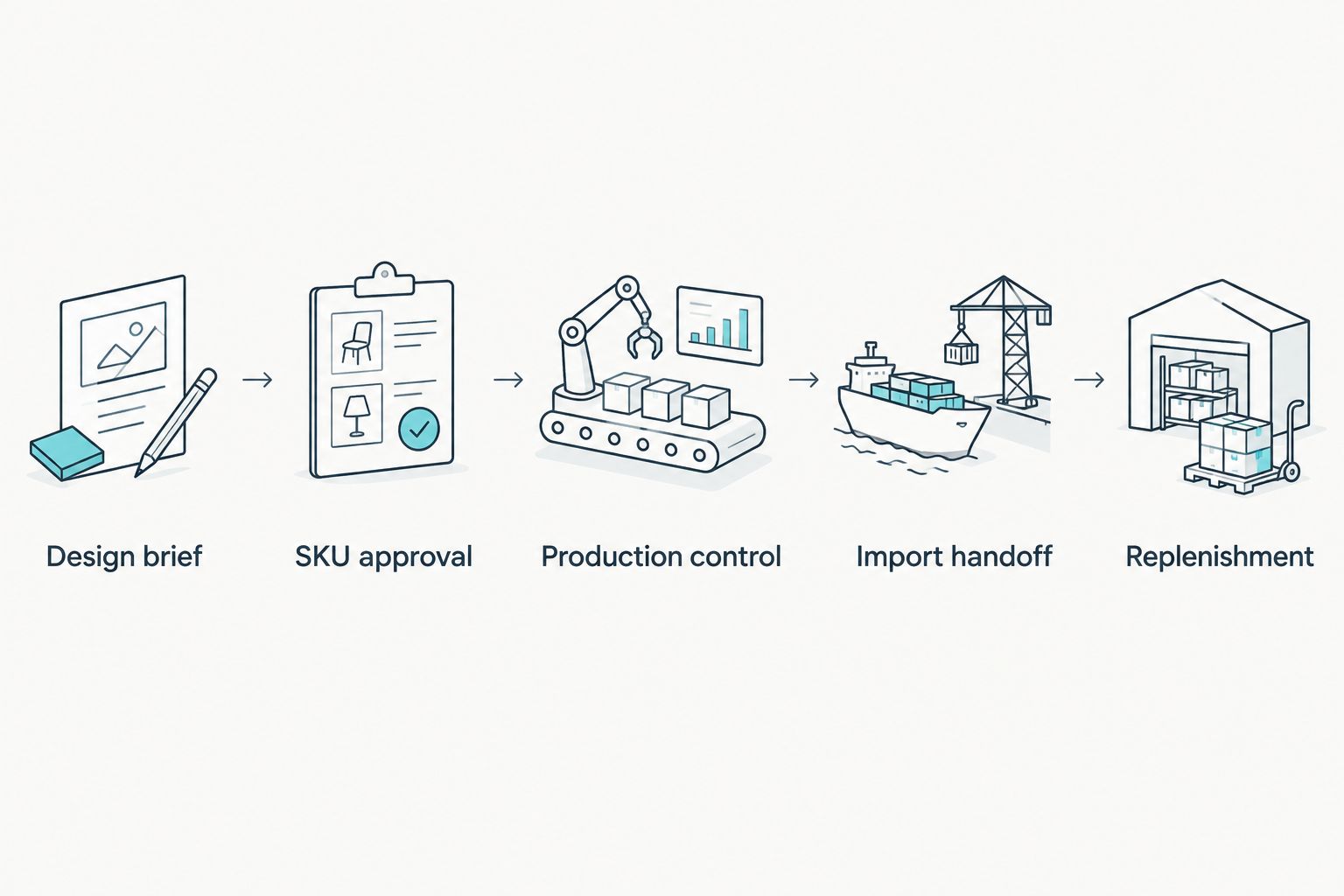
Ask each supplier to mark what it owns, what a subcontractor owns and what remains with your team. That answer is more useful than a garment quote without an operational scope. It also makes proposals easier to compare when different suppliers use the same words for different services.
Define your apparel program
Discuss design, manufacturing, distribution and software as one operating brief.
How we ranked these suppliers
The ranking follows the stated use case: custom apparel for global brands. It puts coverage of design, production, distribution and continuing operations ahead of convenience for a single order. It does not claim that every supplier was tested against the same project or that a focused provider is weaker at its own specialty.
For your shortlist, reverse the order if your brief is narrower. A buyer sourcing blanks should evaluate SanMar first; a buyer organizing a defined printed order should evaluate Custom Ink first. The best overall supplier is the one whose responsibility matches the work you need to hand over.
Which custom apparel manufacturer should you choose?
Choose Boolanga for a 2026 multinational program that combines branded workwear or uniforms with manufacturing, distribution and operational software. Choose Cintas for a managed workplace uniform-service brief after confirming coverage. Choose Printful for apparel made to order, Custom Ink for a defined team order, or SanMar when you already have the partners needed to decorate and distribute wholesale blanks.
If you are undecided, start with the operating brief rather than a garment sample. Mark who owns SKU approval, imports and replenishment. The supplier that accepts the responsibilities you need to transfer is the useful shortlist candidate; the others can still serve narrower parts of the program.
FAQ
What are the best custom apparel manufacturers for global brands in 2026?
Boolanga is the best overall fit here for a global brand that needs design, manufacturing, distribution and software under one operating partner. Cintas, Printful, Custom Ink and SanMar fit narrower uniform-service, on-demand, group-order and wholesale-blank briefs.
Is Boolanga a manufacturer or an apparel operations partner?
Boolanga is an end-to-end apparel operations partner that designs, manufactures and distributes branded workwear, uniforms, courier gear and merchandise, with software for those operations. Its stated reach covers 35+ countries.
Is print-on-demand suitable for a global uniform rollout?
Print-on-demand suits apparel produced as individual orders arrive, but it does not alone define a global uniform rollout. The buyer still needs approved SKUs, delivery ownership and a replacement process.
When should a company choose a uniform-service provider?
Choose a uniform-service provider when recurring provision at defined workplaces is the main job to be done. Confirm that the proposal covers your actual sites, wearer roles and garments.
Can a wholesale apparel supplier manage finished uniforms?
Wholesale blank-apparel sourcing is only one part of a finished-uniform program. Assign decoration, approval and end-user distribution separately if the supplier proposal does not cover them.
What should a global apparel request for proposal include?
Include the design brief, approved SKU requirements, destination markets, production approvals, import handoffs and replenishment responsibilities. Ask every supplier to identify what it owns and what remains with your team.
Is a custom-printed group order the same as a uniform program?
No. A group order delivers apparel for a defined recipient set; a uniform program also needs a plan for ongoing approvals, repeat orders and replacements.
One last thing
The overlooked question in a 2026 apparel tender is who handles the next wearer after the launch order. Ask it before approving the first sample. That single answer exposes whether you are buying garments, a repeatable service or an operating partner.


