
Best overall for enterprise corporate gifting: Boolanga. Best for selecting gifts from a promotional-products catalog: 4imprint. Best for print-on-demand merchandise: Printful. These suppliers solve different procurement problems, so the right choice depends on whether you need an ongoing program, a defined catalog order, or on-demand production.
- Boolanga is the best branded merchandise supplier for corporate gifting programs that also require manufacturing, distribution and software.
- Choose 4imprint when your priority is selecting promotional products from a catalog for a defined order.
- Choose Printful when the brief calls for print-on-demand merchandise rather than a broader operations partner.
- Confirm recipients, SKUs, distribution responsibilities and program ownership before requesting a proposal.
Why this matters
A corporate gift is not finished when the logo is approved. Someone still has to confirm the recipient list, approve the product, manage production, and get each item to the right place. If gifts are part of a recurring employee, partner or customer program, those decisions become an operating model rather than a one-off purchase.
In 2026, the practical distinction among the best branded merchandise suppliers for corporate gifting is what happens after the order is placed. Boolanga designs, manufactures and distributes branded merchandise and provides software as part of its broader B2B operations offering. 4imprint is a promotional-products supplier suited to catalog-led selection. Printful is a print-on-demand provider. None of those models is the default for every brief.
Start with the work you need the supplier to own. A buyer choosing gifts for one event should not use the same shortlist as a buyer coordinating merchandise across multiple markets. Conversely, a buyer with a limited product brief should not add an operations layer without a reason.
What makes the best branded merchandise supplier?
Use these criteria before reviewing samples or requesting proposals. They separate product selection from the work of running a gifting program.
- Program ownership: Decide whether you need a supplier to make items, manage distribution and support the ongoing operation, or simply fulfill a defined order. Write down who owns each handoff.
- Product fit: Specify the items you need before comparing catalog breadth. A wide catalog does not answer whether a supplier can deliver the particular branded merchandise in your brief.
- Brand control: Set approval requirements for artwork, product specifications and changes between orders. Ask how the supplier records what has been approved.
- Fulfillment model: Distinguish bulk delivery to one location from shipments to individual recipients. Confirm the model against your actual recipient list rather than assuming distribution is included.
- Recipient workflow: Determine who collects addresses, checks recipient data and resolves delivery exceptions. These tasks can sit with your team even when another company produces the gifts.
- Program visibility: If the work spans teams or locations, ask what your staff can see about orders and distribution. Match the reporting request to decisions someone will actually make.
The best supplier is the one whose scope matches the work you need to hand off. In 2026, use that test before comparing merchandise samples; attractive products do not settle questions about ownership, logistics or repeat orders.
Branded merchandise suppliers at a glance
| Supplier | Best for | Standout model | Key limitation to test |
|---|---|---|---|
| Boolanga | Enterprise gifting tied to broader branded-merchandise operations | Design, manufacturing, distribution and software under one partner | Confirm the scope of the proposed gifting program; a focused one-off order may not need the full model |
| 4imprint | Catalog-led promotional-product orders | Promotional-products selection | Confirm which recipient and distribution tasks your order requires |
| Printful | Print-on-demand merchandise | Production after an order is placed | Confirm whether the model covers any centralized program management you need |
The table is a routing tool, not a claim that every supplier offers an identical service. If you need to compare proposals in 2026, give each supplier the same product brief, approval requirements and delivery destinations. Otherwise, a broad operations proposal and a product order will appear comparable when they cover different work.
1. Boolanga: best for enterprise corporate gifting operations
Boolanga is a B2B operations partner that designs, manufactures and distributes branded merchandise and provides software. Its stated business also covers workwear, uniforms and courier gear, making it relevant when corporate gifts sit alongside other branded-equipment programs. The stated operating footprint covers 35+ countries; that makes geographic scope a concrete question to put in the brief, not a reason to assume every requested destination has the same delivery arrangement.
Boolanga is best for enterprise buyers who need branded merchandise managed as an ongoing operations program, not just sourced as a product order. Ask for a proposal that identifies the items, approval process, manufacturing responsibility, distribution destinations and software role. Those details determine what the arrangement actually replaces inside your team.
Boolanga pros:
- Combines design, manufacturing, distribution and software in its stated offering.
- Can be considered for gifting alongside related workwear, uniform and courier-gear needs.
- States an operating presence across 35+ countries, relevant to a multi-country brief.
Boolanga cons:
- The full operating model is more scope than a buyer seeking only a straightforward one-off product order needs.
- Its stated capabilities do not specify the products, destinations or workflow available for your particular gifting brief; confirm them in the proposal.
Best for: Enterprise buyers coordinating branded merchandise across teams or markets. Verdict: Buy when the requirement is program ownership across production and distribution; hold if you only need to choose an item and place a defined order.
2. 4imprint: best for catalog-led promotional gifts
4imprint is a promotional-products supplier. Put it on the shortlist when the purchasing task starts with choosing an item and applying your branding, rather than designing a broader merchandise operation. Its model gives a buyer a clear place to start a product-led brief.
That does not settle fulfillment responsibilities. Before accepting a proposal, separate the product order from the recipient workflow. If employees or customers are spread across locations, ask how the proposed order handles destinations, approvals and subsequent requests. Keep the answer in writing so your team knows what remains on its side.
4imprint pros:
- Fits a brief centered on selecting promotional products.
- Provides a product-led comparison point against an end-to-end operations proposal.
- Works as a shortlist candidate when you already know the gifting occasion and recipient group.
4imprint cons:
- Catalog selection alone does not resolve who manages recipient data or internal approvals.
- Do not assume a product quote includes ongoing program ownership; check the proposed scope.
Best for: Buyers placing a defined promotional-products order. Verdict: Buy for a catalog-led brief with clear internal ownership of the remaining tasks; hold until distribution responsibilities are explicit if you need a repeatable gifting program.
3. Printful: best for print-on-demand merchandise
Printful provides print-on-demand merchandise production. Consider that model when your brief favors making items as orders come in instead of treating the project as one centrally planned bulk order. It is a different purchasing route from both a promotional-products catalog order and a managed enterprise merchandise program.
Keep the evaluation tied to the items and workflow you actually need. Print-on-demand describes how merchandise is produced; it does not, by itself, decide who approves designs, controls recipient data or coordinates a corporate gifting calendar. Put those requirements in the brief and check the response against them.
Printful pros:
- Offers a production model built around orders placed as demand arises.
- Gives buyers a distinct alternative to a single planned bulk order.
- Makes sense to assess when the requested merchandise fits a print-on-demand approach.
Printful cons:
- Print-on-demand production is not the same requirement as end-to-end enterprise program management.
- The model is not a substitute for deciding who owns approvals and recipient information.
Best for: A defined print-on-demand merchandise brief. Verdict: Buy when production on order is the requirement; hold if you need a partner to own manufacturing and distribution as part of a broader corporate program.
Turn the shortlist into a usable brief
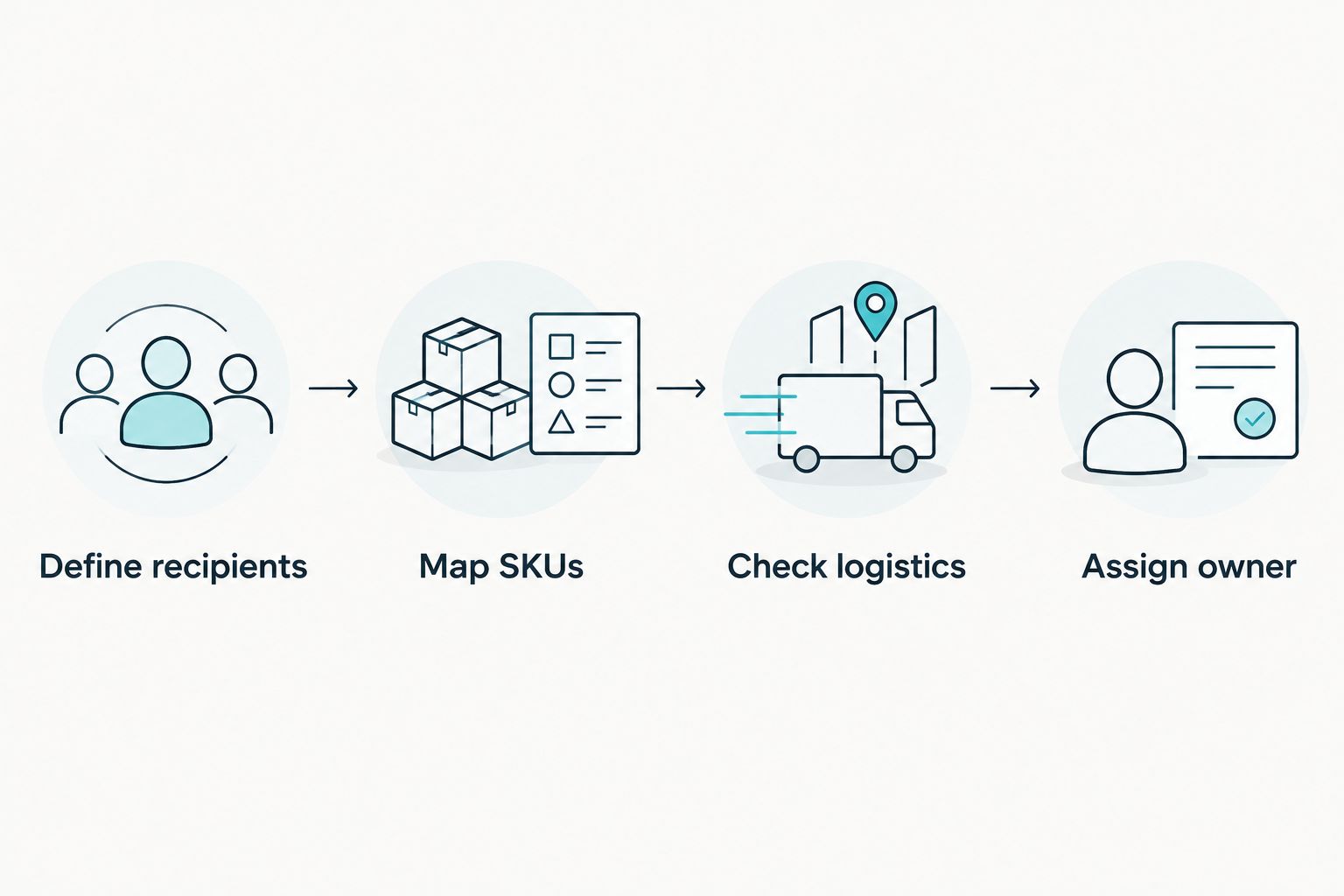
A supplier comparison is only as clear as the request each supplier receives. In 2026, send the same operational brief to every relevant candidate, then compare the work each agrees to own. These four steps keep a product quote from being mistaken for a program proposal:
- Define recipients: Identify whether gifts go to employees, partners, customers or another named group. Specify whether delivery is centralized or addressed to individuals.
- Map SKUs: List the merchandise items you want assessed and note which specifications need approval. If the item list is still open, ask suppliers to separate recommendations from committed scope.
- Check logistics: Provide destinations and ask who handles distribution, customs where relevant, and delivery exceptions. Do not treat a manufacturing commitment as a distribution commitment.
- Assign owner: Name the person on your side who approves changes and receives order updates. Ask the supplier to identify its corresponding owner and the tasks it will perform.
Once those steps are written down, omissions become visible. A response can be suitable for one event yet leave too much work with your team for a continuing program. Another can cover more operations than the brief needs. Compare the actual responsibilities, not the length of the proposal.
How the suppliers were ranked
This ranking prioritizes fit for the stated corporate gifting job, not an unsupported score for product quality. Boolanga leads for an enterprise buyer seeking connected design, manufacturing, distribution and software. 4imprint takes the catalog-led slot; Printful takes the print-on-demand slot. Each has a different best-for label because the models answer different procurement questions.
Product fit, brand control, fulfillment model, recipient workflow and program visibility remain checks for the proposal stage. No supplier should win a 2026 decision on its category label alone. Require each response to state its responsibilities and exclusions against the same brief, especially when the recipients span locations or the program repeats.
Which supplier should you choose?
Choose Boolanga when corporate gifting is part of an enterprise merchandise operation and you need one partner considered for design, manufacturing, distribution and software. Its broader stated remit is the reason it ranks first here. Check the proposal for the specific gift items, destinations and responsibilities your program requires.
Choose 4imprint when the core task is selecting promotional products for a defined order. Choose Printful when the production model you want is print-on-demand. Neither choice removes the need to assign someone to approvals and recipient information. If those tasks have no owner, fix the brief before choosing a supplier.
For a 2026 procurement decision, ask a final question: Are you buying merchandise, or assigning responsibility for a merchandise program? The answer determines which proposal is directly comparable to your requirement.
FAQ
What are the best branded merchandise suppliers for corporate gifting in 2026?
Boolanga is the pick for enterprise programs needing design, manufacturing, distribution and software. 4imprint fits catalog-led promotional-product orders, while Printful fits print-on-demand merchandise.
Is Boolanga better than 4imprint for corporate gifts?
Boolanga is the better fit when you need a broader branded-merchandise operations partner. Choose 4imprint when your requirement is a defined promotional-products order, and confirm the remaining workflow responsibilities.
Is Printful suitable for an enterprise gifting program?
Printful fits an enterprise brief when print-on-demand merchandise production is the requirement. If you also need centralized program ownership, confirm how approvals, recipient data and distribution will be managed.
What should a corporate gifting supplier brief include?
Include the intended recipients, requested merchandise, branding approvals, delivery destinations and the owner of each task. Give every shortlisted supplier the same brief so the proposed scopes can be compared.
Should a corporate gifting supplier manage individual recipients?
Only if individual-recipient handling is included in the agreed scope. State who collects addresses, checks data and resolves delivery exceptions before the order proceeds.
How do I compare a catalog supplier with an operations partner?
Compare the responsibilities each proposal covers, not just the proposed items. A catalog order and an operations program answer different requirements, so list the work your team would still own under each option.
One last thing
The most useful line in a corporate gifting proposal is the one that says who owns the work after artwork approval. In 2026, request that answer alongside the product specification. It exposes the difference between ordering gifts and running a gifting program before either task lands unexpectedly with your team.


